


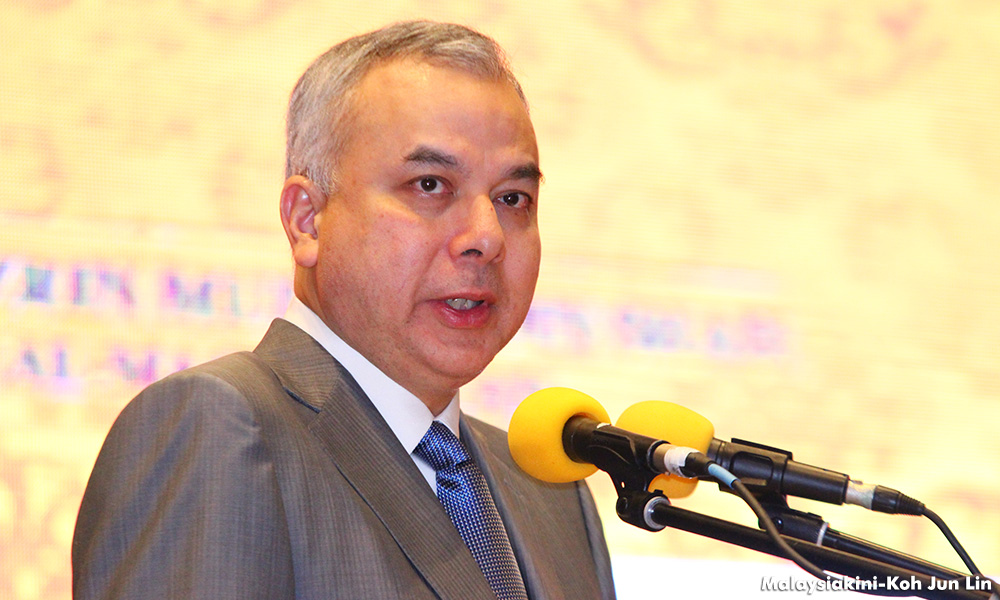

Perak sultan: Moral compass awry, let's make it right
Malaysia's "mediocre" performance on the Corruption Perception Index and Rule of Law Index shows that Malaysia's moral compass has gone awry, said Perak Sultan Nazrin Muizzuddin Shah Sultan Azlan.
He said if Malaysians are serious about instilling ethics in business and government, then the problem needs to be approached honestly and openly.
These indices, he said, paint a bleak picture of Malaysia's existing laws and institutions - that they are only mediocre at best.
“While there are many who believe that we should not be overly concerned by indices, we have to realise that perceptions of our country have not arisen out of thin air.
“Perception is part of the reality. And the perception tells us that, in many aspects of life, our moral compass has gone awry.
“We are all culpable, if not as perpetrators, then as bystanders – guilty of dependence, apathy and unthinking obedience,” he said at a conference themed 'Putting ethics to work in business and government' in Kuala Lumpur today.
The conference was organised by the Malaysian Anti-Corruption Foundation. The sultan is its patron.
Malaysia currently ranks 50 out of 175 countries in the 2014 Corruption Perception Index, and is ranked 39 out of 102 countries in the 2015 Rule of Law index.
In his speech, Sultan Nazrin highlighted that there are three means that societies use to encourage individuals to do the right thing – by instilling cultural or religious values, by putting incentives in place to encourage good behaviour, and the use of the law and legal institutions.
However, he said each of these methods has its own drawbacks.
Humans are fallible and may "allow the devil to get the better of us". Markets may respond to respond to "perverse incentives" that lead to market failure. And laws can't always be relied upon to change human behaviour, who inadvertently find loopholes to exploit, he explained.
Personal responsibiity
The sultan, who holds a PhD in political economics and government, said there are several steps that Malaysians must take, pointing out that individual Malaysians must take personal responsibiity for issues related to ethics and integrity.
“They cannot afford to 'outsource' these matters to educational institutions, peer groups, employers, and even the government. The family unit is critical in these efforts,” he said.
He added that these efforts to uphold ethical behaviour need to be consistently upheld from the family level to society at large.
Piecemeal efforts, he said, would not work and only serve to breed cynicism, which is difficult to reverse.
He said there should be zero tolerance for those who try to "game the system".
“Where unethical behaviour is also illegal, prosecution and severe sentencing will send a clear message to the rest of society of what is accepable and what is not.
“Where unethical behaviour is not illegal, the media must play an active and instrumental role as the 'fourth estate', holding those in power accountable for decisions or actions deemed illegitimate.
“At the same time, those who speak up, make sacrifices, and act in ways that promote ethical behaviour ought to be commended and celebrated. In far too many countries, they are instead silenced, penalised, and persecuted,” he said, among others.


Are you sure you want to delete this comment?
This action cannot be undone.