




Is fame-shaming on Facebook legal in Malaysia?
COMMENT Lately it has been more frequent than ever to see people ‘fame-shame’ people online, in particular on social media such as facebook and twitter, often as a reaction to an unpleasant experience they endured. Basically these Shamers would take a photo of the offender and post it on social media with descriptions and criticisms of what the Offenders did.
Common examples are when people experienced a terrible customer service at a certain restaurant, or when they were bullied on a road rage incident. Some even take it further to fame-shame a stranger who didn’t offer his seat to a pregnant lady on the LRT despite the Shamer himself not being directly involved.
COMMENT Lately it has been more frequent than ever to see people ‘fame-shame’ people online, in particular on social media such as Facebook and twitter, often as a reaction to an unpleasant experience they endured. Basically these Shamers would take a photo of the offender and post it on social media with descriptions and criticisms of what the Offenders did.
Common examples are when people experienced a terrible customer service at a certain restaurant, or when they were bullied on a road rage incident. Some even take it further to fame-shame a stranger who didn’t offer his seat to a pregnant lady on the LRT despite the Shamer himself not being directly involved.
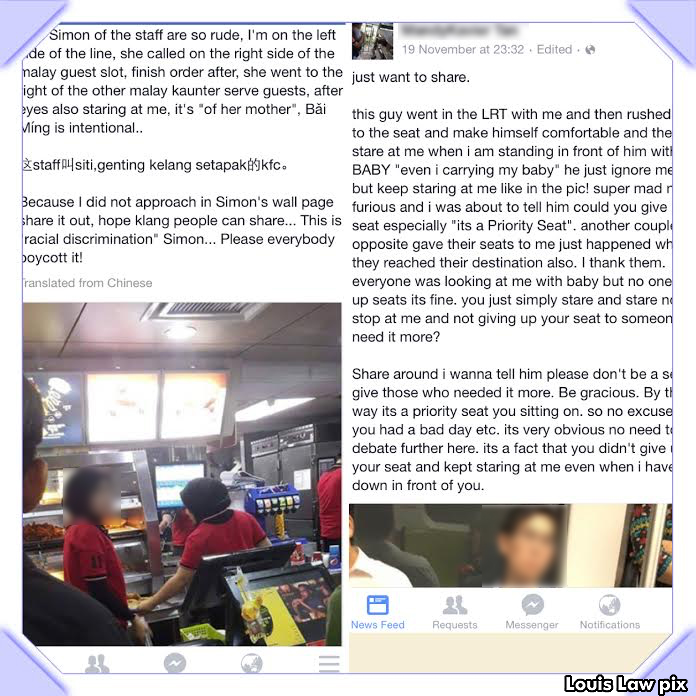 This popularity of this fame shaming culture is not surprising:
1) Fame shaming through social media offers an easily-accessible, zero-cost medium for us to ‘punish’ an Offender that the law could not offer, either for the cost of bringing a legal action or that the act, though inconsiderate, did not suffice to be illegal - ie vaping in public indoor spaces;
2) Fame-shaming is a non-violent thus a more ‘acceptable’ way to satisfy our natural desire for retribution and vindication; and
3) Fame-shaming may even be justified as a ‘crowd-sourced’ way of social control; through the deterrence effect of fame-shaming, public order may improve, for example people start offering seats to elderlies on public transport for fear of being fame-shamed.
Actually public-shaming has been used during the infancy stage of the legal system. Public canning, public flagellation, or pillories are common methods used by governments across the world.
However, isn’t it precisely the acknowledgement of the drawbacks of public-shaming as a means of punishment that the above methods were removed over the years?
Can the end of public shaming justify the means? Or is the end even proportionate for the harm done by the offender?
Legal point of view
To start things off, neither is there case law (from what I know) at this time that states on point that it is illegal to ‘fame-shame’ nor anyone has been prosecuted for such an act. Nevertheless, one should still be aware of the following:
Criminal law
From the legal point of view, Shamers should think twice before they decide to proceed as they may find themselves being brought to court for their act of shaming. Under Malaysian law, the most likely cause of action against a shaming act is defamation. Defamation is a crime under criminal law, Section 499 to Section 502 of the Penal Code.
Section 499 provides that whoever, by words either spoken or... by visible representations, makes or publishes any imputation concerning any person, intending to harm, or knowing or having reason to believe that such imputation will harm the reputation of such person, is said to defame that person.
Without going into detailed analysis of the law which will certainly bore you, in simple terms it means that if your Facebook post is posted with the intention, or you reasonably know that your post has the ability, to harm the reputation of someone, then you may be prosecuted for defamation.
The potential punishment under criminal law is imprisonment for two years maximum or a fine or both.
However, one of the most used defence in a case of defamation is justification, whereby the defendant argues that whatever he said is true. Therefore, at least when you intend to fame-shame, make sure what you say is true and honest. If you exaggerate, lie, or cook-up something fake, whether out of anger or vengeance, you may just find yourself in jail.
Credit to my Master, Syahredzan, for pointing out this.
The other possible offence that one may commit for ‘fame-shaming’ is under the Communications and Multimedia Act 1998 which states that it is an offence for improper use of network facilities or network service, etc including if a person who by means of any network facilities or network service or applications service knowingly - (i) Makes, creates or solicits; and (ii) Initiates the transmission of, any comment, request, suggestion or other communication which is obscene, indecent, false, menacing or offensive in character with intent to annoy, abuse, threaten or harass another person.
The person shall, on conviction, be liable to a fine not exceeding RM50,000 or to imprisonment for a term not exceeding one year or to both and shall also be liable to a further fine of RM1,000 for every day during which the offence is continued after conviction.
In terms of case laws, there have been cases where insults on sultans posted on websites have led to charges in court and several were found liable. The key being the intention to annoy, abuse, threaten or harass, which one must be reminded that these intention can be inferred simply by the content of what was posted.
Although similarly there has not been a case specifically on point in regard to “fame-shaming”, it is still a very relevant provision of the law to be mindful about.
Civil law
Besides, defamation is also covered under civil law - the Defamation Act 1957. The above-mentioned criteria to satisfy a case for the claimant, and the abovementioned defence is still applicable. The main difference is you may be slapped with a suit for compensation which is where you hear news that people were sued for defamation and claimed up to RM100,000 or even RM1 million for compensation.
Another potential claim against an act for shaming is intrusion into the right to privacy. However, unfortunately the law in Malaysia isn’t clear on this. On the one hand, some cases explicitly state that intrusion to privacy is not a legally recognised wrongdoing in Malaysia but, on the other hand, in a famous case where a doctor took photos of a woman’s anus during a medical procedure without informing her, the court held that invasion of privacy rights is actionable in Malaysia.
Nevertheless, I am highly doubtful that taking a photo of a face of a random person, then posting it online is sufficient to be in breach of privacy rights in the eyes of law.
Moral point of view
Law aside, it is my personal view that in any case one really shouldn’t fame-shame someone online.
Let me ask you, have you never been once become so emotional that you acted irrationally? For example, when you had a terrible sleep due to your one-year-old crying throughout the night hence you acted aggressively to someone while on the road?
Or perhaps the person we despise for not giving his seat to an elderly man, actually has severe scoliosis or was having a terrible fever that he really needed the seat?
Truth is we are all humans, we all have our struggles, our unknown secrets. We all make mistakes and suffer from momentary lapse of judgment.
Before we fame-shame someone, perhaps we could be a little bit more compassionate or empathetic to the person who behaved badly, or we could just not react and walk away?
Secondly, also it is important for those who come across these posts on Facebook to remember that perhaps it has been exaggerated or is one-sided and not the full story. Simply joining in the public denunciation without knowing the full picture is very unfair to the accused.
Put yourself in his shoes, how would you feel if one day you were wrongly accused online by someone for doing something, then others who do not understand the full story mindlessly share your photo and simply join the crowd in criticising you? And you have no chance to reply?
Most important of all, an impulsive act of vengeance of yours may just lead an accused to suffer very serious consequences, such as losing a job or even a relationship; it has happened before. Yes, he may have said something very nasty or racist, but is it proportionate to cause a father of three to lose his job for one single bad mistake? Fame-shaming is a door that once opened, cannot be closed.
Conclusion
Considering the severe consequences it may have on the accused, the recognition that humans are imperfect and do make mistakes, the possibility that what is shared may only be misleading half-truth as well as the possible legal consequences, I urge everyone to stop doing this. Forgive and forget.
LOUIS LIAW is a lawyer (currently a pupil-in-chambers) based in KL, Malaysia. He blogs at louisliaw.wordpress.com


Are you sure you want to delete this comment?
This action cannot be undone.