



PAS-Umno pact fraught with issues, far from settled
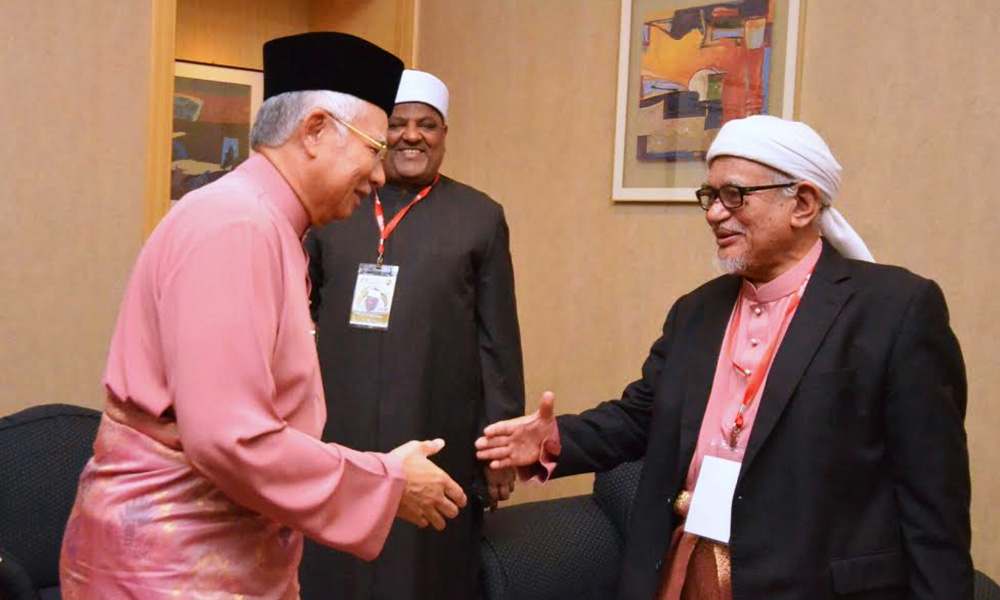
ANALYSIS Najib Abdul Razak and Abdul Hadi Awang may be wearing the same shade of pink at the official opening of a conference for al-Azhar University alumni on Thursday but the form of political cooperation said to be in the cards between the parties they helm is far from settled.
Despite the overtures of peace - whether it’s the olive branch extended twice just this past week by the Umno president, or PAS’ No 2 Tuan Ibrahim Tuan Man backpedaling yesterday from his stance earlier this month that his party would never work with Umno to save it from ruin - the two are still testing the grounds of their collaboration.
One political analyst even predicted that a formal alliance that is supposed to uphold Malay-Muslim unity will have to wait its course.
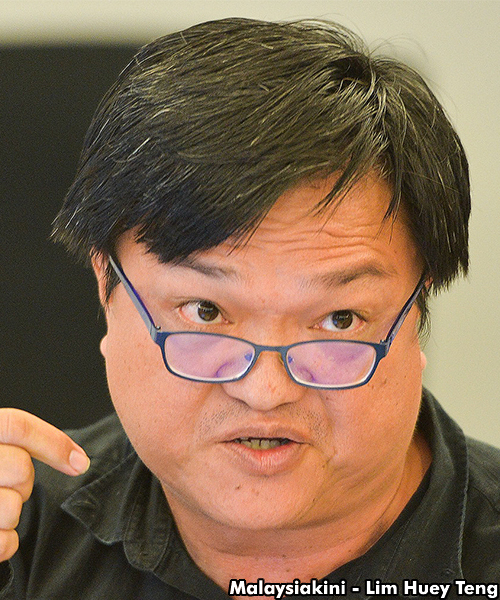 Penang Institute fellow Wong Chin Huat (
photo
) believes that a merger between the two parties is not on the cards, at least until Umno “gets weaker”.
Penang Institute fellow Wong Chin Huat (
photo
) believes that a merger between the two parties is not on the cards, at least until Umno “gets weaker”.
“It's because a merger won’t be in the interests of both parties,” he told Malaysiakini .
A loose pact, however, might be formed, and he said pushing for the implementation of hudud would be of benefit to both parties.
It would burnish PAS’ Islamic credentials to defeat Parti Amanah Negara (Amanah), as the two parties are set to go head to head in battles for constituencies.
“If Umno were to support hudud, it will justify PAS’ case and will also make Umno look ‘holier’, despite all these corruption scandals,” said Wong.
Hard to regain non-Malay confidence
Independent pollster Merdeka Centre executive director Ibrahim Suffian, however, does not support Wong’s PAS-Umno hudud hypothesis, as Umno’s coalition partners would oppose the move.
“I expect the two parties to cooperate on matters strengthening Islamic law but short of hudud in the coming years,” he said.
Umno is indeed finding it hard to regain the confidence of the non-Malay community, opines Ibrahim.
“Hence the move further to the Malay religious right end of the spectrum to gain votes that can offset the loss of non-Malay support.
“It depends on how cooperative PAS will be and the nature of cooperation whether it will lead to an electoral pact or just a co-ordination on Malay-Muslim issues. It's likely the latter,” he said.
Ibrahim pointed that both parties are being pragmatic, hence their collaboration.
“Umno needs to shore up its sagging base and PAS needs to take advantage of a perceived weaker Umno, as well as shore up some places where they are feeling weak,” he said.
If PAS is viewed as a Muslim nationalist party, an Umno-PAS pact would be seen as a rational move, said Wong.
He cited an amanat (mandate) Hadi made in 1981, in which the PAS chief said he was not against Umno because it had long been in the government, rather, because it had perpetuated the "constitution of the colonialist".
“On that reason Hadi had then opposed Umno and accused Umno members of being kafir (infidels),” Wong pointed out.
Ultimately, however, he said it is not about implementing the Islamic criminal law or otherwise, but rather, to create a parallel system to unite all Muslims without changing the nation’s boundaries.
“To change the country into an Islamic state, they must get Muslims united politically as a single force so that they can be more powerful vis a vis the non-Muslims,” said Wong.
It’s about survival
But for Prime Minister Najib Abdul Razak in particular, it is all about his survival.
“I don’t think he believes all these things. (Therefore), to make sure that he survives, he would do the Brunei sultan way,” said Wong, citing the Brunei ruler whose announcement of the implementation of hudud in his state was met with critics pointing out the royal family’s life, alleged to be full of vices.
Umno, which is in a weak position, would simply take on all of PAS’ ideologies.
“Because for Najib it’s all about his survival. Survive first and then later worry about what will happen.”
PAS, on the other hand, will definitely gain something out of this pact, as staying in the opposition means that it would have to give way to Amanah in terms of seat allocation, which is unacceptable.
“To stand alone would be tough, as it would have to take on both sides. And PAS will be caught for its ‘soft’ stance on Najib.
“Voters won’t see them (PAS) as an alternative to Najib. In a three-corner fight, voters will vote for Amanah or DAP.
“So the best way to keep Hadi’s goals is to work with Umno,” he explained.
Formal or covert pact
Wong said the choice is therefore between a formal pact or a covert pact where the two parties do not fight seriously in elections.
“For a particular seat, if Umno knows that PAS is stronger, it will just give way.
“When that happens the biggest loser is going to be PKR and not Amanah. Amanah will look more principled and PKR would be caught in the middle and by then, would have peeved off enough people,” noted Wong.
A formal pact, on the other hand, would not be feasible as both parties must explain the merger to their respective members.
“Once they merge, they are going to lose members on both sides. A covert pact, on the other hand, is just like playing a game.
“And in three-corner fights, they can split the opposition because some opposition supporters would be too frustrated to understand why and will end up not voting,” Wong explained.
This move, however, could backfire, if the interests of the people of Sabah and Sarawak are taken into account.
“If they (East Malaysians) are bothered about hudud, for example, then it will be challenging for Umno.
“As long as they can be convinced that it’s a Malayan (peninsular) problem, then they would not be bothered,” he said.
Matching pink outfits
Najib on Thursday had once again offered to forge close ties with PAS at the regional conference of al-Azhar graduates.
For Universiti Islam Antarabangsa (UIA) lecturer Maszlee Malik, the staged meeting was not about extolling the virtues of a PAS-Umno partnership.
What it did highlight was the inability of the alumni from Al-Azhar, the university long seen as the standard bearer of the faith, to create a better narrative for Islam in the country.
“It was shaped by the organiser to score some political points for the mileage of certain people,” he said.
Declining to reveal the individuals or groups who stood to gain something, Maszlee however said PAS was definitely not the one which will come out stronger.
“The multaqa is but another venue for certain people to score political points, and it failed the majority of al-Azhar graduates throughout the nation,” he said of the three-day regional meeting co-sponsored with the Prime Minister’s Department.
Umno and PAS on the stage together is just incidental.
“What’s important is that PAS is the one who stands to lose the most; they will not gain anything,” he said.


