


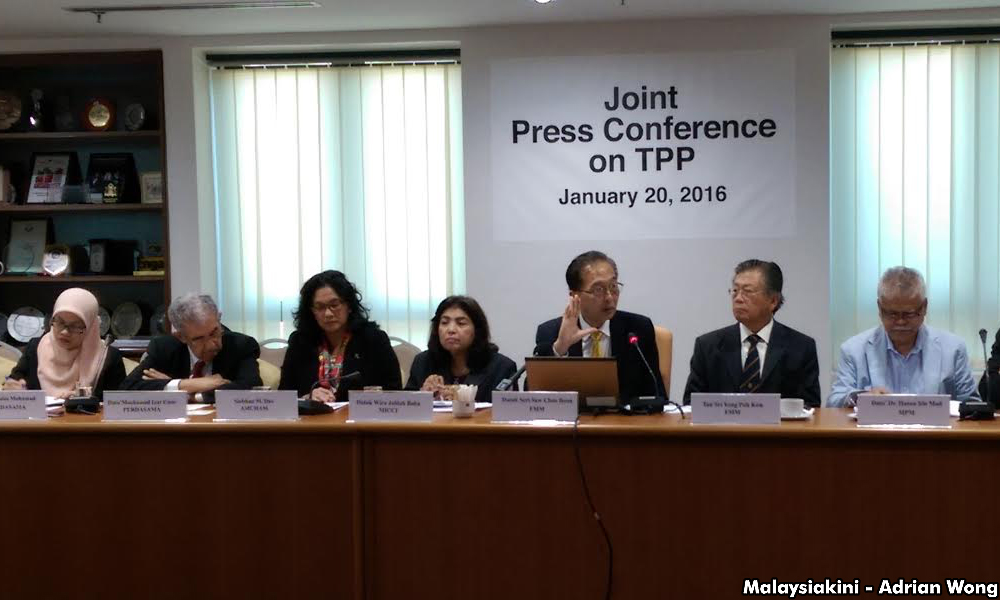

Seven business groups support controversial TPPA
Seven major business associations have thrown their support for Trans-Pacific Partnership Agreement (TPPA).
They have asked those who oppose it, including former prime minister Dr Mahathir Mohamad and Parti Sosialis Malaysia (PSM), to show proof that TPPA is not good for the country.
Among them are Federation of Malaysian Manufacturers (FMM), Malaysian International Chambers of Commerce and Industry (MICCI), the Associated Chinese Chambers of Commerce and Industry of Malaysia (ACCCIM) and SME Association of Malaysia.
The others include Malay Consulative Council (MPM), Malay Businessmen and Industrialist Association of Malaysia (Perdasama) and American Malaysian Chamber of Commerce (Amcham).
Seven major business associations have thrown their support for Trans-Pacific Partnership Agreement (TPPA).
They have asked those who oppose it, including former prime minister Dr Mahathir Mohamad and Parti Sosialis Malaysia (PSM), to show proof that TPPA is not good for the country.
Among them are Federation of Malaysian Manufacturers (FMM), Malaysian International Chambers of Commerce and Industry (MICCI), the Associated Chinese Chambers of Commerce and Industry of Malaysia (ACCCIM) and SME Association of Malaysia.
The others include Malay Consultative Council (MPM), Malay Businessmen and Industrialist Association of Malaysia (Perdasama) and American Malaysian Chamber of Commerce (Amcham).
"It's a free country, everybody can protest, but they must be responsible.
"They must give facts, don't give allegation or general statements, anything must be supported by facts," FMM president Saw Choo Boon told reporters after a press conference in Selangor.
He was asked to respond to an anti-TPPA protest to be staged by PSM, Bersih and others in the coming weekend
Further quizzed regarding Mahathir's claim that Malaysia's demographic do not suit such agreement and the nation will be submitting to foreign forces, Saw simply dismissed it.
"He has to support his claims by facts, data and greater details. I don't understand (his claims), maybe I am not as clever as him," he quipped.
Have to change the mindset
Earlier, in an hour-long press conference, the groups put forward lengthy argument and explanation in defence of the TPPA.
One of the focuses, however, was on SME association president Michael Kang's claim on small and medium companies' faith in the agreement.
In an interview with The Malaysian Insider , he expressed concern that about 30 percent of SMEs risk going under once TPPA comes into effect in two years as they might not be able to meet higher labor and environment standards.
To this, SME association deputy president Ong Chee Tat described it as "psychological fear".
"Some of the concerns are smaller industries, which could be sunset industries.
"We have to change our mindset. Malaysia is a small market, we have to look at the bigger opportunity, the bigger market," he stressed.
This was echoed by ACCCIM deputy secretary-general II Michael Chai Woon Chew, who admitted that a certain percentage of SMEs would be phased out, but also pointed out that new players will come in.
"It's a natural process, with increase in competition, there will be more SMEs which can't cope, or they are in the wrong industry and have to close down.
"A maximum of 30 percent will be affected, a lot of them are of natural process, then there will be new SMEs formed to cater for the new industry," he said.
Chai also argued that with higher labour standards, more investments from advanced economies will be flowing into the country.
"Yes, labour standards will not only increase salary, but also the cost of compliance.
"But we have to look at it, for the more advanced economies, they have these labour standards, they look for countries with these standards, so they could invest in.
"They avoid going to a country with no labour standards. If we have these labour standards, certainly better investments and industries will come in, then we will move up to that level," he said, adding that SMEs in Malaysia is resilient to challenges.


Are you sure you want to delete this comment?
This action cannot be undone.