



Amanah's 'flung microphone' revolution
COMMENT In the early 1980s, Mat Sabu’s speeches were not like how they are today, full of humour and laughter.
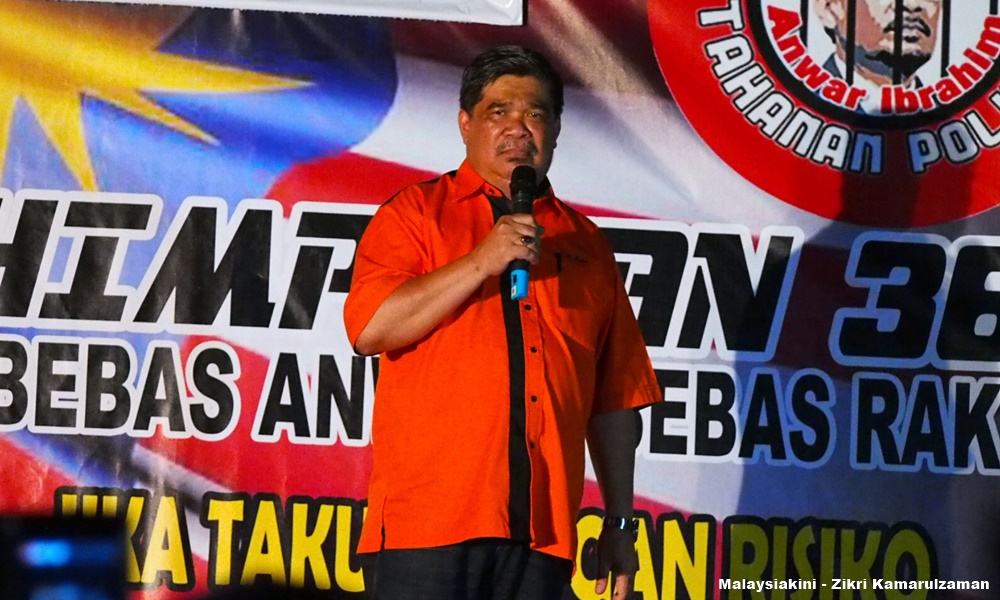
Thirty-five years ago, his speeches were fiery, like the one he made on Tuesday night in front of the Sungai Buloh Prison, in front of a crowd who gathered to mark the first anniversary of former opposition leader Anwar Ibrahim's jailing.
Mat Sabu, whose real name is Mohamad Sabu, spoke for less than five minutes.
The Parti Amanah Negara (Amanah) president started his speech by apologising because all his four children are either students or had graduated, but none of them are like their counterparts in Indonesia.
He also apologised because opposition supporters – which include farmers and fishermen – did not camp out on the streets for three weeks like their peers in Thailand, even though they were 'oppressed'.
The start of his speech was full of interesting political rhetoric. But three minutes later, what he did was simply unforgettable...
COMMENT In the early 1980s, Mat Sabu’s speeches were not like how they are today - full of humour and laughter.
Thirty-five years ago, his speeches were fiery, like the one he made on Tuesday night in front of the Sungai Buloh Prison, in front of a crowd who gathered to mark the first anniversary of former opposition leader Anwar Ibrahim's jailing.
Mat Sabu, whose real name is Mohamad Sabu, spoke for less than five minutes.
The Parti Amanah Negara (Amanah) president started his speech by apologising because all his four children are either students or had graduated, but none of them is like their counterparts in Indonesia.
He also apologised because opposition supporters – which include farmers and fishermen – did not camp out on the streets for three weeks like their peers in Thailand, even though they were 'oppressed'.
The start of his speech was full of interesting political rhetoric. But three minutes later, what he did was simply unforgettable.
Everyone was momentarily stunned before they cheered and applauded him. One week later, they will still talk about how he hurled the microphone away onstage.
Amidst the cheers and debate about whether his action was appropriate or otherwise, many seemed to have forgotten what he had urged for before the microphone flew into the stage backdrop.
“How long are we going to remain like this? I have reached 60. Are we fighters or are we simply trying to please the heart of our brother who is imprisoned? *Cis! Let’s rise up!”, he had said.
He was referring to former opposition leader Anwar Ibrahim who has been languishing in jail for the past year after being found guilty for sodomising his former aide Saiful Bukhari Azlan.
Fiery self
In an interview with Malaysiakini yesterday, Mohamad envisions his future speeches to be more serious in nature. This vow reminds us of the kind of approach he took in his early days with PAS.
Back then, he was full of vigour as the PAS Youth chief, coupled with the spillover effect of the Iranian revolution some 35 years ago.
His speeches then were full of stories of people rising up against oppression around the world. The word ‘revolution’ was always at the tip of his tongue.
And before he recited the Quranic chapter al-Asr, which was the norm in concluding an event, he would shout ‘Neither East, nor West, daulah Islamiah ’, a rallying call which never failed to fire up the crowd then.
The slogan used back then was modified from a speech by Ayatollah Khomeini, Iran’s revolutionary leader who toppled the 54-year tenure of the Pahlavi monarchy – a secular government accused of being America’s puppet.
Mohamad was seen as among the PAS’ leaders who were inspired by the Iranian revolution which had also greatly impacted the Islamisation process around the world including Malaysia.
He was then among the leaders who put forth the idea of an ulama leadership in PAS. The concept of the syura council was also inspired by the wilayatul faqih concept still practised in Iran.
Nevertheless, starting from the formation of the Chinese Consultative Council (CCC) in 1986 to the PAS supporters club in its latest form – the PAS Supporters’ Congress (DHPP) - PAS has come to be more open and inclusive.
Who would have thought that top PAS leaders like Mujahid Rawa would spend time in churches participating in inter-faith dialogues?
But all those things are today nothing more but memories. Mohamad and more than a dozen other top PAS leaders have left PAS to form Amanah to ensure that their idea of a 'PAS for all' becomes a reality.
But the road for Amanah does not seem so easy.
If Amanah before this claimed that most of their new members came from Kelantan, PAS now claims that many have returned to be with them.
Hindraf colours
Malaysians have to admit that 35 years after the Iranian revolution, PAS has become a party full of ideas related to the ulama leadership, Islamic state, and hudud law.
PAS’ struggle definitely cannot be separated from these three-pronged agenda.
No one can deny these beliefs, not even Perlis mufti Mohd Asri Zainul Abidin who believes that discussions on hudud are not a strategic move when facing a general election.
 Mohamad, as a veteran in the world of politics, surely knows this too.
He realises that Amanah may be seen as being 'not Islamic enough' when compared to PAS. The Islamist party's robed and turban-clad members by far outnumber those in Amanah.
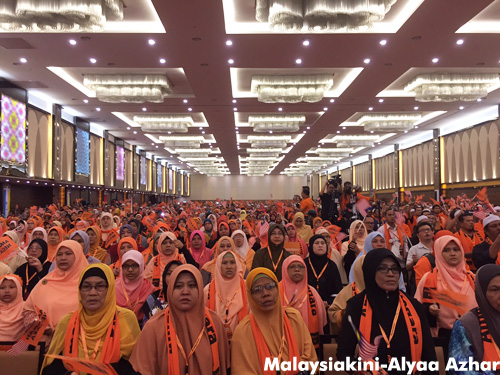
PAS’ green and white flag – colours associated with Islam – has more or less highlighted its Islamist credibility compared with Amanah’s official colour, orange, which makes one can't help but think of Hindraf.
The hard times for Amanah now were experienced by Mohamad when he was in PAS 30 years ago. Back then, even finding a venue to hold a programme was difficult.
Mohamad surely remembers how he had to speak under rubber trees, at the homes of supporters, as well as on the padi fields under the scorching sun.
Amanah today needs to revolutionise itself to remain relevant in the country’s political scene. To do that, they must showcase the kind of strength which PAS doesn't have.
After last year’s muktamar, PAS was seen as being more chummy with Umno and this was seen through its offer to advise the government in certain areas, as well as its cooperation with Umno on certain issues.
Therefore, the time is ripe for Mohamad to go against the tide by flinging the microphone. He realises that is Amanah’s strength - not 'inclusive', not 'moderate', but revolutionary.


Are you sure you want to delete this comment?
This action cannot be undone.