




Hospital staff persevere despite maintenance woes
SPECIAL REPORT Across Malaysia, there are approximately 139 public hospitals under the auspices of the Health Ministry.
According to statistics, the number of beds can range from as low as 28 - at the Hospital Sultanah Hajjah Kalsom in Cameron Highlands - to as many as over 2,000 at the General Hospital in Kuala Lumpur.
Some of these hospitals are now more than 100 years old.
Over the years, a growing population has led to rising demand for good yet affordable healthcare, which in turn has placed increasing pressure on the public healthcare system.
Coupled with austerity measures under the recalibrated Budget 2016, where the government slashed expenditure by RM9 billion, even the Health Ministry is affected...
SPECIAL REPORT Across Malaysia, there are approximately 139 public hospitals under the auspices of the Health Ministry.
According to statistics, the number of beds can range from as low as 28 - at the Hospital Sultanah Hajjah Kalsom in Cameron Highlands - to as many as over 2,000 at the General Hospital in Kuala Lumpur.
Some of these hospitals are now more than 100 years old.
Over the years, a growing population has led to rising demand for good yet affordable healthcare, which in turn has placed increasing pressure on the public healthcare system.
This was made worse by the recent economic uncertainties that have pushed up costs in the private healthcare sector, sending many who cannot afford the increases back to the public healthcare system.
Coupled with austerity measures under the recalibrated Budget 2016, where the government slashed expenditure by RM9 billion, even the Health Ministry is affected.
“We are not spared… basic health services shouldn't be affected by any cut, but in areas that do not touch on that, we will cut down as much as we can,” Health Minister Dr S Subramaniam had said.
Even before the oil revenues plummeted, dealing with the impact of a less than satisfactory maintenance system in public hospitals has become part and parcel of the daily challenges faced by dedicated doctors, nurses, and staff, as highlighted in the first two parts of this special report.
In this third and final part, Malaysiakini talked to three individuals who have accompanied their loved ones who are long-term users of local public health facilities.
They sang praises of the hospital staff, who persevered despite the drawbacks in the infrastructure and maintenance of their workplaces where they provide care to patients.
Good system
Photojournalist Zainulfaqar Yaacob first took his wife, Siti Hajjar Hassan, to Hospital Sultanah Aminah in Johor Baru four years ago.
At the age of 23, she was diagnosed with Stage 4 Hodgkin’s Lymphoma, a cancer that affects white blood cells.
 “We were given the best service from the very beginning.
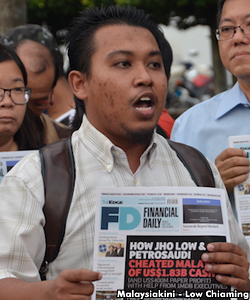
“Of course, there were some constraints but we could see how dedicated the doctors and staff who attended to my wife were, to their duties,” Zainulfaqar ( photo ) said.
The young couple then moved to Penang, where Zainulfaqar said his wife continued to seek treatment at the Penang General Hospital, one of the oldest and largest public hospitals in the country.
“There would always be a lot of patients but the Haematology Unit at the hospital has a very good system in place.
“Every time she needed to undergo blood transfusion, we will make an appointment ahead of time so that we do not need to wait for long. The quality of service is what you would expect from a private hospital,” he said.
One year before Siti Hajjar was diagnosed with cancer, Zainulfaqar said, he got the opportunity to sit right beside her when she gave birth to their daughter at the Bukit Mertajam hospital.
“Maybe not many fathers would be able to experience that moment.
“Bukit Mertajam Hospital is one of the Health Ministry’s ‘baby-friendly’ hospitals and I was lucky enough to be able to accompany her,” he said.
Dedication despite limitation
Activist Ronasina, whose real name is Mohd Affandi Ramli, also has a similar tale to share from his experiences in taking care of two daughters who were born with cerebral palsy.
Ronasina’s first daughter Annisa passed away in 2011 and he is now taking care of 13-year-old Annur, together with his wife Raja Rohaisham Raja Muhaiddin.
“It is undeniable that government hospitals will always be packed, but it’s the same in other countries as well. Annur now goes to Serdang Hospital but she had also been treated at government hospitals overseas.
 “The level of services provided by doctors and nurses here is much better. I have friends from Jakarta who said they would rather come here because they trust the professionalism of our doctors,” Ronasina (
photo
) told
Malaysiakini
.
“The level of services provided by doctors and nurses here is much better. I have friends from Jakarta who said they would rather come here because they trust the professionalism of our doctors,” Ronasina (
photo
) told
Malaysiakini
.
He also related his not-so-pleasant experience when his daughter was admitted into an overseas hospital.
"For 14 days, she was warded at the Intensive Care Unit (ICU) of a private Jakarta hospital. It was quite depressing and nerve-wracking. For two weeks, we were only only allowed to be with her during visiting hours and we had to stay in the waiting room for the rest of the duration.
"Annur was also once admitted to the ICU at the Beijing Military Hospital in 2012. It was sadder there, for we were not allowed in at all. And it was difficult to communicate because of the language barrier. We had to rent underground accommodation across from the hospital," said the activist.
He added that Annur is eligible for free treatment at all government hospitals in Malaysia, through assistance from the Welfare Department.
‘Cramped realities’
Meanwhile, MMSC Learning Group executive chairperson Abdul Rahman Abdullah had, in a recent Facebook posting, shared his observations while accompanying his wife to take their grandchild for a check-up at Hospital Kajang.
Among others, Rahman noted, the infrastructure was much “inferior” compared with other government agencies.
“I fully sympathise with the situation faced by our doctors and their teams. Small and cramped consultation rooms, non-conducive waiting rooms… these are the realities of our hospitals.
“We went to the hospital two days in a row. Our total time spent was only around two to three hours, not much different from the nearest private hospital,” Rahman said, in praising the efficiency of the hospital staff who had to deal with a high number of patients.
 He also told
Malaysiakini
that he was very impressed with the doctor who had attended to his grandchild.
He also told
Malaysiakini
that he was very impressed with the doctor who had attended to his grandchild.
“By coincidence, the specialist doctor is a Chinese but very fluent in speaking Malay.
“The doctor was not just satisfied with just updating me and my wife but he also insisted on personally calling and talking to my son (the father of the child). I am very proud of the doctor's professionalism,” Rahman said.
While the doctors, nurses and staff seem to be doing their best to provide care for patients and their carers, the quality of a nation’s public healthcare cannot be measured by the dedication of its staff' alone.
Those whose duties are to provide quality care and assistance to patients and their carers - as the stories above illustrate - need a working environment that does not frustrate them from carrying out their responsibilities.
Surely the maintenance and infrastructure woes at these public healthcare facilities need to be addressed, before Malaysia can improve its system to deliver better healthcare outcomes, as highlighted in the 11th Malaysia Plan’s goal of providing universal access to quality treatments.
Related stories
Part 1: Hospital horror - after air-con glitches, now lifts malfunction


