
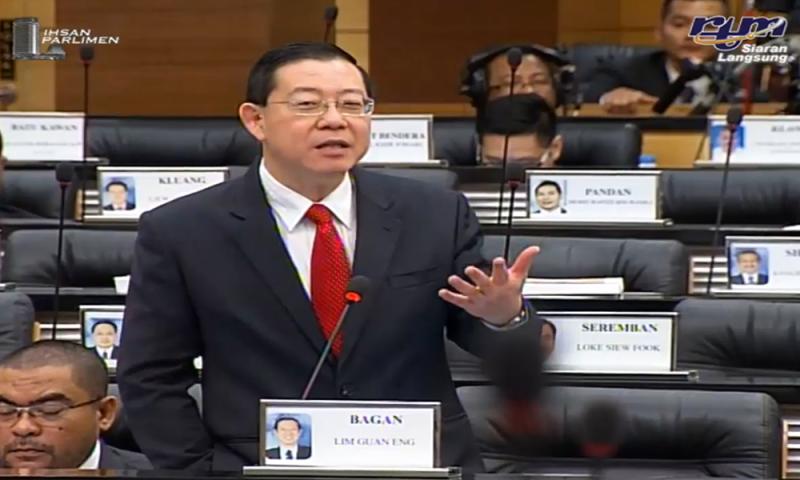
Parliament has turned down an appeal by Lim Guan Eng (DAP-Bagan) on his question regarding Switzerland attorney-general's revelation of misappropriation of US$4 billion by 1MDB.

Lim's question was first rejected by the House last week on the premises that he had asked a question based on assumption.

His appeal was rejected today by Dewan Rakyat speaker Pandikar Amin Mulia in his chamber on the same premises.

The frustrated DAP secretary-general then warned the relevant ministries not to "main-main" (play around) with the issue.

Lim argued that since the Swiss AG Michael Lauber had said his office contacted Malaysia formally to request for aid in his investigation on a possible violation of Switzerland’s laws by 1MDB, the House should not have rejected the question.

"This is not an assumption as this is an official statement made by the Switzerland attorney-general," he said.

"The Switzerland attorney-general is not a nobody.

"The statement cannot be seen as an assumption, unless you want to cut diplomatic ties with Switzerland.

"We want the accountability in 1MDB's probe, we want an answer as to the whereabouts of US$4 billion (RM16.4 billion) in relation to 1MDB," he stressed.

Dewan Rakyat deputy speaker Ronald Kiandee, who chaired the sitting, said the speaker's decision was final.

"I do not have other decision, which different from his," he said, adding that Lim can bring up the issue during the debate on the royal address.

Lim however questioned whether the relevant minister will answer a question rejected by the House based on assumption.

"Please answer this, I am appealing. This is not for me, but for the Malaysians who want the truth. This is important, don't play-play," he said.

On Jan 30, the office of Swiss attorney-general Michael Lauber had requested Malaysia for help in its investigation into possible violation of Switzerland's law by 1MDB.

A Swiss criminal investigation had revealed that about US$4 billion (RM16.6 billion) appeared to have been misappropriated from Malaysian state companies.

Lauber reportedly said the possible violations included corruption, abuse of public office, money laundering, and criminal mismanagement.