


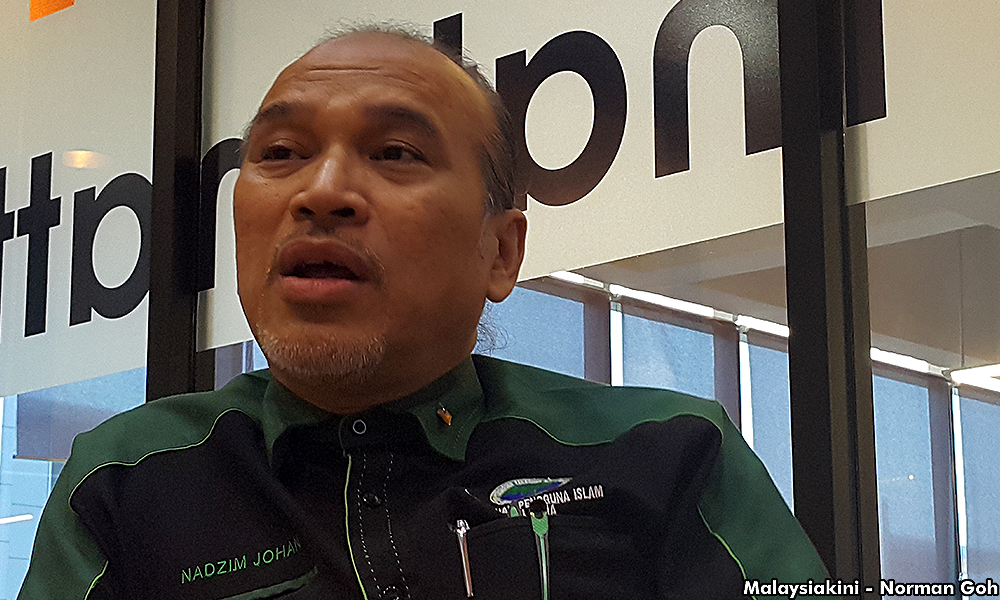

We have placed consumerism in boot of car, laments PPIM chief
INTERVIEW As activist leader of the Malaysian Muslim Consumers’ Association (PPIM), Nadzim Johan is vehement in his opinion that everyone must take up consumer issues.
No one, he said, can claim that he or she is not a consumer.
INTERVIEW As activist leader of the Malaysian Muslim Consumers’ Association (PPIM), Nadzim Johan is vehement in his opinion that everyone must take up consumer issues.
No one, he said, can claim that he or she is not a consumer.
In an interview with Malaysiakini , Nadzim lamented how Malaysian consumers seemed to have lost their sense of priorities.
Consumers, he said, must work together on the welfare of the rakyat regardless of their political affiliations.
Just because a person is not in the same political party as others, this does not give them the right to marginalise or oppress the person, Nadzim explained.
“We go out promoting (our respective) parties but at the end of the day, we are still consumers,” he said.
Consumerism, he said, was something that must be put close to the heart and this is where education instilled through the family institution becomes important.
PPIM makes it a point to go to schools and to conduct forums and seminars to promote consumer education.
Nadzim also goes on air at Bernama radio for six hours a week to talk about consumer issues.
As activist leader, it is Nadzim’s job to be “on the ground”. It has been nine years since he has been in this post.
Matters in relation to protocol and policies, he said, are handled by the association’s secretary-general.
Nadzim lamented how Malaysian consumers are not alert, evidenced by the “tremendous” number of cheating cases.
Consumers, for example, are easily duped by “scratch and win” contests and telecommunications companies, he claimed, sometimes take advantage of them.
“We have put consumerism not in the backseat but in the boot of the car; now we end up suffering,” he said.
‘ Rubbish in our soul’
“When we go to festivities and night markets, we throw rubbish everywhere. It has become a culture and is a very distinct characteristic to Malaysians.
“We have a lot of rubbish in our soul which has led us to become like this,” he lamented.
Malaysia, he said, may proclaim of having the best roads, but in the end, most Malaysians belong to the same society which throws rubbish everywhere.
To drive his point further, Nadzim cited the country’s high accident rate, which to him is mostly due to “bad attitude”.
Citing a friend who had visited Norway, Nadzim said it is the practice there for those who come early to park the furthest away from entrances.
“This is so that those who come late can park nearer. But this practice, which is very Islamic, is not happening here.
“Norway’s accident is probably the lowest in the world because they adhere to good behaviour. For us, we simply don’t care about the rest.”
Helping regular folks
The lack of support for consumerism therefore has only bitten Malaysians back because in the end, he emphasised, everyone is a consumer.
He said this is where PPIM comes in - to educate the masses about consumerism.
Speaking on what that had led him to PPIM, Nadzim said his upbringing made him concerned of the things surrounding him.
Citing his father who was a “very upright government servant”, Nadzim said it was in his blood to believe that something needed to be done with regard to the plight of regular folks.
Many consumers, he said, do not know how to solve their problems, nor do they have the capacity or understanding of consumer-related issues.
“Those who have some knowledge have to come up to say what’s right and what’s not.
“That’s one of the reasons why we thought there should be a movement that protects the interests of consumers,” he said.
Stressing that the country has enough political parties, Nadzim said what that was needed was a movement that protects the people.
Although PPIM – established almost 20 years ago – had a small start, the association has gained momentum.
The biggest achievement, thus far, was freeing people from bankruptcy, which, said Nadzim, was almost impossible for other organisations to do.
Nadzim recalled one case where a woman was in bankruptcy for RM80 million for 13 years because of a loan she didn’t take.
“After we came in, within a year the problem was solved. But it definitely needed effort.” he admitted.
Nadzim, meanwhile, acknowledged that some regarded PPIM as a crony of the government.
“(But) we try to work with everybody and not just the government. We work with non-governmental organisations and the opposition, as long as it’s for the benefit of consumers,” he said.
He however declined to share instances where they had collaborated with the opposition.
And although he admitted that the group receives funds from the government, they are needed to organise programmes to educate consumers, he stressed.
PPIM, however, has only a small research team. It is the association’s wish to be able to conduct lab tests one day.
“We hope to have that, it’s one of the things we want to do, but we don’t have the resources yet,” he said.
The emphasis on Muslim consumer-related issues, explained Nadzim, is due to the importance of halal food in the country since Muslims are the majority.
“Our belief is simple - we are what we eat – irrespective of what our religion is,” he said.
Islamic consumerism, he said, is peculiar in that there is no oppression.
“That’s why we are angry when supposed proponents of Islamic banking still charge interest. That’s oppression, it’s wrong,” he stressed.
And although PPIM may have the word ‘Muslim’ in its name, one does not have to be Muslim to lodge a complaint with PPIM.
In a day, PPIM receives 25 to 55 complaints, and that accounts to more than 10,000 complaints per year.
The top two categories of complaints received are from people who have borrowed from loan sharks and those who feel that they have been cheated in “scratch and win” contests.
From the complaints, 10 to 15 percent come from non-Muslim consumers.
'Plenty' of enemies
Nadzim, however, admitted how the group has “plenty” of enemies.
Threats that their houses will be burned down, are only normal, and Nadzim himself has received such threats.
It is only natural, however, as some quarters may not be happy when PPIM comes into the picture in defence of consumers, he said.
“We take the initiative; sometimes even the authorities get angry because they think we are interfering.
“But we are just giving our opinions so that no unfair issues are practised,” he said.
A case in particular that saw PPIM under the spotlight was the “long-sleeve” nurse issue after the group highlighted the matter.
Some may question that instead of a consumer issue, it had more to do with labour rights.
But Nadzim begged to differ.
“No, it is a consumer issue. Anything that affects you, affects society,” he rationalised.
Admitting that the hospital in question was not happy with them, Nadzim stressed that the issue was actually “much ado about nothing”.
“It’s about religious conviction, not extremism. It’s not a life or death situation but we have to train our people to hold on to principles.
“I don’t see why this should be a stumbling block to race relations. It has nothing to do with racism,” he said.
Debate over dress code for nurses in private hospitals had raged on in December last year after nurse Naziah Sauni Samat claimed she was dismissed by Damai Services Hospital for insisting on wearing long sleeves.
However, the hospital insisted that Naziah was dismissed for disciplinary reasons.
Non-consumer related issues
PPIM is also known for having lodged police reports on certain non-consumer related issues. Asked why the group does this, Nadzim said it was merely to put things on record.
“At least it is put on record that we are protesting against the matter. Because consumerism includes educating (the public) about proper ethics,” he said.
Together with Ikatan Muslimin Malaysia (Isma), PPIM lodged a police report in 2014, urging that business radio station BFM’s broadcast journalists and the station be charged under the Sedition Act.
The group said BFM had crossed the line in discussing the issues of ‘kalimah Allah’, Muslim headscarves and sacrificial meat.


Are you sure you want to delete this comment?
This action cannot be undone.