
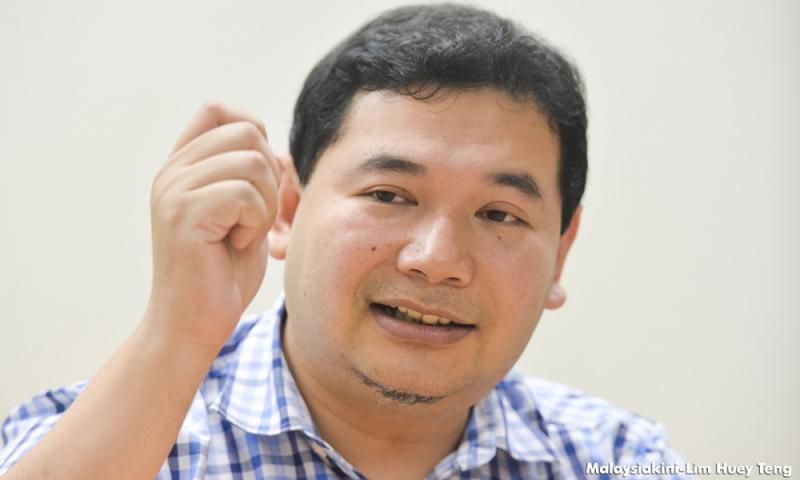
An MP, a former United Nations special rapporteur and Gerakan Youth deputy chief saw red over Thursday's Court of Appeal majority decision that allows state and federal governments to sue individuals for defamation.

They said this implied that parliamentary democracy in Malaysia is not developed and felt that criticisms of the government should be allowed.

Pandan MP and PKR vice-president, Rafizi Ramli, who is alarmed with the impact of the decision, suggested that all Pakatan Harapan MPs who are also lawyers to help look at the existing law, and if necessary, draft a private member's bill to oppose such a decision.

Former UN special rapporteur on the independence of judges and lawyers, Param Cumaraswamy, said the decision implied that parliamentary democracy in Malaysia is not well-developed like that in England as common law does not apply here.

“If that is the case, what parliamentary democracy is envisaged in Section 124 (b) of the Penal Code in having laws criminalising activities detrimental to parliamentary democracy?” he told Malaysiakini .

Gerakan Youth deputy chief, Andy Yong, also told Malaysiakini that he agreed with the views aired by former Court of Appeal judge Mohd Hishamudin Mohd Yunus that the decision (governments can sue individuals) is retrogressive and against common law principle.

Param said that in a defamation suit what was at issue was injury to the plaintiff's reputation.

“To evaluate the reputation of a government, whether federal or state, adherence to principles of good governance, transparency and accountability will have to be called into question.

“Being a civil suit, will the governments subject themselves to discovery and produce documents without invoking state security or Official Secrets Act?,” he asked.

Hoping for a full Federal Court bench to review the majority decision, Param ( pix ) also said Thursday's judgment went against or was inconsistent with the recent ruling by the Court of Appeal in the Adnan Yaakob vs Utusan Malaysia .

All three of them were commenting on the majority judgment written by Court of Appeal judge Abdul Rahman Sebli in the case of the Sarawak state government and Sarawak financial office versus Kuching MP, Chong Chien Jien where it ruled governments can sue individuals for defamation.

Rafizi, who is also PKR secretary-general, warned that the majority decision could see big risks to every Malaysian as it empowered ministries, government agencies and departments or local councils to use taxpayers' money to file suit whenever the people raised issues against the government.

He said in a statement that the principle that the government cannot sue was decided by common law and this was practised in the United Kingdom.

Under this common law system, the people being taxpayers allow the government to function and therefore are the employers of the government.

Negative impact

Rafizi cited the 'Derbyshire Country Council vs Times Newspapers' case in which it was decided that the federal government or any local council cannot sue the people who criticise them as they should be open to uninhibited public criticism.

He warned that if the decision (allowing the government to sue individuals) stands and is unchallenged in the Federal Court, it would bring a negative impact to the people and country.

This is because besides MPs, the government can also sue NGO leaders and academicians using public funds, if their views are not agreeable to Umno-BN.

“The people will be the victims. I am concerned if this is not corrected it would be a weapon to shut the people up.

“I will monitor this case closely to ensure that it does not stick and become law and be abused by the Prime Minister Najib Abdul Razak's administration.

“I hope that Chong as the defendant in this case would file a leave to appeal this decision. I also hope that when it reaches the Federal Court, Sarawak Chief Minister Adenan Satem would show that he is different from Umno-BN leaders by directing the Sarawak government to stop the suit. This would allow the Federal Court to strike out the Court of Appeal decision.”

Rafizi hopes the people would not take this decision lightly, especially in light of Najib trying to cover the 1MDB scandal.

Gerakan's Yong said government bodies can still sue for defamation if they can prove actual financial loss.

“We need to understand that if the wealth of the state derived from the state’s subjects could be used to sue those for defamation, it would seriously interfere with freedom of expression of opinion.

“However, I am aware that governments should not have to stand by idly while false information is being spread to injure them.

“Hence it is likely to be in the public interest that the government is vindicated if the facts justify it. There is a need for balance. Perhaps declaratory remedies is the ideal decision,” said Yong who is also a lawyer.

He also hoped that the Federal Court would look into this case urgently as “our country is moving towards the status of a developed nation”.

“I am strongly in favour of Justice Yeoh Wee Siam's decision in Terengganu state government vs Syed Azman Syed Ahmad Nawawi case where she concludes that '...due to strong public interest consideration, [government executive] can maintain an action for defamation in his personal capacity but not in his official capacity'.

“'To allow such person to do so would tantamount to intimidating members of the public and strike fear in them, thereby stifling or discouraging constructive public criticism or question of government administration in situations where such criticism or question are necessary for the public good",” he said.