




Household income: Iban rank the lowest among bumis in Swak
The Iban, who form Sarawak's largest indigenous group, have the lowest mean household income among the main bumiputera groups in the state, according to a 2002 survey.
The Iban, who form Sarawak's largest indigenous group, have the lowest mean household income among the main bumiputera groups in the state, according to a 2002 survey.
The Iban, who are found in all eight administrative divisions of the state, had a mean (monthly) household income of RM1,547 compared with RM2,482 for the Malays, RM2,294 for the Bidayuh, RM1,957 for the Melanau and RM1,883 for the other bumiputeras.
The mean household income of Sarawak bumiputeras in 2002 was RM1,959 compared with RM3,373 for the Chinese, who form the state's second largest racial group.
These statistics were unveiled in a presentation by the Prime Minister's Department Economic Planning Unit (EPU) deputy director-general Dr Wan Abdul Aziz Wan Abdullah at the recent Bumiputera Minorities Economic Congress in Kuala Lumpur.
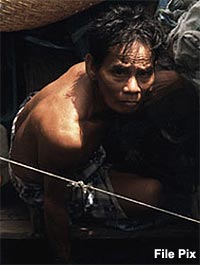 The figures lend credence to the claim that among the major ethnic groups the Iban who make up about 30 percent of Sarawak's 2.4 million population and living largely in the rural areas fare the worst in terms of average family earnings monthly.
But their position vis-a-vis mean household income has improved over the past 15 years, from RM710 in 1990 to RM1,186 in 1995 and RM1,547 in 2002.
Government's efforts
According to the same survey, nearly six out of every 10 adult Iban are engaged in agriculture, leading them to being described as largely an agricultural community, although an increasing number is engaged in manufacturing (6.5 percent), construction (11.5 percent) and social services (10.5 percent).
The other main bumiputera groups are less involved in agriculture - 21.3 percent Malay, 44.3 percent Bidayuh, 29.7 percent Melanau and 49.6 percent other bumiputeras (including the Orang Ulu).
Incidentally, nearly three out of every 10 Malay and at least two out of every 10 Melanau are directly engaged in social services (government departments, etc).
The percentages for the other bumiputera groups in the social service sector are lower.
Among the Dayak sub-groups or other minority non-Muslim ethnic groups, the mean household incomes, according to the survey, were RM1,470 for Kayan, RM1,436 for Kelabit, RM1,498 for Lun Bawang and RM515 for Penan.
The EPU deputy director-general said as part of strategic planning and development of bumiputera minorities, the government is putting emphasis on the development of native and customary rights land.
Among other government efforts to help the minorities is the setting up of a bumiputera participation unit in the EPU, expedite employment restructuring exercise, creating middle-class bumiputera entrepreneurs, enhancing the role of trust agencies, to award at least 60 percent of contract works to bumiputeras and ensuring adequate capital to support bumiputera entrepreneurs and forging a smart and strategic partnership between bumiputera and non-bumiputera.
An important strategy is to increase the number of bumiputera-owned and controlled public-listed companies.
At the request of the government, the congress resolved that bumiputera minorities be defined to comprise the Dayaks of Sarawak and the Kadazandusun-Muruts of Sabah and other indigenous ethnic groups in the two states for the purpose of planning, implementation and monitoring of what it called the nation's policies and programmes relating to socio-economic development.
TONY THIEN is malaysiakini 's Sarawak-based stringer.


Are you sure you want to delete this comment?
This action cannot be undone.