




Rights groups: Refugee protests in line with human rights
Refugees who organise demonstrations and protests have every right to do so despite their illegal status, as laws and liberties are binding on all persons, according to two human rights organisations.
Refugees who organise demonstrations and protests have every right to do so despite their illegal status, as laws and liberties are binding on all persons, according to two human rights organisations.
They were responding to claims that recent demonstrations organised by refugees and asylum seekers had a hidden agenda to expedite resettlement to a third country, as they were 'volunteering' to be arrested.
 "They have the right to assemble. Many of them are really desperate and fled their country after years of persecution," said Amnesty International Malaysia (AIM) acting-director Josef Roy Benedict today.
National Human Rights Society of Malaysia (Hakam) secretary-general Elizabeth Wong agreed that the Burmese have the right to express their concerns.
She said the protestors were probably hoping that the governments of Burma and Malaysia would look into their concerns.
"The Malaysian government cannot be immune to these concerns and must address them," she said.
In January and February, dissidents from Burma had staged two demonstrations in front of their embassy in Kuala Lumpur.
The first group - from the ethnic Chin community - were protesting against repression of Christianity in Burma. The second group protested against human rights violations in Burma.
'Legitimate concerns'
 Wong said the demonstrators had legitimate concerns such as the continued detention of Burmese democratic icon Aung San Suu Kyi and over 1,300 political prisoners, the repression of Christians in a mainly Buddhist nation, and Burma's chairing of Asean in 2006.
"These are all very legitimate issues and protests are held in countries around the world on these issues. Therefore this is not unusual and it's up to them (Burmese refugees) to determine the best approach to highlight these issues," she said.
Other concerns are the statelessness of the Rohingya - a Burmese Muslim minority group - and the resumption of the national convention to draft a constitution - which critics have dismissed as unlawful because the rightfully elected government is not involved in the process.
Burma has been ruled by a military junta since a coup in 1962. A general election was held in 1990, in which the National League for Democracy won over 80 percent of the seats. However, the junta refused to allow it to assume power.
"Laws, and by extension, rights and fundamental liberties are applicable to everyone here," Wong said.
Risks involved
Meanwhile, Benedict said laws in Malaysia - particularly the Police Act 1967 - undermine rights of the protestors.
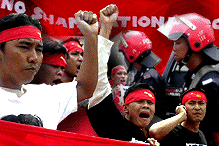 "The demonstrators flee human rights violations and come to a country where refugee rights are not recognised and protected by the government," he said.
"Allow me to quote (Article 20 of) the Universal Declaration of Human Rights as a basis for the rights of individuals to assemble peacefully. These rights must be respected and protected."
However, both Benedict and Wong said refugees and asylum seekers who intend to stage protests are always advised - should they contact right groups - of the potential risks of holding demonstrations in Malaysia.
They stressed that their organisations explain the possibility of arrests and deportation, and educate them on their rights within the Malaysian context.


Are you sure you want to delete this comment?
This action cannot be undone.