



Aleyasak loses appeal against police in Bersih assault incident
Self-employed Aleyasak Hamid@ Hassan today lost his appeal in his suit against the police and government for the injuries, including a fractured knee, he allegedly suffered from policemen, whom he could not identify, during the 2007 Bersih rally.
The Federal Court dismissed four questions of law posed by Aleyasak's lead counsel and former Federal Court judge Gopal Sri Ram, and Latheefa Koya, who handled the case pro-bono.
This was despite Sri Ram putting forth a convincing argument that despite not being able to identify the policemen who caused the injury when one of them stepped on his knee, the government was still vicariously liable for the claim as it was the hirer of the policemen involved.
Self-employed Aleyasak Hamid@ Hassan today lost his appeal in his suit against the police and government for the injuries, including a fractured knee, he allegedly suffered from policemen, whom he could not identify, during the 2007 Bersih rally.
The Federal Court dismissed four questions of law posed by Aleyasak's lead counsel and former Federal Court judge Gopal Sri Ram, and Latheefa Koya, who handled the case pro-bono.
This was despite Sri Ram putting forth a convincing argument that despite not being able to identify the policemen who caused the injury when one of them stepped on his knee, the government was still vicariously liable for the claim as it was the hirer of the policemen involved.
Sri Ram told the court that vicarious liability is a common law principle of strict no-fault liability.
“Under this principle, a blameless employer is liable for a wrong committed by his employee while in the course of the employment. During the course of the event (Bersih), there were several people who had also complained that they have been assaulted by the police,” he said.
“The court should revisit in the case of Kerajaan Malaysia vs Lay Kee Tee, as the government shall be liable for any act done, including those done by its agents,” he said.
 The senior lawyer said the court should depart from having the plaintiff being required to identify the person who caused the injury.
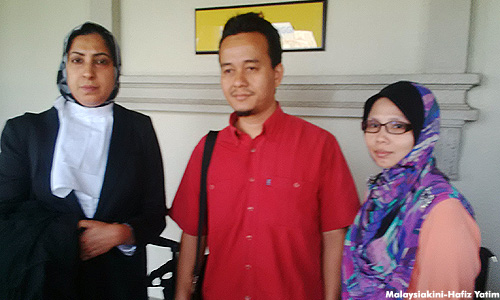
He added that the fact that Aleyasak (centre in photo) said the policemen were from the Federal Reserve Unit should not be considered fatal to his case.
Alternatively, Sri Ram sought for Sections 5 and 6 of the Government Proceedings Act, which required the person responsible to be named, to be declared as unconstitutional.
Panel disagrees on challenge to sections
During the course of the trial, a witness from the Federal Reserve Unit (FRU) testified that they did not break their formation to move in against the protesters.
This testiomy resulted in the court dismissing Aleyasak's claim.
After a break of about 40 minutes, Court of Appeal president Md Raus Sharif, who led the three-member bench, said they unanimously decided not to revisit the case of Kerajaan Malaysia vs Lay Kee Tee and they also disagreed they that should challenge Sections 5 and 6 of the Government Proceedings Act.
“Hence, we dismiss the appeal with costs,” Justice Md Raus said. The court awarded costs of RM5,000 to the government, which was represented by senior federal counsel Alice Loke and Andi Razalijaya A Dadi.
The other two judges were Federal Court judges Justice Azahar Mohamed and Justice Balia Yusof Wahi.
Aleyasak named the Kuala Lumpur police chief, Dang Wangi OCPD, the inspector-general of police and the government as defendents in the suit.
Aleyasak has testified before the High Court in Kuala Lumpur during his trial that his aunt dropped him off, outside the Kamdar Store on Jalan Tuanku Abdul Rahman, to watch the rally on that day in 2007.
Later, as he was walking with the crowd towards Dataran Merdeka, he heard shouts of ‘run, run!’ and watched FRU members approaching.
"Then the FRU officers surrounded me and kicked at my ribs. They stepped on my left knee and then I heard a ‘pop’ sound - I knew then that my knee was fractured," Aleyasak testified.
Claim dismissed by High Court and COA
Despite this, the High Court dismissed his claim as Aleyasak could not identify who assaulted him. In the judgment, Judicial Commissioner Azizul Azmi Adnan said the police officer responsible for the injury should have been identified before vicarious liability could be claimed from the government.
In the case before the court, the judge said, it was proven from the testimony that the KL police chief, OCPD and IGP were not involved in the physical assault.
“Despite them holding the posts as those responsible and in charge of those under their command, it is not sufficient for the court to determine that they were directly responsible for the act.
“Two elements need to be proven for vicarious liability. The first is whether the person responsible was truly responsible for the act and for the second, the plaintiff must prove the agent or principal worker was involved.”
“In this case, the plaintiff could not identify which police officer assaulted him, despite him confirming it was the police. However, the responsible officer should be named, based on the case of Lay Kee Tee,” Judicial Commissioner Azizul ruled.
Aleyasak's appeal to the Court of Appeal was also dismissed by the court, four months ago, on the same grounds.


Report this comment
Are you sure you want to delete this comment?
This action cannot be undone.