
Opposition delusion after the twin polls
ANALYSIS As the dust settles on the Sungai Besar and Kuala Kangsar by-elections, many in the opposition parties have tried to play down their defeat.
PAS, for example, hailed the fact that it could capture about half the opposition votes in both by-elections as evidence of the party’s strength, and claimed credit for at least half of all votes Pakatan Rakyat received in the past.
On Pakatan Harapan’s side, Parti Amanah Negara (Amanah) hailed the fact that a nine-month-old party could garner half of the opposition’s vote share as a success against PAS, which existed even before independence.
As much as the opposition parties would like to peddle good news to keep morale up, the attempts to gloss over the twin polls is tantamount to a refusal to face the difficult realities confronting the opposition.
Malaysiakini takes at a look the statements coming from the opposition after the by-elections and why they are problematic.
ANALYSIS As the dust settles on the Sungai Besar and Kuala Kangsar by-elections, many in the opposition parties have tried to play down their defeat.
PAS, for example, hailed the fact that it could capture about half the opposition votes in both by-elections as evidence of the party’s strength, and claimed credit for at least half of all votes Pakatan Rakyat received in the past.
On Pakatan Harapan’s side, Parti Amanah Negara (Amanah) hailed the fact that a nine-month-old party could garner half of the opposition’s vote share as a success against PAS, which existed even before independence.
As much as the opposition parties would like to peddle good news to keep morale up, the attempts to gloss over the twin polls is tantamount to a refusal to face the difficult realities confronting the opposition.
Malaysiakini takes at a look the statements coming from the opposition after the by-elections and why they are problematic.
‘Nine-month-old Amanah could defeat PAS’
On the surface, this is a commendable achievement for a young party, but Amanah ultimately failed its role in Harapan.
Amanah was created to replace PAS in the opposition coalition. It was not meant to be just a replacement in name.
 It needed to take over PAS' role in capturing Malay voters, particularly in the rural heartland, for Harapan.
In the Sungai Besar by-election, Amanah captured a meagre seven percent of votes in the polling district of Parit 13 Sungai Nipah compared to PAS’ 47.2 percent and BN’s 45.8 percent.
This polling district was a litmus test for Amanah as it is one of the few Malay rural heartlands in Sungai Besar won by PAS in the last general election, where more than 90 percent of the voters are Malays.
In the 13th general election, PAS won 52.4 percent of the votes compared to BN’s 47.6 percent in this polling district.
Likewise, in Kuala Kangsar, Amanah polled 5.5 percent of the votes in the polling district of Kampong Mesjid, which also comprises more than 90 percent Malays.
PAS polled 44.6 percent of the votes while BN received 49.9 percent.
If Amanah is to rely on Chinese voters to achieve its so-called success against PAS, DAP may as well contest the election itself. Amanah would have no relevance in such a case.
‘PAS’ strength is proven, contributed half of Pakatan’s votes’
The by-elections did show that PAS has a support base that would stick with it through thick and thin but all it proved was that the party is capable of being a spoiler and not a winner.
The party also tried to exaggerate its strength by claiming the by-elections proved PAS contributed at least half of Pakatan’s votes in the past.
It derived this from the fact that PAS received around half of the opposition votes in both by-elections.
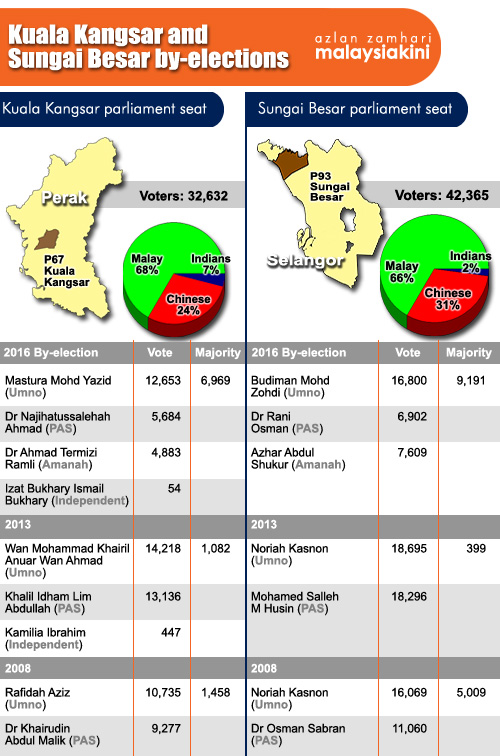
This was partly due to the fact that the seats have substantial Malay voters, with 66 percent in Sungai Besar and 68 percent in Kuala Kangsar.
 However, if DAP contested a by-election in the Chinese-majority state seat of Puteri Wangsa, presently held by PAS, in Johor, the former will likely be able to capture more than half of the opposition’s vote share, too.
Should DAP then also claim that it contributed more than half of Pakatan Rakyat’s votes, which PAS benefited from?
The reality is the constituencies across the country have various demographic make-up and PAS, DAP as well as PKR relied on each other as each have their own strengths in certain kinds of constituencies.
‘Chinese swing to BN is small, they’ll come back in GE’
To some extent, Chinese voters do have a tendency to go for the ruling coalition in a by-election where there is no possibility of a change in government, and this was also observed in the Teluk Intan by-election.
Furthermore, outstation voters, who are more anti-government, are less likely to return home to vote in a by-election.
Was the swing small? A PKR state assemblyperson believed so when he took to Facebook to claim that even though BN captured the Chinese-majority polling district in Jerlun by increasing its share of votes from 29.7 percent to 52.6 percent, the ruling coalition only increased its numerical votes by only 93.
 However, he erroneously left out a ballot box as the streams for this polling district during the Kuala Kangsar by-election had increased from three to four.
BN increased its votes from 363 to 568 in Jerlun, a difference of over 200 votes, while Harapan’s votes under Amanah fell from 861 to 415. PAS won 88 votes while the Independent candidate won nine votes.
Even if the turnout was strong, BN would still give Harapan a run for its money compared to the last general election, where the opposition coalition won hands down.
Furthermore, the opposition would be taking things for granted if it believed that it will still have solid support from outstation voters in the next general election.
Outstation voters made an effort to return home to vote against BN due to the likelihood of a change in government.
If the opposition is unable to convince voters that this is still a possibility in the next general election due to multi-cornered fights, they may not bother coming home.
The opposition coalition’s Chinese support in the last general election was also unprecedented, with some areas hitting as high as 85 percent, making it difficult to maintain the skewed position.
The notion that the Chinese swing to BN in the by-elections was not significant, like the two other justifications by PAS and Amanah, only serves to soothe the opposition's wounds, or worst, lull them into complacency.
‘BN majority not large against combined opposition votes’
In the Sungai Besar by-election, BN garnered 16,800 votes compared to Amanah’s 7,609 votes and PAS’ 6902 votes, winning by a 9,191-vote majority.
In the Kuala Kangsar contest, BN captured 12,653 votes compared to PAS’ 5,684 votes, Amanah’s 4,883 votes and the Independent candidate’s 54 votes, winning by a 6,969-vote majority.
 There have been arguments that if Amanah and PAS' votes are combined, BN’s majority in Sungai Besar and Kuala Kangsar are only 2,289 and 2,086 respectively.
No matter how one plays with the figures, the method of calculation for the majority in a first-past-the-post system is the total number of votes garnered by the winner subtracted the first runner-up’s votes.
The opposition can either address the real issue, which is the opposition split, or it can add up the total number of votes garnered by the opposition again in the next election.
Looking at the big picture
The opposition needs to confront the reality that it is now faced with several bad choices instead of sugarcoating the outcome of the by-elections.
It can either take the pragmatic approach, which some may see as a ‘shortcut’, or it can take the idealistic approach, which will be a long and arduous journey without guarantee of success - either choice would be a difficult one.
Pragmatic approach
If Harapan’s purpose is to win power as soon as possible, then setting up Amanah was a mistake.
It could barely capture the Malay heartland and therefore cannot claim to be PAS’ replacement in the opposition coalition.
In the beginning, supporting the setting up of PAS splinter Amanah as a more moderate Islamic party would seem like a good idea as it would make it easier for Harapan partners, in particular DAP, to work with them.
However, the creation of Amanah also meant the transformation of PAS to a more hardline party as the ultra-conservative forces now have complete monopoly over the party in the absence of the progressives who departed for Amanah.
This means PAS is now even harder to work with than it was during the final months of Pakatan Rakyat and any cooperation with them would only create an even more unstable coalition than before.
It would have been a less difficult task had the progressives hunkered down in PAS and bid their time for a renewed takeover when the time was right.
PAS had proven to be a dynamic party, having been a party with leftist anti-colonial tendencies under Burhanuddin al-Helmy and later transforming into a Malay ethno-nationalist party and subsequently adopting a more Islamist approach to challenge Umno.
 It may have taken five or even 10 years for the progressives to mount a new takeover but it is nowhere as difficult as trying to build the grassroots of a new party that could take decades long.
With the absence of the progressives in PAS, there is hardly anyone left in the party to challenge president Abdul Hadi Awang even if he leads PAS to multiple defeats.
The thriving conservative hardliners in the vacuum left behind by the progressives also mean that PAS will likely remain uncompromising and ultra-conservative with or without Hadi for the foreseeable future.
The damage is done and there is no turning back. This is the kind of PAS that Harapan now needs to deal with if it wants to capture power in the short term - not only in the context of federal power, but also maintaining Harapan-controlled states.
There have been proposals that PAS be allowed free reign in the east coast and northern states while Amanah contests in the west coast Malay-majority constituencies.
This sounds ideal, but it will never happen with the new and more hardline PAS.
PAS will never give way to Amanah and has made it clear it is ready to see the opposition burn before that happens.
The quick solution would be to give in and ditch Amanah for PAS, which, while more emboldened and uncompromising, can deliver the Malay rural heartland votes.
Such a coalition is likely to be more unstable than Pakatan Rakyat and may eventually suffer the same collapse, but serves its short-term purpose.
Idealistic approach
The other option would be to stick with Amanah.
This is based on the belief that after multiple failed cooperation attempts with PAS, it would make no sense to press on with a political model that will ultimately end in collapse again.
Standing by Amanah and nurturing a new Islamist party that can break the current dogmatic narrative of Islamic politics in favour of a more progressive one may sound ideal. But is the opposition prepared to remain in the wilderness for several election cycles?
Without a partner to deliver the Malay heartland, coupled with PAS out to exact revenge for supporting Amanah, Harapan will likely lose several parliamentary and state seats.
Is Harapan prepared to bear this pain and wait for Amanah to build up its grassroots, which may take several election cycles, without certainty of success?
NIGEL AW is a member of the Malaysiakini team.