



Amanah veep wants Pahang mufti to retract explosive remarks
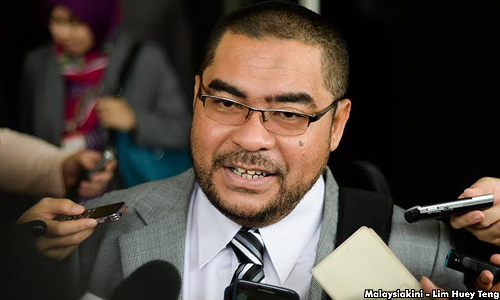
Does Pahang mufti Abdul Rahman Osman share the same view as terrorist group Islamic State (IS), asked Parti Amanah Negara vice-president Mujahid Yusof Rawa.
Abdul Rahman kicked up a storm after he declared DAP as kafir harbi - non-believers who can be killed for waging war against Islam - just a day after the IS called on its allies to kill non-believers in the country.
Does Pahang mufti Abdul Rahman Osman share the same view as terrorist group Islamic State (IS), asked Parti Amanah Negara vice-president Mujahid Yusof Rawa.
Abdul Rahman kicked up a storm after he declared DAP as kafir harbi - non-believers who can be killed for waging war against Islam - just a day after the IS called on its allies to kill non-believers in the country.
Mujahid demanded the mufti to withdraw his kafir harbi (infidels) remarks as Malaysia has its own categorisation for non-Muslims (fiqh muwathonah), which is based on citizenship.
Mujahid warned that the mufti’s remarks may incite hatred between the races and negate the nation’s efforts in national integration.
What is more worrying is that the mufti’s narrow views can lead to extremism among Muslims, said Mujahid.
The Amanah leader suggested the mufti to brush up his knowledge on religious diversity, and the relationship between Muslims and non-Muslims in the context of a multicultural country.
These views were recently presented in a seminar titled ‘NUNJI 15 - Nadwah Ulamak Lil Nahdhah Jadidah’ organised by Amanah, said Mujahid.
Mujahid also told the mufti to be cautious when categorising non-Muslims.
"Does the Pahang mufti assume those who express their views on the country's legal and constitutional system is considered waging war against Islam?" he asked.
Mujahid said the mufti appears to be confused by criticisms over Islamic administrative issues and the concept of waging war against Islam as these are two different things.
“His position as mufti is decided by the state administration which can be criticised and questioned.
“Does the mufti think he is pure and cannot be criticised despite that he is appointed by the administration?” Mujahid asked.
Outdated views
Mujahid said the mufti's view is outdated as the current accepted fatwa in the Islamic world categorises the relationship between Muslims and non-Muslims according to citizenship, which ensures justice for all.
Article 8 of the Federal Constitution guarantees that all citizens are granted legal justice regardless of their race, religion and place of birth, Mujahid noted.
He cited the views of world renowned Islamic scholar Yusof Qaradhawi in his book ‘Al Jihad’ and other well-known ulama who explained that there is now no need for citizens to be labelled as kafir harbi or kafir zimmi.
This is because international and civil relations are defined by laws of the land, and are tied to the standards of the United Nations Charter.
The concepts of kafir harbi and kafir zimmi existed in the past when the world was geo-politically divided between Darul Harb and Darul Islam.
“Is the mufti aware of the implications of calling non-believers kafir harbi? It allows the properties of those categorised as such be seized and they be evicted from the land,” Mujahid said.
“Except for the IS and other terrorist groups like Al-Qaeda and Taliban, the whole world has dismissed the use of kafir harbi or zimmi on non-Muslims.”


Are you sure you want to delete this comment?
This action cannot be undone.