


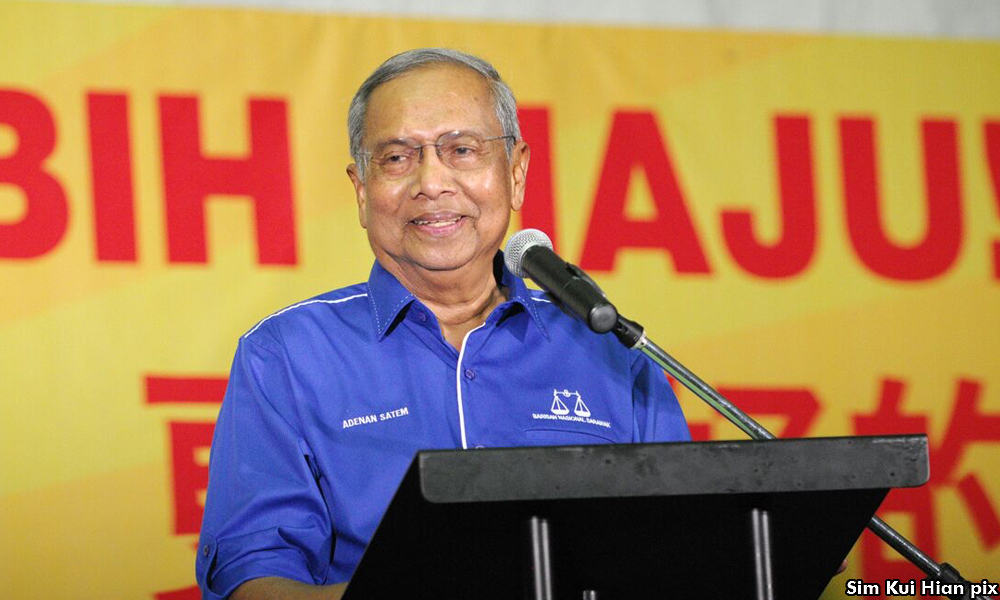

Will Adenan succumb to absolute power?
COMMENT “If they, after consulting with their constituents, still insist on joining PBB, then we have no choice but to entertain their applications favourably.” Adenan Satem made this declaration on June 5 after chairing his party’s supreme council meeting in response to the nine partyless assemblypersons who applied to join PBB.
He did however give them till June 30 to reconsider their decision and to consult their constituency, but his statement of favourable response, basically builds a perception that the act of consulting their constituency is a mere charades and probably just for the sake of formalities.
The reason that the issue of these assemblypersons is so highly debated is because the issue is not just about a matter of membership, but more about the integrity of the so-called unwritten rule, where PBB, as the backbone of the state BN, will not take more than the seats required to form a simple majority in the state legislature.
Over the years, this understanding has been accepted by all the ruling coalition, as well as been the basis for power-sharing among the component parties. This principle, which was probably integrated since the establishment of PBB through a merger between the Bumiputera party and Pesaka in 1973, has held the component parties of PBB and SUPP together at that particular moment of time.
This ‘unwritten rule’ of course played a more prominent role in the 1980s where Abdul Taib Mahmud had the ‘unofficial’ agreement between the component parties especially during the height of the Ming Court Affair.
Now, Adenan is at this crossroads. Should he or should he not seize the opportunity to expand its political clout especially when the opportunity has come knocking on the door, or should he stick to the unwritten rule that supposedly has stood the test of time.
This dilemma isn’t new, and PBB has faced similar decision where in 1983, their leaders then, refused to accept ex-SNAP members’ application to join PBB in ad hoc lead by Daniel Tajem after the aftermath of the Leo Moggie/Tajem group infighting against James Wong/Kalong Ningkan in SNAP. This of course led to the formation of PBDS in 1983 with Moggie as its first and last president.
There was also the instance after Ming Court Affair in 1987, where the late Joseph Balan Seling, Datuk Michael Ben and Gramong Juna applied to enter into PBB. This time round, their applications were approved.
Currently, PBB holds 40 out of the 82 seats available and will only need another two seats to command a simple majority in the state legislative assembly. If the nine assemblypersons’ applications are accepted, PBB will only be short of another six seats to hold a two-third majority in the assembly.
‘How does this even concern us?’
The question we are now asking is of course, “how does this even concern us? Isn’t this just internal party/coalition politics?”
I for one strongly believe that his decision will definitely have a great impact the political landscape in Sarawak and thus affect every one of us.
What is most obvious of course, is that PBB can form a simple majority government, disregarding any previous agreement, thus rendering the BN spirit of power sharing among component parties irrelevant. So the so-called ‘check-and-balance within itself’ is further made obsolete, thus proving further that the other component parties are merely subservient and just at the mercy of PBB.
If that is true, what is the point of voting for the other component parties when they don’t even have a voice within their own circle? They are probably there just to add up the numbers and also only there to try guarantee their own political survival.
Secondly, as mentioned, if all the nine YBs are admitted, PBB would then have 49 seats, just short of six more seats to have absolute power of a two-thirds majority. This empowers one party with the mandate and ability to amend the state’s constitution, at the risk of them doing it for their own benefit.
In theory, this will give them the absolute ability to choose its own cabinet, make arbitrarily decisions or pass bills in the legislative assembly with or without the support of the other component and minority parties.
With the current trend, this possibility is not too unimaginable. If Adenan and PBB accept these applications, it will probably then open up the flood gates and set a precedent that if any of the other assemblypersons were to have a fall-out against any of their own component parties, they will have no hesitation to leave their respective party to join PBB, and their application have to be treated favourably based on this precedent.
This opens up the possibility that whole government could technically be run by the machinery and hierarchy of a single party, its committee and of course, its president. That itself by definitions, is against democratic principles and check-and-balance we supposedly have in our political structure.
What is even more dangerous, is that PBB in essence is a race-based political party (Malay/bumiputera). So the political landscape of Sarawak will then be dealt with the possibility of race playing a more prominent role especially in political affiliation. This means arbitrary decisions benefitting a particular race can be made by a singular race-based party without any consensus from the different component parties which supposedly represents different communities and other secular entities.
Will the future leadership always be wise and moderate?
Sarawakians may now perceive Adenan as a ‘moderate’ leader, however can we even guarantee the future leadership will always be wise and moderate to listen and take into consideration not only the voices within their coalition, but also the public at large.
Remember, Adenan has publicly said that he will only be there for one term.
Furthermore, absolute power will also make the state BN vulnerable to any manoeuvres or interference at the federal level. For example, for Umno to come in, all they need is to lobby with one party and wouldn’t even need to consult the other component parties.
This is not foreign in our political scene. We have history of federal interference in the ousting of our first CM Stephen Kalong Ningkan, whom many believed to be engineered by the federal government due to his vocal stand for Sarawak rights.
Just imagine the perils we all are going face, if a leader, who have no qualms to bring in Umno or any other hazardous sentiments for his personal gains, is elected to lead the state.
Once PBB has achieved absolute majority, it is highly unlikely that it will give up its power even within a ‘friendly’ coalition. Talk of the need to strengthen PBB so that Umno will not come in is futile, as through this move, if it happens, further proves clear traits of Umno within PBB itself.
Substitute Umno with PBB and there might be no differences. A race-based party, ingrained with corruption and of course having the same structure where minority parties are merely filling up breathing space in the house.
So, June 30 has already come and gone, but we have yet to see a resolution.
The questions again, will Adenan succumb to temptations of absolute power? Will he allow the age-old understanding of power-sharing to be obsolete since technically there is no sanction for breaking such an ‘unwritten rule’.
Will he pass on this opportunity to strengthen his own party, and maybe set a legacy for himself, especially since the opportunity seems to be presenting itself?
The key is for us to understand, is that Adenan’s move, will reflect who he really is.
In politics, honour and integrity may be a rare commodity, but if Adenan is willing to step on and dishonour his own kind, imagine what more will he do to the people.
KELVIN YII is a parliamentary assistant to Stampin MP Julian Tan.


Are you sure you want to delete this comment?
This action cannot be undone.