



Would it be treason?
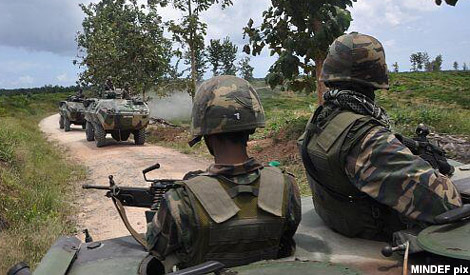
COMMENT I have been wondering whether ‘treason’ is a correct word to use if an army general takes on the order from the prime minister, who now has the power under the National Security Council Act (NSC) to declare an emergency.
This is without seeking the consent of the Yang di-Pertuan Agong, although all along, we know that the Agong is designated under Article 41 of the Federal Constitution as the Supreme Commander or Commander-in-Chief of the Malaysian Armed Forces.
The loyalty of the Armed Forces will always be to the Agong, and not anyone designated by him and definitely not the prime minister. Therefore, the powers that have now been given to the prime minister, are they constitutional or against the Federal Constitution? This is something for the constitutional experts to debate on.
COMMENT I have been wondering whether ‘treason’ is a correct word to use if an army general takes on the order from the prime minister, who now has the power under the National Security Council Act (NSC) to declare an emergency.
This is without seeking the consent of the Yang di-Pertuan Agong, although all along, we know that the Agong is designated under Article 41 of the Federal Constitution as the Supreme Commander or Commander-in-Chief of the Malaysian Armed Forces.
The loyalty of the Armed Forces will always be to the Agong, and not anyone designated by him and definitely not the prime minister. Therefore, the powers that have now been given to the prime minister, are they constitutional or against the Federal Constitution? This is something for the constitutional experts to debate on.
Will the army obey the prime minister’s instruction, or would it rather wait for the green light to be given by the Agong since the army’s loyalty is strictly to the Agong, by virtue of Article 41 of the Federal Constitution?
If it is against the Federal Constitution, can the NSC Act not be challenged in court especially since it has been passed recently and hastily, without the amendments requested by the Conference of Malay Rulers, which simply goes to show that there is no longer the respect for the rulers themselves?
Once overturned, and the Federal Court upholds that the Agong is still the supreme commander, would the army general be committing treason for obeying the instruction from a sitting prime minister especially if there is death of civilians involved?
What if Prime Minister Najib Abdul Razak or the National Security Council were to declare that a particular area is in a state of emergency? Who would be responsible for the declaration of emergency under the current provisions in the NSC Act?
I believe the army general is in a big dilemma, since treason in Malaysia attracts capital punishment.
What if?
There is a lot of talk on the ground that we may not even see the next general election. Because Najib is embroiled in the 1Malaysia Development Berhad (1MDB) scandal, he may use the NSC Act to call an emergency.
The rumours have it that the ruling party will use people like the red shirts to cause problems in some areas to justify the NSC declaring the state of emergency. This, they say, is allegedly Najib’s ploy to remain in power for as long as the country is in a state of emergency.
I do not think Najib is so ungentlemanly as to call such emergency measures, especially when the world is now watching Malaysia intensely after the US Department of Justice (DOJ) filed a civil suit which brings to light with all the hard evidences of money-laundering process involving four named individuals and one Malaysian Official No 1.
Any wrong move would immediately trigger the US’ determination to pursue the charges against the Malaysian Official No 1. But then, I always stand corrected.
At this juncture, it is only a civil suit against Najib’s stepson, Riza Aziz, and Najib’s associate, Low Taek Jho, who were the beneficiaries of the money siphoned out from the state fund. For some unknown reasons, the US DOJ has not named the Malaysian Official No 1. There are a couple of possible reasons.
One is that it chooses not to go beyond the civil suit, or go after the head of state of another nation for criminal activities, other than to just recover the money siphoned from the 1MDB. There could be some political reasons behind the non-prosecution of the Malaysian Official No 1 which we know nothing about.
This would mean that the DOJ would be seen as not upholding justice since this is a criminal case of money-laundering, given its power to prosecute, and the criminals will continue with their act as though nothing has happened.
The DOJ has dropped enough hints for us to arrive as a fair conclusion that they were referring to Najib, who is also the stepfather of Riza Aziz. We are also told that the Malaysian Official 1 was cited as a “high-ranking official in the Malaysian government who also held a position of authority with 1MDB”.
The second reason why the DOJ is not naming Najib directly at this point in time is because they choose to give face to Najib, with the hope that he would step down on his own accord.
The third reason is that I suspect civil suit is only the beginning. While the civil suit is to seize the properties suspected of being purchased using money siphoned from 1MDB, they are still investigating and gathering information about the main culprit behind the scandal.
When there is sufficient evidence, they may proceed with criminal prosecution. This is likely to be the case; therefore, whenever Najib is still in a very precarious position.
Not being named as a defendant during the civil suit, therefore, does not necessarily mean that Najib is absolved of guilt, as suggested by our attorney-general, Apandi Ali. His case could be the next change.
From the report filed by the DOJ, it is obvious who the Malaysian Official No 1 is, and that the money purportedly received from a Saudi Prince had in fact been derived from the 1MDB fund. I am therefore surprised that Apandi is still trying to defend the indefensible.
One does not need to go through the court process as long as the investigators have put together based on hard facts and all the bank documents. Malaysians have waited long enough for the full story to be out, and now that it is out, who will listen to some people crowing: “No one should rush to judgment before allegations are proven in court”.
Surprisingly, this was title of only one or two articles that appear in mainstream media, and the Malay Mail Online. Malaysiakini is the only website that has provided the full picture of what was said in the DOJ press conference.
What’s next?
I doubt if there is anything else Najib can do at this juncture except to step down in disgrace and face the consequences. To remain in power any longer will only mean that the country will go down the path of Zimbabwe.
While the whole world can guess who is involved in 1MDB scandal, there are still some in the corridors of power who are living in self-denial. This will be to their peril, as Malaysians are so much better informed these days.
In the urban constituencies, this 1MDB scandal will be hard to erase for many years to come.
While the opposition front is still led by de facto opposition leader Anwar Ibrahim, former prime minister Dr Mahathir Mohamad and his team will undoubtedly lead the charge into the rural constituencies to ensure a victory for the forces that are now gung-ho on removing Najib.
There is also no guarantee that Umno’s No 2 would also remain faithful to Najib, when Dr Mahathir steps up his pressure against Najib. The time may come when Ahmad Zahid Hamidi may quietly ask Najib to leave his office, and allow things to normalise before the next general election is called.
Meanwhile, I do not think that a state of emergency is possible without the consent of the Agong because it would lead to the suffering of the people of this country, and ultimately, it may even decide Najib’s own fate, as his case is now hanging in the balance with the open-ended identity as Malaysian Official No 1.
STEPHEN NG is an ordinary citizen with an avid interest in following political developments in the country since 2008.


Are you sure you want to delete this comment?
This action cannot be undone.