




KiniGuide on TNB pylons vs Taman Cheras Hartamas residents
KINIGUIDE On Monday, five residents were arrested while protesting the construction of TNB power pylons in the residential area of Taman Cheras Hartamas.
Today's instalment of the KiniGuide seeks to shed light on the controversy, which may be unfamiliar to many Malaysians.
Where is Taman Cheras Hartamas?
Taman Cheras Hartamas (TCH) is located smack in the southeast of the Kuala Lumpur city centre, roughly 11km away.
TCH straddles the border between Selangor and Kuala Lumpur; most of it is located in the industrial state, though its eastern side spills across the border with Kuala Lumpur.
On its west is a side road named Jalan Cheras Hartamas which marks the boundary of the housing area, while Taman Connaught lies further to its west.
Viewed from the sky or on maps, the residential area looks like a cleaver laid on its side on a northwest-to-southwest axis. About 300 families reside in the 6,000-square metre area.

TCH falls under which local government?
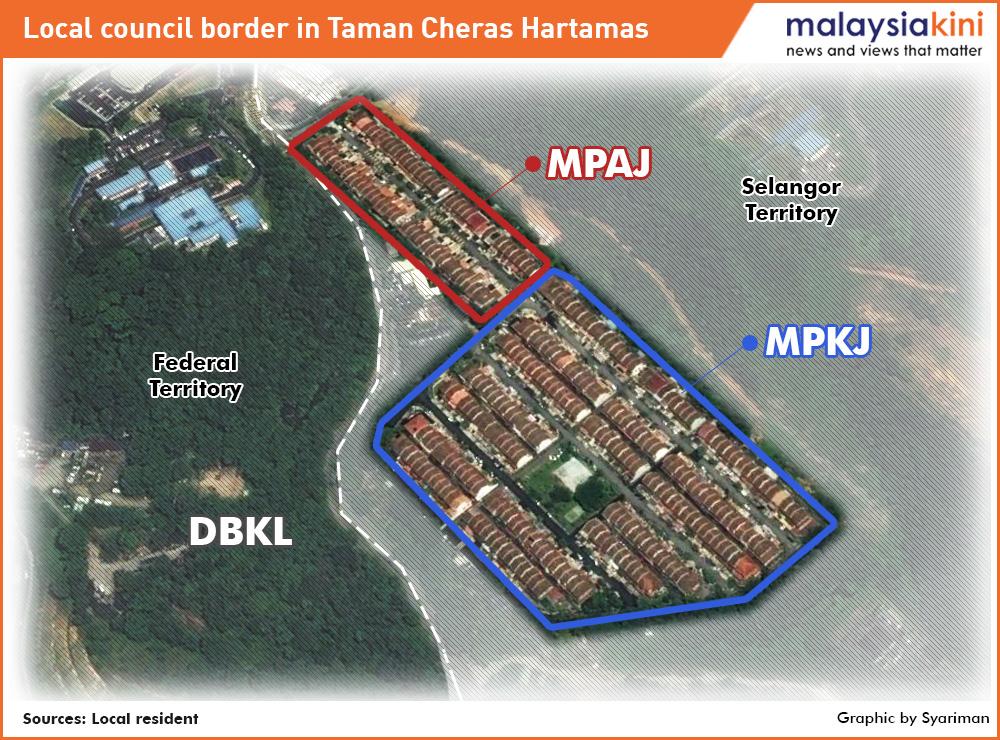
The majority of TCH, which is located in Selangor, falls under the jurisdiction of two municipal councils - the MPAJ (Majlis Perbandaran Ampang) and MPKJ (Majlis Perbandaran Kajang).
But the portion of TCH that lies in Kuala Lumpur falls under the jurisdiction of DBKL (Kuala Lumpur City Hall).
This arrangement, which is due to its peculiar location, has resulted in TCH becoming almost like a local government no-man's land, as the lines between the different jurisdictions can often seem muddled.
What are pylons?
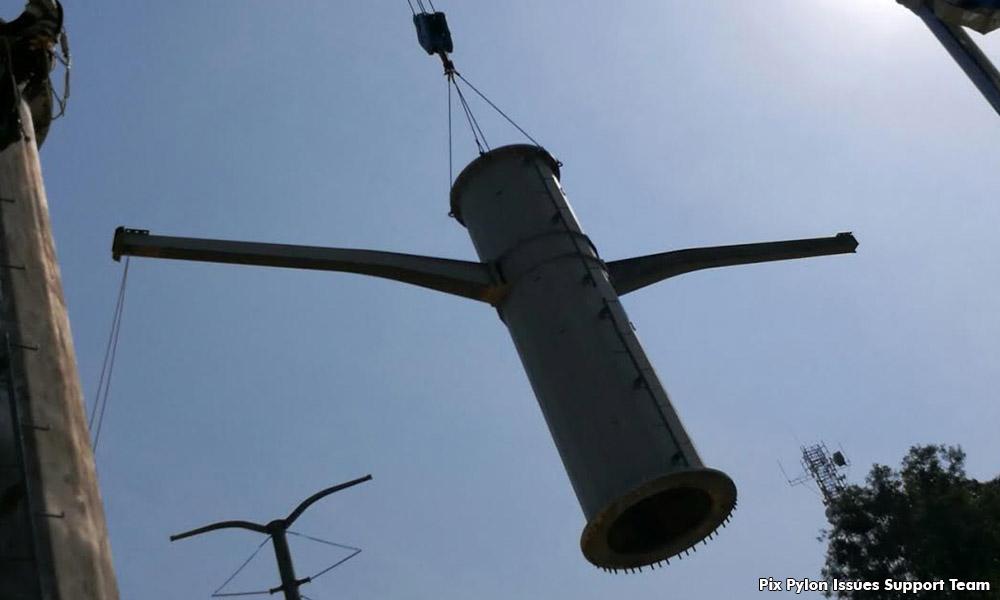
A pylon is a tall structure used to support high-tension transmission cables across great distances. National power company TNB plans to build several of these in and around TCH. In this particular case, the pylons are fishbone-shaped.
Based on TNB plans, a string of seven pylons will be constructed from the south of the residential area all the way to the southwest on the opposite side, creating an almost ‘U’ shape that will ring TCH.
Why must TNB build the pylons?
According to the Selangor government, the project is crucial to fulfil Selangor's development plan.
More specifically, the pylons are needed to provide power supply to the Langat 2 water processing plant and the upcoming Sungai Buloh-Kajang LRT line.
KINIGUIDE On Monday, five residents were arrested while protesting the construction of TNB power pylons in the residential area of Taman Cheras Hartamas.
Today's instalment of the KiniGuide seeks to shed light on the controversy, which may be unfamiliar to many Malaysians.
Where is Taman Cheras Hartamas?
Taman Cheras Hartamas (TCH) is located smack in the southeast of the Kuala Lumpur city centre, roughly 11km away.
TCH straddles the border between Selangor and Kuala Lumpur; most of it is located in the industrial state, though its eastern side spills across the border with Kuala Lumpur.
On its west is a side road named Jalan Cheras Hartamas which marks the boundary of the housing area, while Taman Connaught lies further to its west.
Viewed from the sky or on maps, the residential area looks like a cleaver laid on its side on a northwest-to-southwest axis. About 300 families reside in the 6,000-square metre area.
TCH falls under which local government?
The majority of TCH, which is located in Selangor, falls under the jurisdiction of two municipal councils - the MPAJ (Majlis Perbandaran Ampang) and MPKJ (Majlis Perbandaran Kajang).
But the portion of TCH that lies in Kuala Lumpur falls under the jurisdiction of DBKL (Kuala Lumpur City Hall).
This arrangement, which is due to its peculiar location, has resulted in TCH becoming almost like a local government no-man's land, as the lines between the different jurisdictions can often seem muddled.
What are pylons?
A pylon is a tall structure used to support high-tension transmission cables across great distances. National power company TNB plans to build several of these in and around TCH. In this particular case, the pylons are fishbone-shaped.
Based on TNB plans, a string of seven pylons will be constructed from the south of the residential area all the way to the southwest on the opposite side, creating an almost ‘U’ shape that will ring TCH.
Why must TNB build the pylons?
 According to the Selangor government, the project is crucial to fulfil Selangor's development plan.
More specifically, the pylons are needed to provide power supply to the Langat 2 water processing plant and the upcoming Sungai Buloh-Kajang LRT line.
When did the project commence?
The project started in 2010 but only two pylons were finished, with another pylon built halfway, after which the construction stopped because of protest from residents.
But in early August, the residents discovered that TNB had transported construction materials to the pylon sites, as contractors seemed poised to resume construction. This has led to the residents' latest round of protest.
What is the current status of the pylons?
Originally, the seven pylons were at varying levels of completion – pylon 2 (AP27) and pylon 3 were completed while pylon1 (AP24) was only half-built, then suspended.
The constructions of pylon 4 (AP27), pylon 5 (AP27/1), pylon 6 (AP27/2) and pylon 7 (AP28) were suspended indefinitely six years ago.
However, TNB resumed construction in June this year, claiming that it had the approval of the Selangor government.
On Aug 8, five residents were arrested while protesting the renewed construction. By the time of the arrest, TNB had completed constructing the remaining four pylons.
On the morning of Aug 11, a resident told Malaysiakini that TNB has completed the last unfinished pylon, AP24. With this, the network of pylons is now complete; all that is needed now is for the stringing of the high-tension transmission cables.
Why are residents protesting against the pylons?
TCH will be surrounded by seven high voltage pylons. Residents worry that living within the area of the electromagnetic fields (EMF) is akin to living inside a microwave.
They said the high level of radiation is bad for health as it might increase the risks of cancer, birth deformities as well as trigger the collapse of the local real estate value. All this would increase the residents' stress level.
 According to TNB, the nearest pylon to the housing area is 42.5 metres away, adhering to the mandated 20-metre safety rule.
However, residents noticed that this measurement is questionable because TNB is taking the inner house door as the measuring point instead of the drain outside the fence.
Measurements on the ground show that there may be valid concerns about the claim, as two of the pylons seem to be less than 20m away from the nearest house.
TNB's own measurement on projected EMF densities at TCH shows it to be at 0.5 milligauss (mG), though it is expected to increase to 20mG once the pylon is functioning - over 40 times higher than the original level.
TNB revised its statement later and said that the expected density after project completion will be 30mG. The inconsistency of the TNB measurements raises concern on its credibility.
Moreover, research published in the 'Journal of Biosciences and Medicines' suggests prolonged exposure to EMF should not exceed 2mG.
In 2002, the United Nations (UN) International Agency for Research on Cancer (IARC) officially categorises EMF into category 2B, for possible carcinogenic effects to humans. One of the most common sources of EMF pollution listed is none other than high voltage electric cable.
Meanwhile, the World Health Organisation has advised minimising any possibility of prolonged contact with EMF.
What are the alternatives suggested by residents?
Residents demand that TNB relocate the pylons to a distant site, for example, further north to the planned SUKE highway route, or connect the cables underground, from the far north pylon (AP 28) at the residential area, taking the underground route beneath Jalan Cheras Hartamas and joining up with the last pylon (AP 24).
The proposed curved line also reduces the total number of pylons to only five and cut the original distance from 1,200m to 552m.
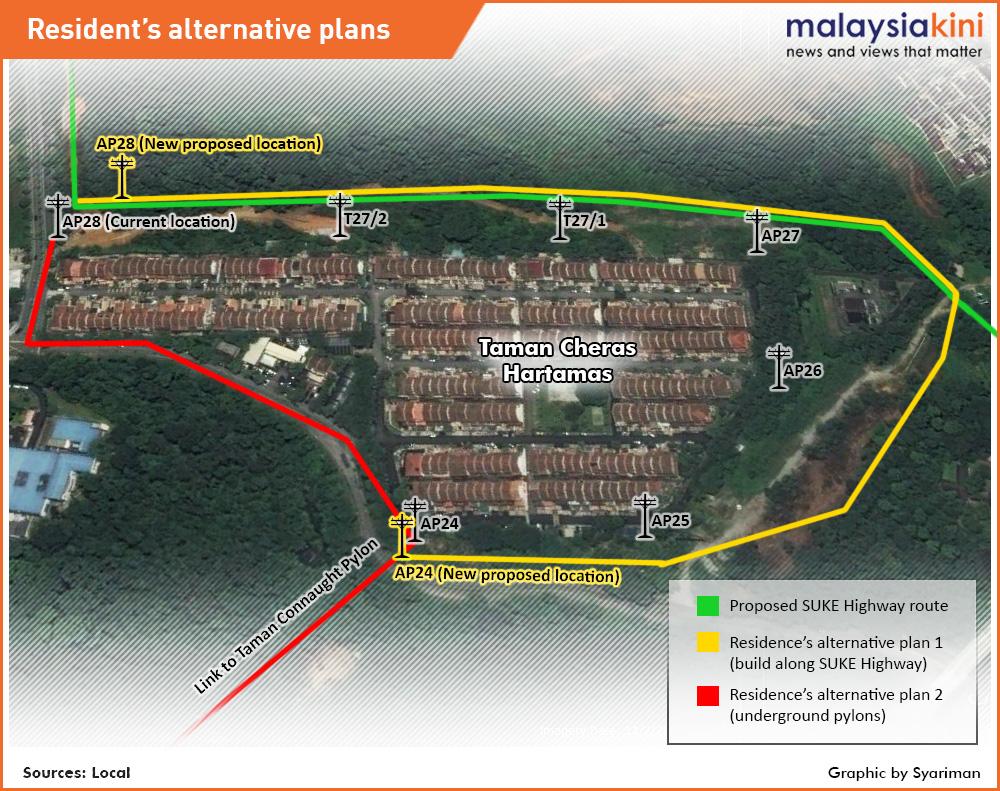
Nevertheless, residents estimate that the expenses for underground cable are high - at about RM42 million - or RM32 million more than using aboveground pylons.
As of now, TNB and the Selangor government have not accepted the proposal. Taking into account the awkward location of Taman Cheras Hartamas, any decisions made will require approval and the agreement of different local authorities, making the situation intractable.
Any responses from authorities?
On Aug 9, the Selangor Menteri Besar’s Office released a press statement, urging the residents to give full cooperation for the sake of the collective good.
The menteri besar guarantees that the government will assure that construction adheres to standard operating procedure (SOP), and reminds TNB to resolve the dispute with the residents.
What are the major protests by the residents?
Since 2009, the TCH Resident's Association has organised a series of campaigns to express its objection to the pylon project.
 Former menteri besar Khalid Ibrahim has promised that construction would not proceed until a consensus is achieved. Subsequently, the construction stopped to the relief of the residents.
However, after Azmin Ali took over as menteri besar, the Selangor government declared that the project would proceed and went on to erect the remaining four pylons. Residents tried different approaches to voice their protest, including writing letters to the authorities and requesting for further discussions.
Unfortunately, their complaints fell on deaf ears. The residents formed the Pylon Issues Support Team to monitor the situation at the construction site to prevent the workers from erecting the pylons secretly.
As the project continued, and with no solution in sight, the residents called for a mass demonstration on May 22, dubbed the '522 protest', which attracted more than 500 protesters and successfully gained public attention.
Early in August, the residents were alerted that the number of heavy vehicles entering the site has increased, and there are new building materials on the construction sites.
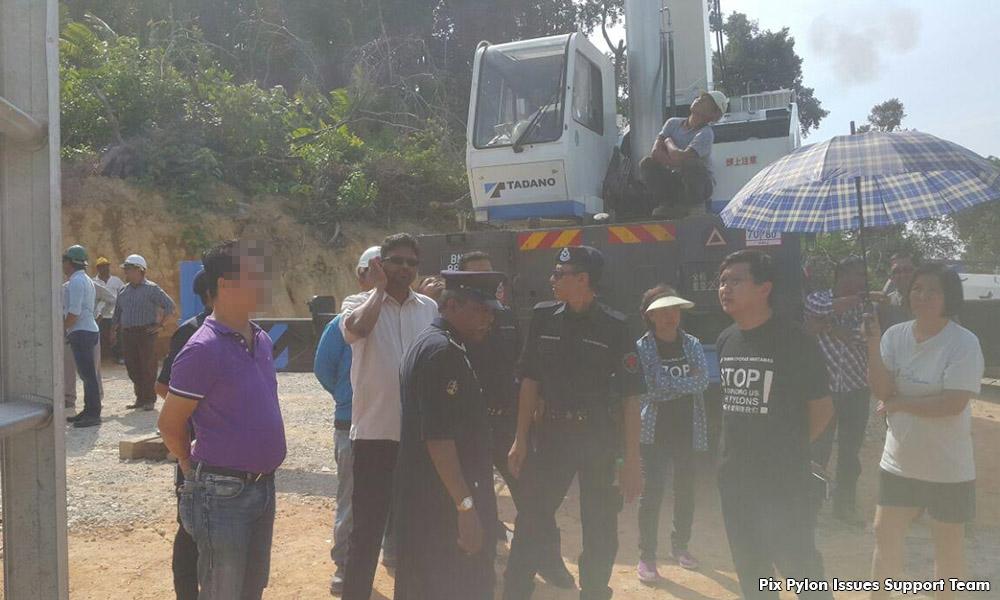
On Aug 9, with aid from auxiliary police officers, TNB forcibly erected the pylons. Five residents were arrested as they tried to stop the construction.
This instalment of KiniGuide was compiled by Cheo Yee Huang & Lim Hai Song.


Are you sure you want to delete this comment?
This action cannot be undone.