




Rare photo of Malayan comfort women in new book
A rare but clear photograph of a group of 'comfort women' - used by Japanese troops during World War II - has been discovered and published possibly for the first time in a book by two Cambridge historians.
A rare but clear photograph of a group of 'comfort women' - used by Japanese troops during World War II - has been discovered and published possibly for the first time in a book by two Cambridge historians.
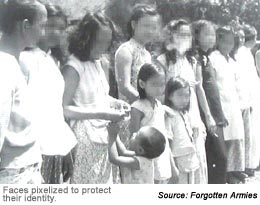 The photograph, reproduced with clarity, shows a group of 10 young Malayan women wearing traditional Chinese and Malay attire, after being rescued in the Andaman Islands in 1945. Three children are with them.
The Andaman Islands, now Indian territories in the Bay of Bengal, were occupied by Japanese troops during the Pacific War.
While it is widely acknowledged that there were 'comfort women' (a euphemism for sex slaves) in Japanese-occupied Malaya and Singapore, this has not been fully researched.
3,500 letters
Authors Christopher Bayly and Tim Harper said that, in 1995, some 3,500 letters were received by "a Malaysian political party" alleging the extensive existence of comfort women but that "none (of these) has been published".
Bayly is Vere Harmsworth Professor of Imperial and Naval History, University of Cambridge and a Fellow of St Catherine's College, Cambridge.
Harper is a senior lecturer in history at the University of Cambridge and a Fellow of Magdalene College, Cambridge.
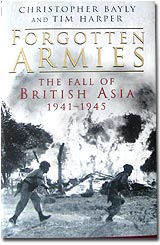 The book,
Forgotten Armies - The Fall of British Asia, 1941-1945
(London, Penguin, 2004), is on sale in Malaysia and Singapore.
The book,
Forgotten Armies - The Fall of British Asia, 1941-1945
(London, Penguin, 2004), is on sale in Malaysia and Singapore.
The authors also quoted unnamed Japanese sources as testifying that Chinese, Malay, Indian, Korean and Eurasian comfort women were kept in 'comfort houses' in occupied Singapore.
Their book narrates the fall of British colonies from Burma to Peninsular Malaya, Singapore, Sabah, Sarawak and Hong Kong during the Pacific War.
Many sections specifically recollect wartime facts and experiences in then Malaya.


Are you sure you want to delete this comment?
This action cannot be undone.