




Cut Sarawaks RM2.5 bil loss, pull plug on ailing 1st Silicon
The Sarawak government-owned hi-tech chipmaker 1st Silicon (Malaysia) Sdn Bhd should close down to avoid further draining the state's financial resources, according to Bandar Kuching member of parliament.
The Sarawak government-owned hi-tech chipmaker 1st Silicon (Malaysia) Sdn Bhd should close down to avoid further draining the state's financial resources, according to Bandar Kuching member of parliament.
Since its incorporation in 1998 up to December 31, 2003, the semiconductor manufacturing foundry - which is 70 per cent owned by the state government through a subsidiary of the State Economic Development Corporation - had suffered a total loss of RM2.5 billion.
 "This figure is greater than the total fund allocated for the development of roads and bridges in Sarawak under the five-year 8th Malaysia Plan (2001-2005), which is only RM2.45 billion," lamented DAP MP Chong Chieng Jen, who is also the party's state secretary.
Chong raised the issue in Parliament during the debate on the Amendment (Investment) Bill 2005 last week.
He told malaysiakini today that he doubted the state government would heed calls to pull the plug on the loss-making mega-foundry because "it would not want to lose face and to be proved wrong".
"If it continues to bleed, it means sustaining annual losses in the hundreds of millions which we can ill afford," he warned.
 Chief Minister Abdul Taib Mahmud had
publicly defended
the state government's investment in the hi-tech electronic sector, arguing it was an industry of the future and Sarawak must be part of it to remain relevant in the changing global business environment.
Chief Minister Abdul Taib Mahmud had
publicly defended
the state government's investment in the hi-tech electronic sector, arguing it was an industry of the future and Sarawak must be part of it to remain relevant in the changing global business environment.
About 1,000 workers, mostly engineers and technicians, are employed in 1st Silicon - one of Malaysia's two wafer fabs - which is situated at the Sama Jaya Free Industrial Zone on the fringe of Kuching city.
Wafer fabs produce silicon micro-processing chips for the world's telecommunication devices, personal device assistants and computers.
Steep in debts
According to the DAP MP, a search with the Malaysian Companies Commission (formerly Registrar of Companies) revealed the company had a paid-up capital of RM1.827 billion.
Of this, RM1.291 billion was held by Sarawak's State Economic Development Corporation, RM421 million by Sovereign Capital Berhad and the remaining RM160 million by 'private parties', details of which were however not given.
It is understood that Sarawak Enterprise Bhd, which is the holding company of Sarawak Electricity Supply Corporation Berhad, has a sizable stake in 1st Silicon.
Chong said despite its large equity base of RM1.874 billion, 1st Silicon had to take extensive loans from international institutions.
"I have with me a list of news releases by 1st Silicon regarding the number of loans raised by it over the years," he said in his speech in Parliament.
They included a new round of financing totalling RM2.332 billion in equity and credit raised in October 2002 and a five-year Islamic bond of RM1.330 billion raised in December 2004 for injection into 1st Silicon.
Chong, however, acknowledged that some of these funds could have been raised to re-finance some earlier more expensive loans, but he did not have the figures for these.
Of equal or more concern to many people in Sarawak, according to Chong, was the company's performance, especially its 'astronomical losses' suffered since 2000, based on extracts of annual returns from the Malaysian Companies Commissions.
He said the returns for 2004 were not available, as were the returns for the years prior to 2000.
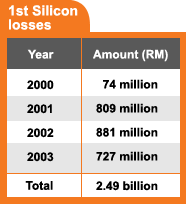 According to reported accounts, the company suffered a loss of RM74 million in 2000, a loss of RM809 million in 2001, a loss of RM881 million in 2002 and a loss of RM727 million in 2003.
Chong pointed out that the state-owned company's loss in 2003 alone was greater than the total allocation of funds for the development of roads and bridges in Sarawak under the 2005 Budget, which is only RM627.34 million.
The opposition parliamentarian said the mega-project hardly looked feasible and economically viable when it could bring in sale of only one ringgit for every four ringgit spent.
He based this on the 2002 revenue of RM113 million with cost of sale (production cost) of RM505 million.
"There is no future in this project and it should be stopped," Chong concluded.
Outdated technology
He said the only reason the owners could raise so much loans overseas was obviously based not on 1st Silicon's performance but the guarantees provided by the government.
Further, the Bandar Kuching representative claimed that 1st Silicon "is generations behind its competitors worldwide" in producing wafer by using 0.25 micron technology process.
"On the other hand, its contemporary in Peninsular Malaysia (Silterra Malaysia Sdn Bhd in Kedah's Kulim) is producing wafer by using 0.15 micron technology process, and will be producing wafer by using 0.13 micron technology process in this year."
Worldwide, in Taiwan and United States, wafer foundries are experimenting on 0.09 micron technology process, he added.
"From 0.25 micron technology, there are 0.22 micron technology, 0.18 micron technology, 0.15 micron technology, 0.13 micron technology. It is clear that the technology employed by 1st Silicon is a few generations behind the latest technology," Chong claimed.
Chong also claimed the auditor-general, entrusted with the responsibility to audit the management of public fund by the government or its investment bodies, had failed "in its duty to highlight and include the financial position of 1st Silicon in its 2003 Audit Report on Sarawak government".
"The loss incurred by 1st Silicon for the year 2003 is RM727 million," he said, adding that "this is definitely a material financial information which ought to be highlighted by the auditor-general in its audit".
Chong also told malaysiakini that he had yet to find out whether there was a deliberate attempt by anyone to block audit into the financial affairs of 1st Silicon.
In addition, he said he did not know why State Economic Development Corporation (SEDC) did not reflect its investment cost in 1st Silicon in its annual accounts.
"In the whole audit report of the Sarawak government, there is no single word mentioned about 1st Silicon. It only mentions that the income of SEDC for the year of 2003 is RM58.28 million whereas its expenses is RM26.03 million.
"Where has the figure of RM727 million loss of 1st Silicon gone? Under proper accounting practices, the accounts of a subsidiary must be consolidated into the group account of the holding company.
"SEDC, being a holding company of 1st Silicon, must include in its yearly reports the financial statements of 1st Silicon," Chong said.
Future dire
The DAP MP's comments came in the wake of the first quarterly financial reporting by top wafer maker Taiwan Semiconductor Manufacturing Company Ltd for 2005 that its revenue was down by 12.9 per cent, net income down by 24.2 per cent and a reduction of 25.3 per cent in fully diluted earnings per share.
It attributed the revenue drop mainly to decrease in wafer shipments and a weaker US dollar against the local currency, while the average selling price remained at the same level.
TSMC, the world's largest semiconductor manufacturer, said that the gross margin for the first quarter declined to nearly 40 per cent from the previous quarter and one of the reasons given was the lower levels of wafer output.
It further stated that revenues from advanced process technologies (0.13 micron and below) increased to 45 per cent of total wafer sales, compared to 36 per cent previously, indicating the segment where market demand is growing.
For the second quarter, TSMC expected wafer shipments to increase but average selling price to decline by what it described as a middle single digit percentage point.
Owners of loss-making fabs elsewhere have either been closed down or sold off to larger ones, or consolidated with bigger fabs.
In one of its recent press releases, 1st Silicon announced on Feb 28, 2005 that it would begin production shipment of 0.25um embedded flash technology.
"1st Silicon's embedded flash process features a state-of-the-art bit-cell size with supply voltages of 2.5V - 3.3V. Combining 1st Silicon 0.25um logic process with the SST's SuperFlash split-gate flash cell, 1st Silicon can readily support the embedded micro-controllers used in consumer, communications and computer applications," chief operating officer Dr John Nelson said.
He gave an indication of what 1st Silicon is focusing on in its production activities using its present installed equipment capacity and technology. "Our focus in on excelling in niche markets and offering the best services."
TONY THIEN is malaysiakini's Sarawak-based stringer.


Are you sure you want to delete this comment?
This action cannot be undone.