


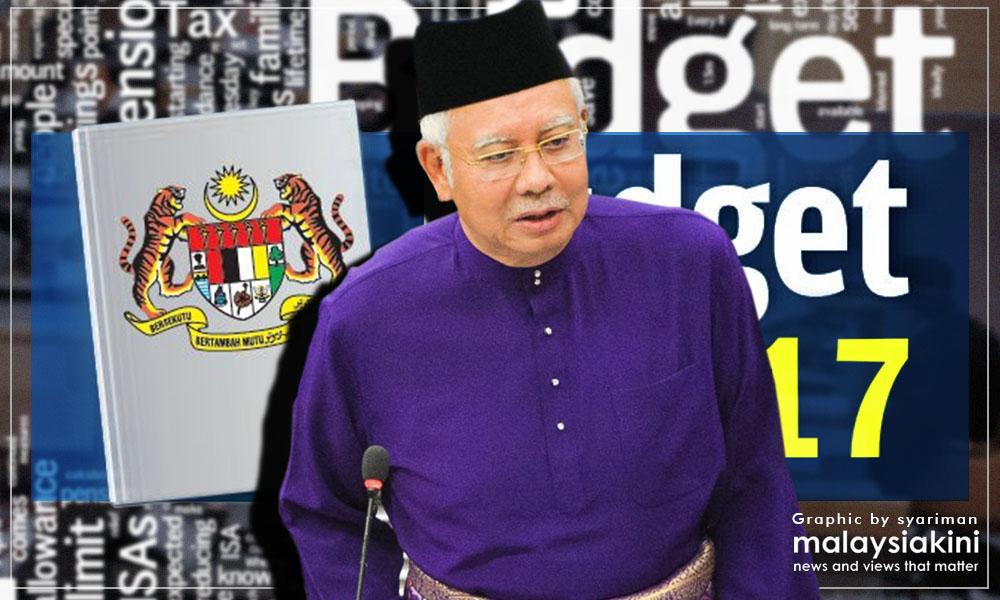

What to watch out for in Budget 2017
Budget 2017 is expected to be a tough one for Prime Minister Najib Abdul Razak.
Najib is faced with the task of allocating from a shrinking purse due to the oil price slump, but he must also consider the possibility of a general election next year.
An austerity budget in order not to break the bank and a goodies-filled pre-election budget are complete opposites.
Nonetheless, the prime minister needs to do a balancing act.
Malaysiakini takes a look at what to expect and what to watch out for when Budget 2017 is tabled tomorrow.
Budget 2017 is expected to be a tough one for Prime Minister Najib Abdul Razak.
Najib is faced with the task of allocating from a shrinking purse due to the oil price slump, but he must also consider the possibility of a general election next year.
An austerity budget in order not to break the bank and a goodies-filled pre-election budget are complete opposites.
Nonetheless, the prime minister needs to do a balancing act.
Malaysiakini takes a look at what to expect and what to watch out for when Budget 2017 is tabled tomorrow.
Which ministries will face cuts
After the 2013 general election, Najib moved to slash various subsidies, including for fuel, gas and sugar, in a bid to bring the country's deficit under control.
 Prior to the announcement of this budget, the subsidy for cooking oil has already been cut and its price is expected to hike in November. Further rationalisations are expected to take place.
However, a sudden slump in the global crude oil price not only threatens to reverse Najib's efforts but essential government services are increasingly finding funds hard to come by.
Putrajaya has downplayed talks of lack of medicines and the scaling back of blood tests at public hospitals, but such talks are cropping up with increasing frequency.
The government is also no longer providing scholarships for students to study overseas under the Public Service Department.
In Budget 2017, it remains to be seen if the cut on subsidies will extend to key services, such as education and healthcare, and by how much. But it will be a test of how serious our fiscal situation is.
The fiscal monster that is the PM's Dept
 Since Najib came to office in 2009, the budget for the Prime Minister's Department (PMD) has almost doubled, from RM12.2 billion in 2010 to RM 23.1 billion this year.
A further increase in the PMD's allocation in Budget 2017, at a time when various government agencies are facing cuts, will likely come under heavy criticism.
Pakatan Harapan in its alternative Budget 2017 believes the first cuts should come from the PMD.
It proposed to slash the PMD's budget by RM10 billion and gradually bring it down to RM5 billion.
The increased allocation over the years is due to factors such as the growing number of ministers – from six to nine – in the PMD since Najib's first cabinet.
It now has 51 divisions, some of which seem redundant, like the Land Public Transport Commission, when the Transport Ministry already exists.
Kluang MP Liew Chin Tong has repeatedly pointed out that the PMD controls RM7 billion in "slush funds" – allocations without detailed purposes, which allow the prime minister to spend according to his discretion.
How Najib plans to allocate funds for the PMD in Budget 2017 will reflect on how in tune he is with the people in these challenging times.
Taxes
The quick fix to resolve the country's revenue shortfall would be to increase the goods and services tax (GST) from the current six percent.
However, this is likely to hurt domestic demand amid indications of weakening consumer sentiment as the government's collection of GST in the second quarter fell by 30 percent compared to the first quarter of this year.
 Putrajaya, which is targeting RM39 billion for 2016, collected RM17.2 billion in GST in the first half of this year.
Furthermore, a GST hike will be a highly unpopular move ahead of a general election.
The government has repeatedly indicated that it plans to maintain the GST rate but this would require it to look at alternative sources of revenue.
The government already hiked taxes on the rich in Budget 2016, increasing the tax rate on millionaires from 25 percent to 28 percent and on those earning RM600,000 to RM1,000,000 from 25 percent to 26 percent.
It remains to be seen if the government will increase taxes further or impose new levies.
However, there has been speculation that corporate tax may be reduced from 24 percent to 23 percent in a bid to stimulate businesses.
BR1M
BR1M was introduced in 2012 as part of the government's attempt to move away from blanket subsidies to a more targeted one.
The RM500 vouchers to households with a monthly income of under RM3,000 in 2012 doubled to RM1,000 in the last budget, with new categories introduced.
 However, the cost to fund the cash handout has tripled, from RM1.8 billion to RM5.9 billion in Budget 2016.
There have been calls to scrap or reduce BR1M for higher income groups, such as the RM800 voucher for households earning incomes from RM3,000 to RM4,000.
However, this is unlikely to take place with a general election on the horizon.
The government is likely to maintain the sum, or increase it marginally, to keep voters happy, but not to the extent that it would put a dent on the federal budget.
Middle class concerns – Housing
Since the last general election, the government has intensified its resources for the middle class.
This is after urban voters, including Malays who make up Umno's traditional base, abandoned the ruling coalition.
The government has largely focused on public transportation and affordable housing.
While major public transportation projects are already underway, the government is expected to step up its efforts on ensuring people can afford their first home.
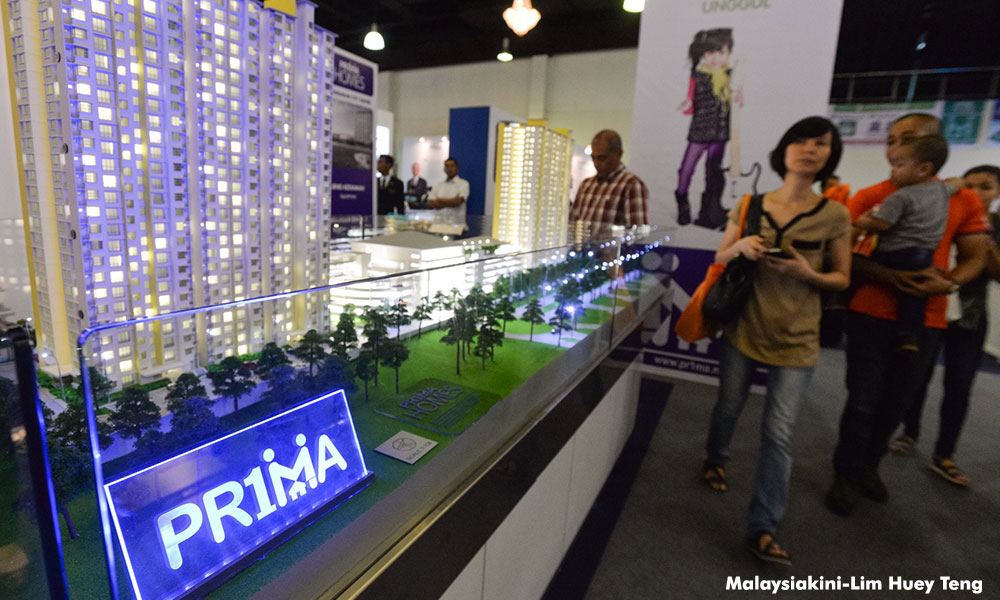 Apart from continuing with the PR1MA affordable housing programme, the government may take additional measures, such as increasing the allowable amount to withdraw from the Employees Provident Fund (EPF) from 30 percent to 40 percent, to purchase a first home.
Such measures will not cost the government money, but could have long-term repercussions, such as dwindling savings, among the people.
However, it is not clear if the government will continue with the RM30,000 subsidy for low income first-time house buyers, such as the MyHome and MyDeposit programmes, amid a tight revenue.
Furthermore, developers have aggressively lobbied the government to scale back its anti-speculation measures amid a slowing property market, including reintroducing the developer's interest-bearing scheme (DIBS) which allows buyers to pay no interest during the construction period of a property.
Cheaper cars?
Quoting sources, Sin Chew Daily reported that the government may impose zero percent excise duty on complete knocked down (CKD) cars – vehicles that are fully assembled locally – for first-time buyers.
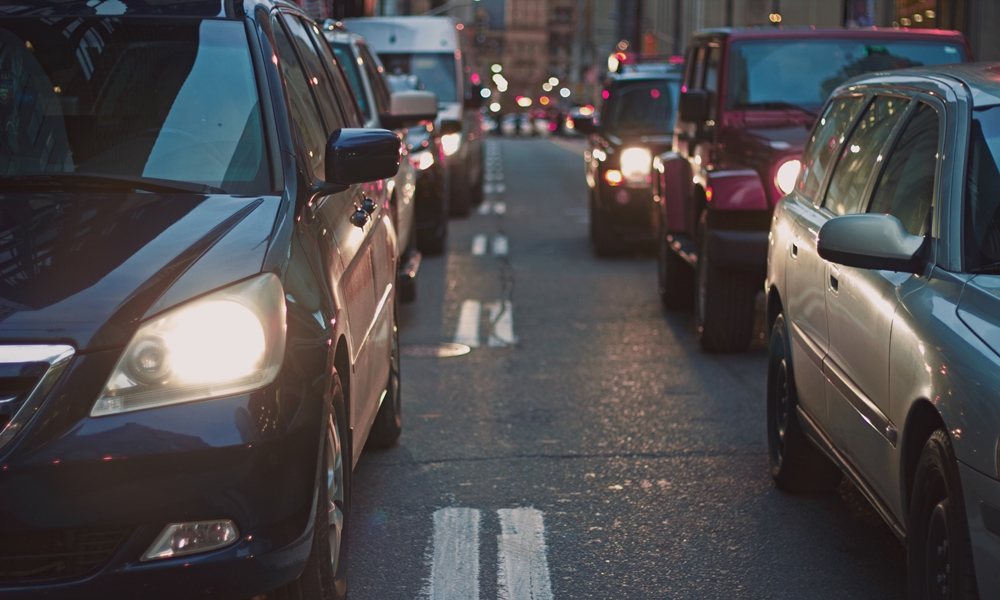 The report said this could translate to savings of a few hundred ringgit to up to RM2,000 for the consumer.
Based on the figures, it is more likely that first-time buyers for CKD vehicles may get a GST exemption or excise tax discount instead of an excise tax exemption.
This is because the lowest excise tax is 60 percent and providing an exemption even for the cheapest car would translate to five-figure savings, which is unlikely at a time when the government is faced with a tight budget.
According to the Federal Revenue Estimates, the government expects to collect RM7.3 billion in excise tax from vehicles this year.
Forgoing the six percent GST on CKD vehicles may boost government revenue, as such a move could stimulate purchase of the vehicles, which are still subjected to the 10-fold larger excise tax.
Election budget
It is customary for the government to give something for everyone in a pre-election budget, and Najib must call for the next general election before June 2018.
But with a tight revenue, even if the general election is to be held next year, Budget 2017 may not reflect this.
Nonetheless, the budget can still provide a strong indication of when the general election will be.
For example, the Election Commission's budget, which has ranged from RM35 million and RM45 million between 2010 and 2012 suddenly spiked by more than 10-fold to RM461 million in 2013.
If a similar trend is seen in Budget 2017, then it will almost certainly mean that the general election will take place next year.


