



Significance of passing AIIB Bill amid China-US race for dominance
As the United States and China jostle for power in the region, Malaysia appears to have taken a neutral stand in its foreign policy, especially in the South China Sea dispute.
However, on Wednesday, the Dewan Rakyat passed the Asian Infrastructure Investment Bank (AIIB) Bill, which is viewed as China's brainchild to counter the Trans Pacific Partnership Agreement (TPPA) that was drawn up by the US.
As the United States and China jostle for power in the region, Malaysia appears to have taken a neutral stand in its foreign policy, especially in the South China Sea dispute.
However, on Wednesday, the Dewan Rakyat passed the Asian Infrastructure Investment Bank (AIIB) Bill, which is viewed as China's brainchild to counter the Trans Pacific Partnership Agreement (TPPA) that was drawn up by the US.
In January, the Malaysian Parliament approved the country inking the TPPA, despite protests from various quarters.
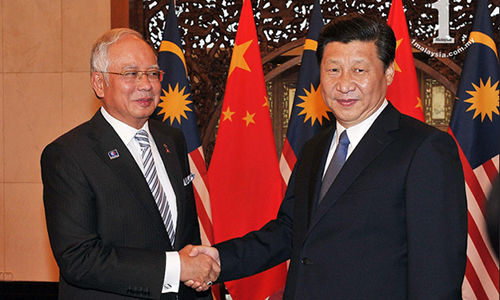
The passing of the AIIB Bill could not have come at a better timing as Prime Minister Najib Abdul Razak is scheduled to visit Beijing at the end of this month.
The move would be seen as a goodwill gesture on the part of the Malaysian government.
The seven-day working trip is Najib's seventh visit to Beijing since helming the government in 2009. He is slated to meet China's top leaders, inlcuding President Xi Jinping and Prime Minister Li Keqiang.
During the debate, several parliamentarians questioned how the AIIB would affect Malaysia's relations with China and the US.
However, Second Finance Minister Johari Abdul Ghani said the creation of the bank would not jeopardise the country's sovereignty.
As for the battle between the two titans in the region, diplomats view Malaysia's neutrality as unfavourable to US interest, as Washington wishes Putrajaya would pressure China to maintain the freedom of navigation in the South China Sea.
Beijing has been protesting against the freedom of navigation concept as it is seen as threatening China's sovereignty in the disputed area.
Najib, on the first day of the current sitting, told the Dewan Rakyat that Malaysia would not involve Western powers in resolving the dispute.
"No agreement with any country, including the US and Australia in terms of the South China Sea issue," Najib responded to a BN lawmaker.
The prime minister also reiterated that Malaysia and China have had a strong bond since 1974, when his late father Abdul Razak Hussein became the first prime minister and South East Asian leader to establish diplomatic ties with the Communist state.
To a question whether other superpowers would view Putrajaya as being too pro-China, Najib brushed off the perception.
In reality, he said China is becoming the global economic powerhouse, which would provide a huge market for Malaysia's palm oil and commodities.
"Should we need investment, tourists or others... from any country, the biggest source would be China. Hence, there is no question of over-reliance, but China is gradually becoming the biggest economy in the world," he pointed out.
To another question from an opposition lawmaker, Najib emphasised that Malaysia would apply the principle of Zone of Peace, Freedom and Neutrality (ZOPFAN) in the South China Sea dispute.
Since taking over the reins, the Najib administration has also maintained good ties with the US, and the prime minister had reportedly told a group of Malaysian students in New York in September last year that he was the only prime minister who had teed off with the US president.
On the same note, it cannot be denied that the relationship has become somewhat strained since the US Department of Justice initiated civil suit proceedings with regard to the alleged abuse of 1MDB funds.
This has led to speculation on whether it could tilt the balance as to Malaysia’s position in the contest between the two superpowers, especially with Chinese firms being involved in deals with the ailing 1MDB.
NG LING FONG is a member of the Malaysiakini team.


Are you sure you want to delete this comment?
This action cannot be undone.