



Civil servants get RM500 instead of bonus for second year running
Editor's note: This story is temporarily not compatible in app. Kindly view on mobile or desktop browsers.
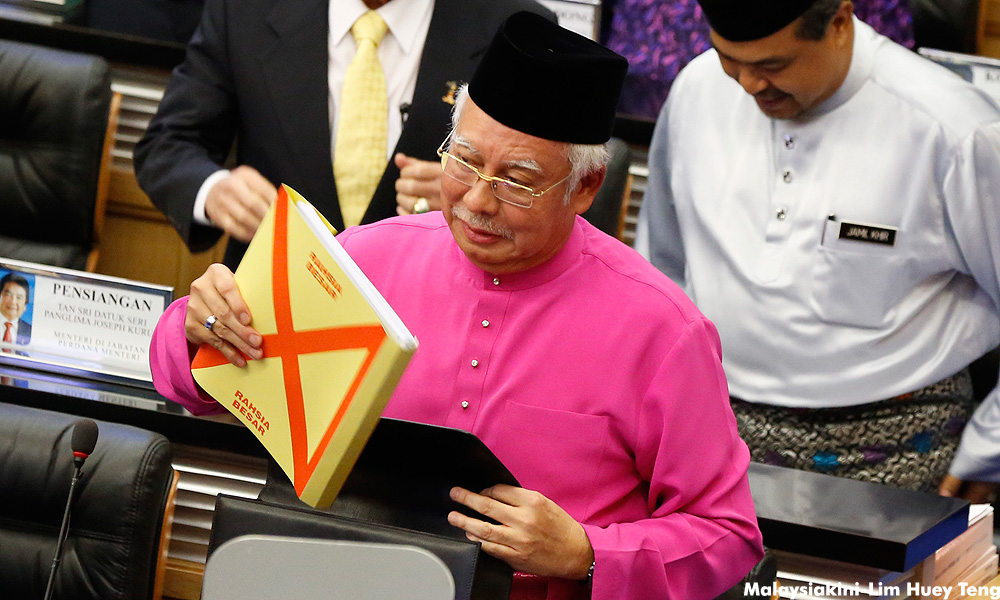
BUDGET 2017 Civil servants hoping for a bonus in Budget 2017 will be left disappointed as none was announced by Prime Minister Najib Abdul Razak.
However, the prime minister said a special assistance of RM500 would be paid to the 1.6 million civil servants.
"To the civil servants, I know you will have sleepless nights if I do not announce this. I have good news.
“As a token of appreciation for the commendable service by public servants, I am pleased to announce a special assistance of RM500 to all public servants and a special payment of RM250 for government retirees. This payment will be made in early January 2017," Najib added.
Editor's note: This story is temporarily not compatible in app. Kindly view on mobile or desktop browsers.
BUDGET 2017 Civil servants hoping for a bonus in Budget 2017 will be left disappointed as none was announced by Prime Minister Najib Abdul Razak.
However, the prime minister said a special assistance of RM500 would be paid to the 1.6 million civil servants.
"To the civil servants, I know you will have sleepless nights if I do not announce this. I have good news.
“As a token of appreciation for the commendable service by public servants, I am pleased to announce a special assistance of RM500 to all public servants and a special payment of RM250 for government retirees. This payment will be made in early January 2017," Najib added.
This is the second year civil servants are being given "special assistance" instead of bonuses.
The practice of announcing bonus for civil servants during the budget under Najib's premiership began in 2011, when he tabled Budget 2012.
By convention, Najib would announce the bonus or special payment for civil servants during Hari Raya and top it with more goodies during the budget.
In Budget 2012, Najib announced a month's bonus for civil servants, which was paid in August (Hari Raya) and December 2011.
Oddly, even though the budget was meant for the following fiscal year, the prime minister announced the bonus for the current year.
In Budget 2013, Najib announced a one-and-a-half months bonus.
However, if broken down by the year of payment, the bonus for 2012 was actually one month's worth - paid in August and December - while the other half month's bonus was paid in January 2013.
Including the bonuses of two years during the announcement was likely to create a "feel good" sentiment among civil servants ahead of the 13th general election, which took place seven months later.
In subsequent budgets, Najib announced the bonus for the following year, in accordance with the budget's fiscal year.
Half-month bonuses were announced for 2014 and 2015.
However, beginning 2013, the half-month's bonus announced in the budget was not matched with another half-month's bonus during Hari Raya.
Instead, a "special assistance" of RM500 was given during Hari Raya, and only to civil servants with Grade 54 and below.
In 2016, no bonus was announced in the budget, but a RM500 special assistance was provided. An additional RM500 was announced during Hari Raya.
However, civil servants with low salaries were given a raise as the minimum salary was increased from RM837 to RM1,200 while those with Grade 17 and Grade 27 saw their minimum salaries increase from RM935 to RM1,350 and RM1,362 to RM1,493 respectively.
Costly civil service
The Malaysian civil service is the single biggest expenditure in the annual budget and its cost has continued to climb under Najib’s leadership.
The budgeted emoluments, or salaries and other payments for civil servants, increased from RM42.2 billion in 2010 to RM77.4 billion in 2017.
To get an idea of the scale, the entire RM40 billion in goods and services tax (GST) Putrajaya expects to collect in 2017 will not be enough to pay for the civil service.
The government has repeatedly said it plans to let go of non-performing civil servants but has been cautious in its approach.
The civil service is considered a major vote bank for the ruling coalition.
Meanwhile, there was no change to individual income tax rates across the board in Budget 2017.
However, Najib announced a number of tax reliefs, including expanding it for the purchase of printed newspapers, smartphones, tablets, Internet subscriptions and gymnasium membership fees.
This would be known as the lifestyle tax relief, which would be combined with tax relief for the purchase of reading materials, computers and sports equipment.
The relief is up to RM2,500 a year, beginning for the assessment year of 2017.
A bi-annual tax relief for breastfeeding equipment up to RM1,000 will also be introduced.
In Budget 2010, Najib's first, he moved to reduce individual income tax rate for those earning more than RM100,000 a year from 27 percent to 26 percent.
There was no change for other income earners. This remained as it is until 2012.
Budget 2013 saw an emphasis on low income earners as the tax rate for those earning less than RM50,000 a year was reduced.
Those earning less than RM5,000 no longer had to pay individual income tax.
Those earning RM5,001 to RM20,000 had their tax rates reduced from four to three percent, RM20,001 to RM35,000 (seven to six percent) and RM35,001 to RM50,000 (12 to 11 percent).
Budget 2014 announced a reform to the tax structure, with an emphasis on the middle class, but this was not implemented.
The exact same announcement was repeated in Budget 2015, which saw the tax rate for those earning RM50,001 to RM70,000 and RM70,001 to RM100,000 reduced by three percent from 19 percent and 24 percent respectively.
The other reductions included for those earning RM100,001 to RM250,000 (26 to 24 percent), RM250,001 to RM400,000 (26 to 24.5 percent) and those earning above RM400,000 (26 to 25 percent).
The tax rate on the rich was increased significantly in Budget 2016, amid the oil price slump, with a three percent hike for millionaires and one percent increase on those earning between RM600,001 and RM1 million from 25 percent respectively.


Are you sure you want to delete this comment?
This action cannot be undone.