




Penang jetties - soon-to-be 'ghettos'
The proposed development project at Koay Jetty and its depleted mangroves in George Town would become the most congested high-density housing project in Penang.
The proposed development project at Koay Jetty and its depleted mangroves in George Town would become the most congested high-density housing project in Penang.
The 165-unit per acre development project, which is far higher than the skyline limit set by the Penang Island Municipal Council, will have a higher density than other housing settlements in the state.
Once completed, the project would transform Koay and Peng Aun jetties into a high dense housing area featuring 2,315 high-rise residential units.
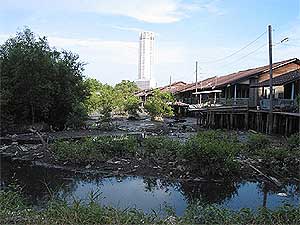 Under the proposal, the new township would be developed within the next four years with commercial lots and a transportation hub that includes a monorail link to Butterworth.
The high density housing project outlined in the proposed plan by the developer, Metrodel Development Sdn Bhd, is far higher than the skyline limit set by the Penang Island Municipal Council.
"The local council owes a public explanation for this," said Save Ourselves (SOS) secretary Ong Boon Keong.
SOS is a small but active grouping of social activists who regularly raise issues affecting residents in Penang.
Traffic congestion
 Ong warned that the project, slated next to an already highly dense housing area, Gat Lebuh Macallum, would only worsen the traffic congestion in the in the Weld Quay area as there is only one access road to enter and exit the city.
"The last thing Penang residents want is a Rifle Range-type ghetto at their footsteps," he said.
Rifle Range has a total 3,888 flats, comprising nine-blocks of an average 432 per block, or 94.37 unit per acre. The project was built on a 16.48ha site in the1960s to cater for the needs of the lower income group.
Gat Lebuh Macallum was developed in the 1990s and consists of 4,500 flats on a 24ha coastal site or 75 units per acre.
The proposed Koay Jetty housing development would have 2,315 units in four blocks on a 5.6ha or an average 165.4 units per acre.
Ong expressed shocked that the authorities have discussed little about whether the limited land of 14 acres was suited for such a high dense project.
Misinforming locals
He accused the state government of misinforming locals on the project.
"Many locals in turn have been misguidedly supporting the project blindly thinking that it would offer them the much sought after affordable houses," he said.
Local municipality housing guidelines allow 30 units per acre while in exceptional circumstances it allows up to 120 units per acre.
However, Koay Jetty housing density overshoots even the exceptional limit.
Besides traffic congestion and unhealthy living conditions, Ong warned that cramping up too many low income groups together in a high dense housing area would lead to social and environmental problems.
"It seems that these special treatment to overlook the density limitation was motivated to generate profits for a private developer.
"The state government and local council had sacrificed the people interests and allowed a private developer to create a urban ghetto for residents to live for years to come," he said.
'Ghost city'
The Koay and Peng Aun jetties, which have about 50 houses and 350 residents, are the last line of jetties situated in a row of eight early Chinese clan settlements located between the ferry terminal and Lebuh Noordin flats.
The jetties of the Lim, Chew, Tan, Lee, New and Yeoh clans fall within the heritage zone demarcated in George Town and will be preserved.
The site is part of a 10ha area earmarked for a grand project to turn the area, which also encompasses the Noordin Street Ghaut site and Prangin estate, into a new commercial-cum-housing and transportation hub at the south-eastern part of the city.
The project is part of the state government's efforts to rejuvenate George Town, which has rapidly turned into a 'ghost city' since the Control of Rent (Repeal) Act 1997 was enforced on Sept 1 that year.
 The state government have cleared the mangroves, which was the habitat of 30 protected species of migratory birds, including close to 200 endangered black-crowned night herons, and a range of marine life, including crabs.
The state wildlife department has relocated the herons and other migratory birds to the state national park, to pave the way for the developer to clear the mangrove area, the only one left in the inner city of George Town, which was originally a mangrove area.
The Support Koay Jetty and Mangrove Action Group, which comprises 10 non-governmental organisations, have been protesting the project from the beginning and even proposed an alternative plan to turn the site into a world-class heritage and nature park.
The proposal has been submitted to Prime Minister Abdullah Ahmad Badawi.
However, cries of the lobbyists, comprising the Penang Tourist Guides Association, Malaysian Travel Trade Association Penang Chapter, Penang Heritage Trust, Baiqi Koay Cultural Revitalisation Ad-Hoc Joint Committee, Malaysian Nature Society (MNS) Penang branch and Malaysian Chinese Muslim Association, had fell on deaf ears.
ATHI VEERANGGAN is malaysiakini 's Penang-based stringer.


Are you sure you want to delete this comment?
This action cannot be undone.