



No fuss over indelible ink if renamed 'election ink', suggests EC officer
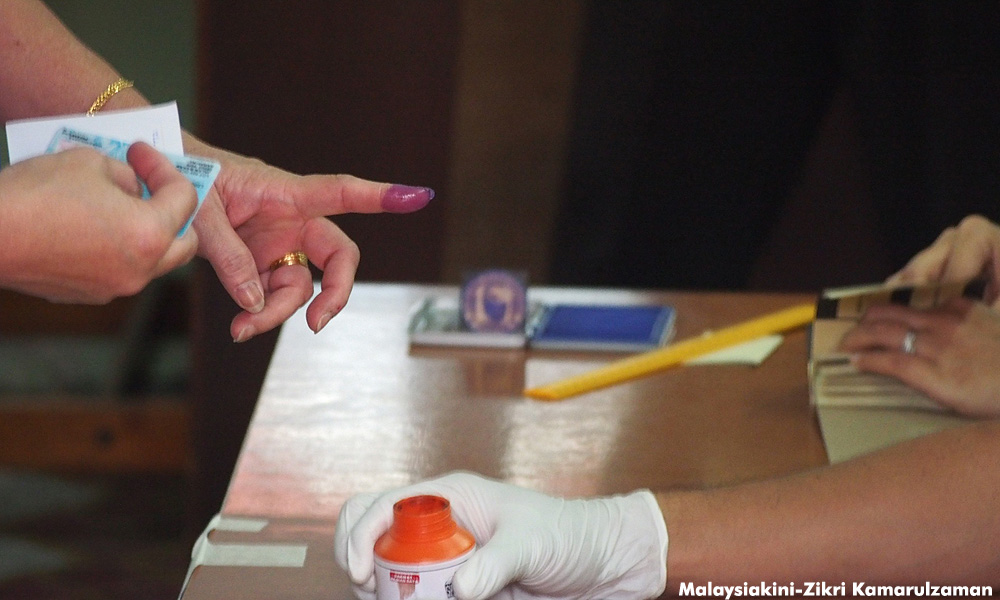
The fuss over how the indelible ink used in the 2013 general election could be easily washed off, may have been avoided with a name change, a representative from the Election Commission has suggested.
"Maybe if we had named it election ink, there would have been no problem.
"It is terminology wrongly chosen by us. For that we apologise," Hasanul Isyraf Naim from the EC’s Election Academy told the audience during a talk addressing criticisms against the EC at Akademi Kepimpinan Hussein last night.
Speaking at the event organised by BN Youth Volunteers, which was uploaded via Facebook Live on the BN Youth's FB page, Hasanul said the ink used to mark the fingers of voters to prevent double voting would last for one day, during the course of normal daily activities.
But he said the ink can be removed if someone were to diligently use chemical or physical means of scrubbing it off.
Only those determined to prove that the ink was not 'permanent' would resort to such measures, he added.
The fuss over how the indelible ink used in the 2013 general election was easily removed, could have been avoided with a name change, a representative from the Election Commission has suggested.
"Maybe if we had named it election ink, there would have been no problem.
"It is terminology wrongly chosen by us. For that we apologise," Hasanul Isyraf Naim from the EC’s Election Academy told the audience during a talk addressing criticisms against the EC at Akademi Kepimpinan Hussein last night.
Speaking at the event organised by BN Youth Volunteers, which was uploaded via Facebook Live on the BN Youth's FB page, Hasanul said the ink used to mark the fingers of voters to prevent double voting would last for one day, during the course of normal daily activities.
But he said the ink can be removed if someone were to diligently use chemical or physical means of scrubbing it off
Only those determined to prove that the ink was not 'permanent' would resort to such measures, he added.
Hasanul admitted that stronger chemicals were available to ensure longer-lasting stains, but the EC settled for a milder version as such substances may be harmful.
In any case, he explained, the EC was hoping to fight "fire with water" by addressing criticisms against it through explanations and talks such as this.
He said the distrust the public had towards the EC was influenced by gossip.
"Malaysians like to hear gossip," he said, adding that the people tended to believe what others said over what was actually happening.
Popular ill-informed beliefs about EC
Hasanul went on to debunk what he said were popular but ill-informed beliefs about the EC and elections in Malaysia.
First off the bat was the use of serial numbers on ballots to allow the EC to know who voted for whom.
Brushing this off, he said serial numbers were not sequential to the voter's list and cannot be matched to individual voters as ballot paper batches are randomly distributed.
The EC secretariat officer also attacked allegations of "phantom voters", saying no one had ever managed to prove this true.
 He clarified that all those whose names are on the voter list are referenced to the National Registration Department (NRD).
He reminded that it is no small thing to accuse a person holding an IC to be a foreigner in disguise, as it could lead to embarrassing situations.
However, Hasanul admitted that the EC voter's roll is not perfect as it does contain names of dead people, whose deaths have not yet been verified with a death certificate for various reasons.
He noted that voters who were onboard flights MH17 and MH370 are still in the electoral roll as there has been no official confirmation of their deaths, without death certificates issued by the NRD.
The EC officer also tackled rumours about blackouts at polling centres.
As most polling centres end the counting just after 7pm, there is ample daylight to count the votes cast, making the lack of lighting moot, he said.
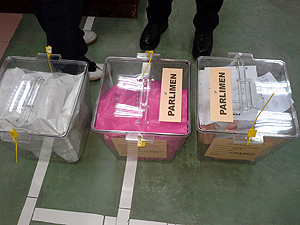
Hasanul reiterated that even if a blackout were to occur and counting was extended into the night, safeguards like Form 13, which lists the total ballots and serial number batches, prevent anyone from "stuffing in more votes" into the transparent ballot boxes during a blackout.
Counting cannot begin until all present agree on the details on the number of ballots and their origin from the original ballot paper batches. "Extra" ballots with erroneous serial numbers would be removed.
"The ballot box does not mean anything, the ballot paper means nothing," he said, addressing rumours of ballot box tampering after counting had been done.
EC does not acknowledge Bersih
Hasanul argued that with counting done at polling centres, the results are officially recorded on Form 14 and a copy given to all polling agents for verification before the ballot boxes are transported to the tally centre.
Asked to explain about Bersih and its relationship with the EC, Hasanul said the commission neither entertains nor acknowledges the pro-electoral reform coalition.
He said the groundswell of support for Bersih was caused by the play of sentiments by the movement, similar to the Reformasi movement of the past.
Hasanul said that most youth do not know what they are doing in Bersih rallies and that they were there only because they were drawn to the "fun" of being part of a large crowd.
The EC officer said that outreach programmes, such as the talk with the BN Youth, was the EC’s way of reaching out to the public and informing them about the misconceptions about the EC and elections held in the country.


Are you sure you want to delete this comment?
This action cannot be undone.