




Report: Rank-and-file cops more prone to graft
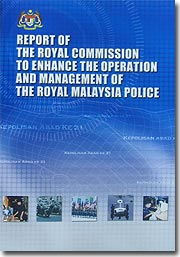
Rank and file police personnel are largely ignorant of what constitutes corrupt practice, revealed the Royal Commission to Enhance the Operations and Management of the Royal Malaysia Police.
Rank and file police personnel are largely ignorant of what constitutes corrupt practice, revealed the Royal Commission to Enhance the Operations and Management of the Royal Malaysia Police.
In its report released yesterday, it found that corruption awareness was "significantly low" at all levels of the police force particularly among the rank and file.
 Citing a few scenarios, it said the rank and file's integrity is lower than officers as the former accepted free drinks/meals from shops while patrolling, conducting business after office hours and accepting festive gifts/hampers, among others.
This finding was based on the 98 complaints of corrupt practices received by the 16-member commission chaired by former chief justice Mohamed Dzaiddin Abdullah.
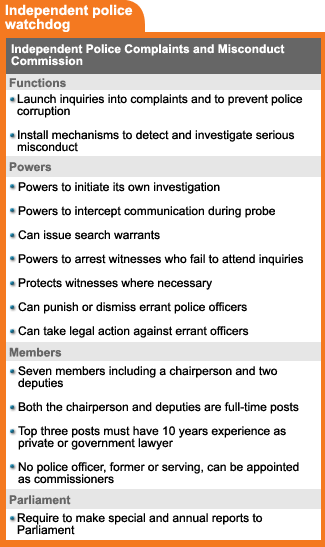
The commission has made a total of 125 recommendations, including a draft bill for a statutory commission specifically to handle public complaints on police misconduct.
'Overworked' cops
As of last March, the commission received over 1,200 complaints via letters, e-mails and public inquiries, the bulk of which were over the lack of follow-up action on reports filed (312), abuse of power (191) and inefficiency and lack of accountability (186).
Many felt that the police failed to follow-up on reports they have lodged but the commission found that a failure to update complainants had created that impression.
The police also allegedly said they were unable to provide updates on reports for fear of jeopardising investigations or that it would be given later once investigations were completed.
The commission, whose one-year tenure officially ended on May 3, also received feedback on custodial deaths (20), poor public relations (119) and suggestions totalling 319.
The delays in taking action or the lack of follow-up, the commission noted, was due to the shortage of resources needed to discharge a wide scope of enforcement duties assigned to them which include immigration and traffic laws.
"Police personnel claimed that they are overworked and have too many cases to handle," said the commission in the 607-page report.
 To overcome the lack of updates, a proposed Section 107A to the Criminal Procedure Code has been tabled in Parliament requiring the station chief to provide the complainant with a progress report on an investigation within two weeks of a request.
The commission, in supporting the proposal, said it should be in the Police Act 1967 instead.
Public relations
In the case of poor public relations, the police was told to give a free copy of a report instead of being seen of making a profit by charging RM2, to improve on counter services, to be more sensitive towards informants or victims and to enhance questioning methods and crowd control.
The commission said illiterate informants or those who were unable to write in Bahasa Malaysia were "rudely told off, humiliated and subjected to verbal abuse and often, their attempts to make a report are not entertained until (he/she gets someone else to help)".
Another example is where a lady wanted to report a few boys who were disturbing and harassing her daughter but was instead "rudely scolded" and told that nothing could be done as no injuries had been sustained.
"The policeman even told her to move away from the area," said the commission.
The police were also noted for being insensitive of victims' feelings or making inappropriate remarks.
In one case, two officers escorting a rape survivor to hospital for a medical examination pointed to her and said loudly ' rogol ' (rape) when asked by colleagues based at the hospital.
Another example is of a woman who went to report her missing husband but was instead asked if he had a mistress and why she, being pretty as she was, was not looking for another man.
Another public relations nightmare involved a schoolteacher who was picked up at random and in an uncivilised manner while having tea with his students at a roadside stall.
The commission said he was asked to get into the police truck "in full view of his students" and without any explanation and much to his embarrassment.
Chain-remands
Noting an administrative directive dated March 14 last year, the commission said refusal to take down or accept a report amounts to a disciplinary offence.
The increasing trend of chain-remands, either by applying to different magistrates for renewal of remand orders each time or moving detainees to another station for other cases were noted as an abuse of power and authority.
The commission said a complainant had described a police check points as "cekik (strangulation) points" due to the extent of abuse of power by personnel.
A public survey conducted by the commission, which said the estimated 878,000 crime victims in urban areas was "a matter of grave concern", showed an increasingly poor crime reporting rate of about 75 percent compared with almost 83 percent pre-2004.
The general reluctance is because reporting a crime is considered too troublesome or that the police is unable to do anything or won't provide assistance, or because it is not a serious crime.


Are you sure you want to delete this comment?
This action cannot be undone.