




Police commission could have done more
The Royal Police Commission' report has not done enough to focus on the gravest forms of human rights violations associated with the police force, such as deaths in custody and by trigger-happy police officers, said a vocal lawyer today.
The Royal Police Commission' report has not done enough to focus on the gravest forms of human rights violations associated with the police force, such as deaths in custody and by trigger-happy police officers, said a vocal lawyer today.
 "We see this report as half a loaf of bread, which is better than nothing. The focus on bringing down corruption in the force is especially commendable, as are the recommendations to repeal or review repressive laws such as the Emergency Ordinance," said P Uthayakumar, who is legal advisor to the Police Watch and Human Rights Committee Group.
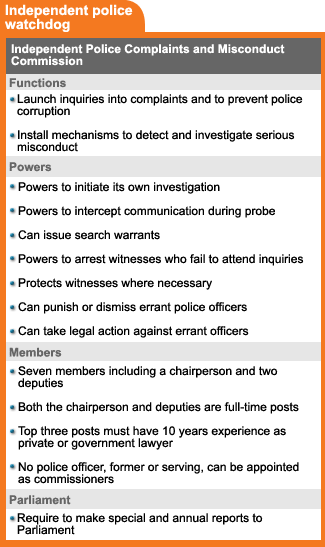 He also expressed concern on the implications to lawyers brought upon by the conditions outlined in Part V of the Independent Police Complaints and Misconduct Commission (ICPMC) draft bill, where advocates or solicitors are compelled to surrender information to the committee, failing which they may be slapped with a fine of RM2,000 or one year's imprisonment.
"This goes against the vein of lawyers working without fear or favour, not to mention being potentially detrimental to the safeguarding of the confidentiality that is so vital in the relationship between client and attorney," he said.
Taking to task the singling out of lawyers in this issue, he asked: "Why are there no similar provisions for members of the police force? There needs to be a mechanism to compel them to disclose information as well. After all, who is being investigated, the police or lawyers?"
He also decried the scope of offences to be dealt with by the proposed commission, which is confined to matters pertaining to disciplinary matters and not criminal abuse of police personnel.
"Right now, if a police officer were to murder someone in detention, it is up to members of the police force themselves to conduct investigations. There will be nothing to stop anyone from falsely citing lack of evidence, as seen from the piles of cases classified as such by the Attorney-General's Chambers. This impedes the delivery of justice.
"If formed, the ICPMC must have its own investigation and prosecuting unit, similar to those in agencies such as the Anti-Corruption Agency and Employees Provident Fund. Only then will they be able to tackle the pressing issue of criminal abuse by police officers in an independent and transparent manner. If not, we will still be stuck at square one."
Swift translation
Meanwhile, human rights advocacy group Suara Rakyat Malaysia (Suaram) lauded the release of the report of and suggested swift translation of its recommendations into action.
 Programme officer S Arutchelvan said he considered the proposal for the
ICPMC
to be the most important feature of the report by the Royal commission to enhance the operation and management of the Royal Malaysian Police.
Programme officer S Arutchelvan said he considered the proposal for the
ICPMC
to be the most important feature of the report by the Royal commission to enhance the operation and management of the Royal Malaysian Police.
"The existence of the complete draft bill (on the ICPMC) is commendable and augurs well for its tabling in Parliament in the near future. We welcome it as a public complaints mechanism with wide ambit to take direct action against members of the police force who violate the law," he said when contacted.
"The appointment of the commission's members must be made in a transparent manner, and the commissioners should have a sound track record in upholding human rights."
While lauding the recommendation to repeal the Restricted Residence Act and Emergency (Public Order and Prevention of Crime) Ordinance, he questioned the exclusion of the Internal Security Act (ISA), which allows for detention without trial.
'Repeal more laws'
Since the ISA is similar to the Emergency Ordinance in terms of its authorisation to detain someone, it should be repealed as well, Arutchelvan said.
However, the report merely proposes a decrease in the initial period of detention for purposes of questioning, from 60 to 30 days.
"Although this is a good start, we fear that it may not be able to tackle the problem of abuse during detention. Our experience has shown that detainees are subject to the most severe forms of abuse during this period of detention."
Arutchelvan said the recommendation to allow ISA detainees access to a magistrate within 24 hours is also commendable but noted that this fails to specify the power of the magistrate in these situations, "specifically to declare such detentions unlawful".
He also urged the repeal of the Dangerous Drugs (Special Preventive Measures) Act, under which the commission has also recommended a maximum detention period of 30 days.
Arutchelvan expressed concern about the efficacy of implementation of the recommendations, given the fate of two similar entities in the past.
"Setting up a task force (under the premier Abdullah Ahmad Badawi) would not suffice in ensuring implementation. There should also be quarterly or biannual reports to track progress under each of the 125 recommendations," he added.
"This is to prevent the recurrence of situations where strong recommendations are left without implementation similar to what happened to the Royal Commission of Inquiry into the explosions at the Bright Sparklers Factory in 1991 and the Royal Commission of Inquiry into the Workings of Local Authorities in Peninsular Malaysia in 1968."
Special session
 Opposition Leader Lim Kit Siang
said
Parliament should be allowed to play its role in creating a revitalised, modern, effective and trustworthy police force.
Opposition Leader Lim Kit Siang
said
Parliament should be allowed to play its role in creating a revitalised, modern, effective and trustworthy police force.
"Abdullah should convene a special three-day parliamentary debate next month to do justice to the commission, its report and recommendations and to establish a parliamentary mechanism to oversee reform to transform the 100,000-strong force into a modern, world-class institution," he said in a statement.
Lim suggested that Parliament should convene three days before or after its next session scheduled from June 20 to July 12.
He noted that the commission has set deadlines - 22 of the recommendations are to be implemented by December, and include a pro-active anti-corruption strategy; review and strengthen the anti-corruption mechanism in the disciplinary division of the police force; and regular job rotations and limitation of tenure.
"If the government accepts all the recommendations, it must also accept the respective dates of completion for implementation..."...the next six months will be an acid test as to whether Abdullah is serious (about this)," he said.
Lim said IPCMC draft bill should be tabled in the next parliamentary session so that the seven-member commission can be established by the last quarter of the year to receive and investigate complaints against the police.
The commission, headed by former chief justice Mohamed Dzaiddin Abdullah, inquired into the role, functions and organisation of the police force and compiled its report based on feedback from the public, among other sources. The report was released yesterday .


Are you sure you want to delete this comment?
This action cannot be undone.