




An independent watchdog on the police force
The Royal Commission to Enhance the Operation and Management of the Royal Malaysia Police has recommended the formation of an independent agency to oversee public complaints against the police.
The Royal Commission to Enhance the Operation and Management of the Royal Malaysia Police has recommended the formation of an independent agency to oversee public complaints against the police.
The principal functions will be to hold inquiries into public complaints, curb police corruption, and formulate mechanisms to detect, investigate and prevent serious misconduct.
Misconduct would be deemed to be "by way of action or inaction or alleged action or inaction" of a police officer suspected of being involved in activities that are not limited to police corruption or any corrupt act within the meaning of the Anti-Corruption Act.
Other misconducts include the commission of criminal acts, breaching of police rules and failing to adhere to the provisions of the Police Act.
 Tentatively named the Independent Police Complaints and Misconduct Commission (IPCMC), the body would have a maximum of seven members including a chairperson and two deputies for a term to be specified in the appointment letter.
Each may remain a commissioner for a period not exceeding two consecutive three-year terms. Both the chairperson and deputies will hold full-time posts.
The chairperson or deputy must have, at least 10 years' experience as a private or government lawyer, preceding appointment by the King on the advice of the prime minister.
No police officer, former or serving, can be appointed as a commissioner. The same goes for members of Parliament or members of state legislative assemblies.
The involvement of police officers, whether serving, former or retired, is only possible through consultancy services or in the work outlined by the commission's task forces.
The draft bill provides for the appointments of, among other secretariat staff, legal counsel from among the judicial and legal service or private practitioners.
Annual reports to Parliament must be submitted by July with a copy to the prime minister and the King.
Power to act
One interesting provision is the commission's power to initiate its own investigations even without any police officer being implicated or suspected of misconduct.
Following a finding of guilt, the commission can order a caution and discharge the police officer, deprive him/her good conduct badges and allowances, stop a salary increment or forfeit one that has been approved and reduce his/her rank.
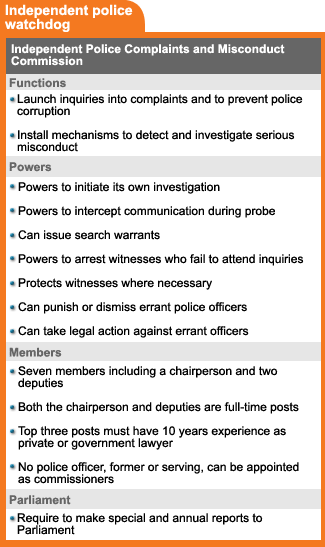 The commission can also impose a fine equivalent to one month of the basic pay, severely reprimand the person concerned and transfer duties or dismiss the officer.
Interestingly, the commission will have the power to investigate not only the suspected police officer on duty within Malaysia but also those off duty and outside the country, including non-police participants. Probes into complaints will have a retrospective effect.
Upon finding a complaint justified, the commission may either refer its recommendations to the police force's disciplinary authority or seek its chief legal counsel's advise on pursuing legal action against the officer concerned.
In a situation where the commission directs the Inspector-General of Police (IGP) not to investigate a complaint, it takes over the probe from him and does not need to disclose anything to him.
Following a recommendation for action to the IGP and a subsequent failure to do so within a given time, the commission can report to the internal security minister who is required to act within 28 days, failing which the commission will report to Parliament.
The commission can apply to High Court for an injunction or restraining order against anyone involved in activities that affects a probe or a potential investigation.
Legal representation is allowed for anyone who appears before a hearing, be they individuals or interested groups.
Fewer formalities
The proposed body is also designed to address complaints and conduct public inquiries in a less adversarial manner with as little formality and technicalities involved without being bound by the rules or practice of evidence.
Inquiry hearings can be held in public or in private, or partly both.
Besides auditing and monitoring specific aspects of police operations and procedures, the body will advise the government on laws and the necessary administrative directives and procedures.
It will also "study and verify" any infringement of police procedures, corruption and misconduct.
Some of the proposed functions may, however, overlap with those of the Human Rights Commission of Malaysia (Suhakam), such as visits to police stations and lock-ups.
One difference compared to the Suhakam Act which prohibits involvement when a complaint becomes a court case is the commission's power to decide whether to commence, continue, discontinue or complete the probe.
The commission will also have powers to intercept, detain and open all communications either via postal services, electronically transmitted messages such as sound, data, text, visual images, signals or any such combination.
It also includes intercepting, detaining and opening communications through the use of any electronic, mechanical or other equipment, device or apparatus.
On the power to investigate and search, lawyers are required to disclose information "notwithstanding any other written law" as long as it forms the subject matter or is related to a complaint.
Refusal to give information during a commission inquiry is considered an offence punishable with a maximum fine of RM10,000 or two years in jail, or both.
The commission will undertake to protect witnesses where it deems necessary, including a provision on secrecy which ensures that confidentiality is maintained by all commissioners, lawyers and groups involved.
The draft bill states that other secrecy laws would not apply for the purposes of this Act.
It also provides for co-operation of inter-agency law enforcement, particularly the Anti-Corruption Agency, the Auditor-General, Bank Negara, Securities Commission, foreign police force and any federal or state authority.
The commission can also co-operate with education institutions and consult with or disseminate intelligence and information to investigative agencies it thinks appropriate on a confidential basis.


Are you sure you want to delete this comment?
This action cannot be undone.