




Gov't to remove tariffs on Japanese cars by 2015
Malaysia and Japan today sealed the outline of a free-trade agreement (FTA) that will open up a major new market for Japanese automakers with the lifting of heavy tariffs on Japanese cars within 10 years.
Malaysia and Japan today sealed the outline of a free-trade agreement (FTA) that will open up a major new market for Japanese automakers with the lifting of heavy tariffs on Japanese cars within 10 years.
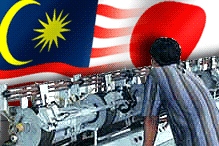 Prime Minister Abdullah Ahmad Badawi and his Japanese counterpart Junichiro Koizumi signed off during a Tokyo meeting on the FTA outline hashed out in weekend negotiations in Kuala Lumpur.
The major sticking point was on tariffs that effectively make Japanese automakers minor players in Malaysia, a major vehicle market that has historically used high taxes to protect its domestic industry.
In turn, Japan will open up its tightly controlled agriculture sector.
"It will definitely contribute to our economy, in the form of investment and in the form of joint ventures," Abdullah said of the FTA.
"It will build confidence among businessmen in Malaysia," he told reporters after his meeting with Koizumi.
"We are going to see more trading and investment activities between Japan and Malaysia in the future."
Final negotiations
He said the broad principles of the FTA were set and that final negotiations would be concluded by the time Koizumi visited Kuala Lumpur in December for an inaugural East Asia summit.
 "What we need to do is to print it in some kind of a legal language to make it a proper document," Abdullah said.
A Japanese official said separately: "Both sides are happy with it and want to sign it as soon as possible."
The agreement said Malaysia will immediately, as of the formal signing of the FTA, eliminate tariffs on knocked down auto parts for Japanese carmakers in Malaysia.
It will completely eliminate tariffs on Japanese finished cars by 2015, "starting with the larger ones," a joint statement said.
Under the deal, "Japan will offer cooperation to the Malaysian autos and auto parts industry to strengthen its competitiveness," it said.
Malaysia already cut import duties to 20 percent on cars made in the Association of Southeast Asian Nations (Asean) on January 1 as part of market liberalisation under the Asean Free Trade Area.
However, it raised excise duties on all new cars sold in the country to offset an expected fall in revenue but the new tax structure has been put on hold after complaints from local auto firms that it provides little incentives for them to produce or assemble cars in the country.
The FTA outline said that tariffs "on most agricultural, forestry and fishery products" will be eliminated within 10 years between Japan and Malaysia.
Eliminate tariffs
With immediate effect, Japan will eliminate tariffs on a number of Malaysian fruits and vegetables including mangoes, papayas and okras.
The FTA also calls for the two nations to step up technical cooperation in fields ranging from education to science to tourism. It said Japan will take in 1,000 Malaysian trainees in the next 10 years in a programme named after the two prime ministers.
The head of Japan's most prominent business lobby, Nippon Keidanren, welcomed the FTA.
"Especially in terms of trade of goods, the agreement realizes a high level of liberalization to make bilateral economic ties more profound," said Hiroshi Okuda, who is also chairman of Toyota Motor, Japan's largest automaker.
"We hope that (agreements) with other East Asian countries such as Thailand will result in an agreement level as high as this one," he said in a statement.
Japan entered its first FTA only two years ago with Singapore. Japan's second free trade deal went into force in April with Mexico, seen as a gateway to the US market.
Japan has also reached a draft agreement with the Philippines on a bilateral free trade deal, which would allow Filipino nurses and careworkers to work in Japan. Negotiations have also been held with Indonesia, South Korea and Thailand.


Are you sure you want to delete this comment?
This action cannot be undone.