




Umno wants it all, claim Penang opposition leaders
The suggestion to rotate the Penang chief minister's post among Barisan Nasional (BN) component parties is being seen as a wake-up call to Gerakan to replace state leader Dr Koh Tsu Koon with someone 'more capable'.
The suggestion to rotate the Penang chief minister's post among Barisan Nasional (BN) component parties is being seen as a wake-up call to Gerakan to replace state leader Dr Koh Tsu Koon with someone 'more capable'.
Local opposition leaders contacted said they believe that the suggestion is indication that Koh is deemed to be politically weak as a state leader.
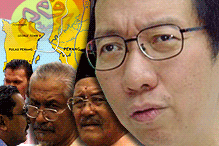 Bukit Mertajam Umno leader Musa Sheikh Fadzir, who made the call recently at the division's annual general meeting, said a rotation system in Penang - like that was practiced in Sabah - would prove that the ruling coalition espouses tolerance and understanding among its partners.
His suggestion, however, was not presented as the division motion.
This prompted Deputy Chief Minister and state Umno liaison committee deputy chairperson Abdul Rashid Abdullah to say the matter could not be taken up for debate at the party's general assembly. However, it could be studied at other levels to obtain feedback.
Penang DAP organising secretary Danny Law Heng Kiang said it was time for Gerakan to replace Koh with a stronger leader.
"When an Umno division can call for rotation of the chief minister's post a la Sabah, it shows that Koh is a political liability to both Gerakan and the Chinese community in Penang," Law said when contacted.
"This could not have happened during the era of Koh's predecessor, Dr Lim Chong Eu."
Law said Musa's suggestion has made a mockery of BN's electoral promise to voters in Penang that the chief minister's post would remain in the hands of a non-Malay.
"Musa's call is very disturbing. It reveals that Umno is power crazy and hell-bent on monopolising power throughout the country," he said.
Law warned that, if the rotation system is implemented, Umno would effectively `hijack' the chief minister's post, as happened in Sabah in the 1990s.
"If Koh remains in power, Penang will have an Umno chief minister for the first time after the next general election," he warned.
Real power
 Parti Keadilan Rakyat state deputy chairperson Cheah Kah Peng said Koh's weak leadership and failure to spearhead Penang's move to achieve developed-state status has exposed him to justified criticism over the past 15 years.
He said Umno has been the "real power" behind the chief minister since 1990.
"This is a wake up call for the people of Penang that Umno wants to dominate all," he said.
Cheah said local Umno leaders had frequently claimed that Koh's government has neglected and marginalised the interests of the Malay community in Penang.
However, he alleged that the community has been the biggest beneficiary of state policies, with bumiputera-owned companies having benefitted from contracts for developments projects in township development, landscaping, car parks and garbage collection.
"Indian Malaysians in Penang are the ones more marginalised and neglected by the state government," he added.
In Penang, Umno controls the two municipal councils, having appointed civil servants to the post of president in each. In the past, the posts were held by political appointees.
The party is the largest in the state, holding 14 state and five parliamentary seats, and thereby dominating the legislative assembly.
Gerakan has only 13 state and three parliamentary seats, while MCA has nine state seats and one parliamentary seat.
Penang is also the 'home state' of premier Abdullah Ahmad Badawi, who heads Umno at the national level.
 Last Thursday, Abdullah
rejected
the proposal to rotate the Penang CM post, saying that the government will maintain the status quo and implement whatever had been discussed and agreed upon.
Last Thursday, Abdullah
rejected
the proposal to rotate the Penang CM post, saying that the government will maintain the status quo and implement whatever had been discussed and agreed upon.
Calls to rotate the chief minister's post in Penang are not new. In 1996, Penang Umno Youth made a similar call during a state-level convention to mark the party's 50th anniversary.
ATHI VEERANGGAN is malaysiakini 's Penang-based stringer.


