




Form IPCMC to weed out rogue cops, Bar Council reiterates
The Bar Council has reiterated its call to the government to establish the often called for Independent Police Complaints and Misconduct Commission (IPCMC), citing the success of similar oversight mechanisms abroad.
The IPCMC appears to be necessary in order for the police force to weed out rogue elements among its ranks and enhance its ability to discharge its duties to the public, the deputy chairperson of the Bar Council Task Force on IPCMC, Firdaus Husni, said.
“It is high time that the government gives birth to the IPCMC. This form of external oversight has been effective in meeting the challenges faced by the police force in other jurisdictions,” Firdaus said at a forum on police accountability hosted by the council in Kuala Lumpur last night.
The IPCMC is a key recommendation in the Royal Commission of Inquiry (RCI) report on the police force that was published in 2005, which said that the Royal Malaysian Police’s own internal oversight mechanism was ‘inadequate, unreliable and frequently ineffective’.
The Bar Council has reiterated its call to the government to establish the often called for Independent Police Complaints and Misconduct Commission (IPCMC), citing the success of similar oversight mechanisms abroad.
The IPCMC appears to be necessary in order for the police force to weed out rogue elements among its ranks and enhance its ability to discharge its duties to the public, the deputy chairperson of the Bar Council Task Force on IPCMC, Firdaus Husni, said.
“It is high time that the government gives birth to the IPCMC. This form of external oversight has been effective in meeting the challenges faced by the police force in other jurisdictions,” Firdaus said at a forum on police accountability hosted by the council in Kuala Lumpur last night.
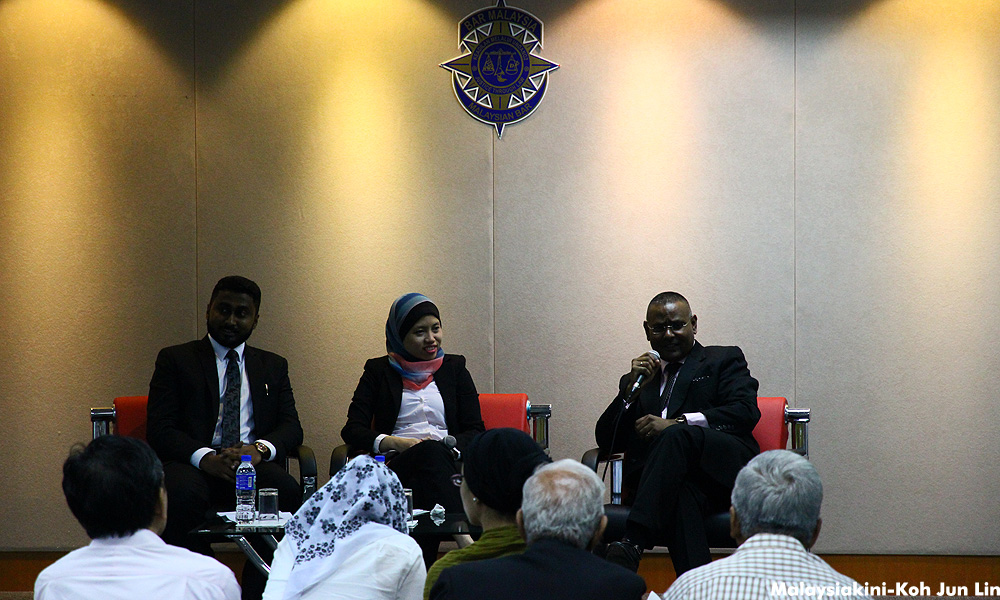 The IPCMC is a key recommendation in the Royal Commission of Inquiry (RCI) report on the police force that was published in 2005, which said that the Royal Malaysian Police’s own internal oversight mechanism was ‘inadequate, unreliable and frequently ineffective’.
The government under the then prime minister Abdullah Ahmad Badawi initially promised to carry out the RCI’s recommendations, including establishing the IPCMC.
However, the idea was met with stiff opposition from the police, and a watered-down version, called Enforcement Agency Integrity Commission (EAIC), was established instead.
At the forum last night, Task Force on IPCMC member Sivaraj Retinasekharan pointed out that unlike the IPCMC, the EAIC has no power to take disciplinary action or recommend cases for prosecution.
There is also no requirement for a compliant to be made to the IPCMC before it can take action, unlike the EAIC, which can only act on complaints that receives.
Firdaus said the IPCMC was not a new idea, but an emulation of the UK’s Independent Police Complaints Commission (IPCC) that oversees the police forces in England and Wales.
The EAIC was established in 2011, whereas the IPCC was established in 2004.
Also speaking the forum was the Queens Counsel Steven Perian, who explained the IPCC’s role and functions in detail.
'Key part is the referral system'
 Perian (photo) said the key part of the IPCC is its referral system. Most of the complaints against the police, he said, are handled by the relevant police force or agency, without the IPCC’s involvement.
The complaints are lodged against the police themselves. Although there is an online form for lodging complaints against the police on the IPCC’s website, this is simply forwarded to the relevant police force without being logged in the IPCC’s system, he said.
In many of these complaints, the IPCC serves as a mechanism for appeal if the complainant is dissatisfied with the police response to the complaint, or if the complaint is not recorded at all.
However, the police must refer some complaints and incidents to the IPCC immediately.
These cases include any contact with police that has resulted in death or serious injury, serious allegations of corruption and allegations of misconduct that is aggravated by discrimination.
“To a large extent, the quicker that the IPCC comes in, the quicker investigations can take place.
“That means it is independent. It is a safeguard for police officers. It is a safeguard for families,” Perian said.
In cases of death in custody, he said, the IPCC would get involved early and a preliminary report would be published within 28 days.
Perian said the IPCC’s independence protects the police from allegations of cover-up, while ensuring defendants and suspects that their complaints are being investigated seriously.
CPS decisions are not final
If the IPCC decides that there is sufficient evidence of a criminal offence and it is in the public interest to prosecute, then the case may be referred to the Crown Prosecution Service (CPS).
However, decisions of the CPS are not the final word, as they can be quashed by a judicial review.
The IPCC can also make ‘learning recommendations’ to the police or other organisations after an IPCC investigation, such as how should they change their policy and training.
The recipient does not have to adopt the recommendations, but is legally required provide a response within 56 days, explaining what actions would be taken, or why action would not be taken.
Asked if he had felt that the IPCC had not done enough, Perian said there have been times where he felt that an IPCC investigation was taking too much time, or that a case that should be prosecuted was not referred to the CPS.
Sometimes, the IPCC reaches the wrong conclusion and the families involved would have to resort to a judicial review.
“But to a large extent, the IPCC actually does quite a lot of work and sends its work off to the CPS. I know of at least two cases this year where the CPS has said that it doesn’t want to prosecute, and the IPCC had gone back, done further investigation and sent the case back to say there is more evidence to prosecute these people.
“I think the IPCC is striving to ensure that the police force we want in the UK is clean and whiter than white. When there is corruption, when there is something that has gone wrong, it is a case of getting it before a jury or the CPS for them to make a decision,” Perian said.


Are you sure you want to delete this comment?
This action cannot be undone.