



The whos and whys behind the Rohingyas' suffering
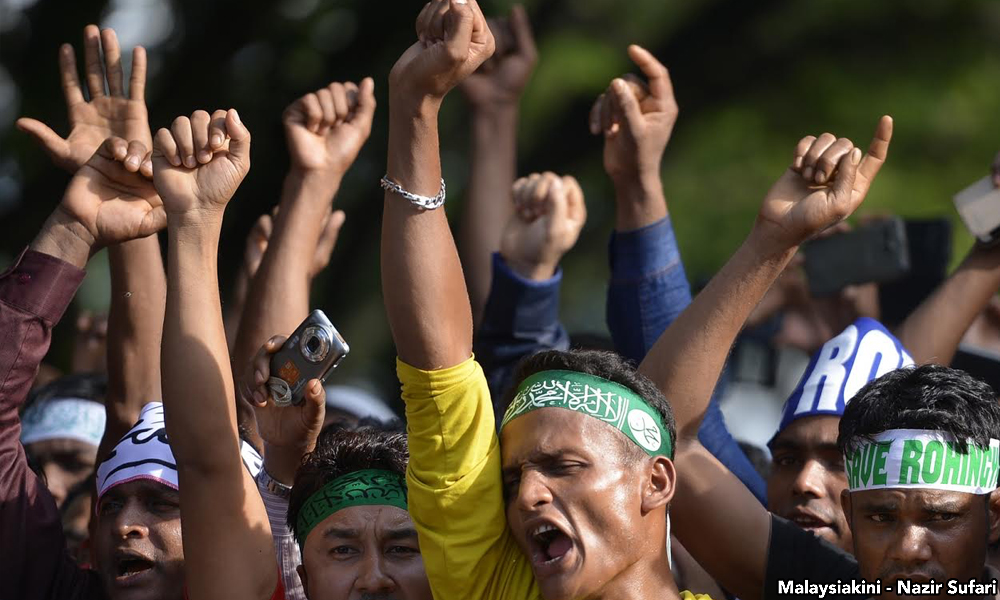
KINIGUIDE Prime Minister Najib Abdul Razak and his cabinet's show at a demonstration last weekend to protest the persecution of the Rohingyas in Myanmar has ruffled diplomatic feathers.
An unhappy six-month-old Myanmar government led by de facto leader Aung San Suu Kyi has pledged to stop sending its workers to Malaysia as a sign of protest.
Malaysiakini attempts to shed some light on the plight of the Rohingyas in Myanmar and why were they being targeted by the military.
Who are the Rohingyas?
The Rohingyas are a Muslim ethnic minority who claim they are indigenous to Myanmar's Rakhine state (formerly known as Arakan) along the western coast of Myanmar, while detractors argue they had migrated from neighbouring Bengal.
They were originally recognised as Myanmar citizens when the country became independent from the British in 1946 and they were once allowed to vote.
However, in 1982, Myanmar's military rulers enacted a new citizenship law that recognised 135 distinct ethnic groups, except the Rohingya and five others. With this, 800,000 Rohingyas became stateless.
The Myanmar government banned the word 'Rohingya' in 2014 and instead referred to them as "Bengalis".
KINIGUIDE Prime Minister Najib Abdul Razak and his cabinet's show at a demonstration last weekend to protest the persecution of the Rohingyas in Myanmar has ruffled diplomatic feathers.
An unhappy six-month-old Myanmar government led by de facto leader Aung San Suu Kyi has pledged to stop sending its workers to Malaysia as a sign of protest.
Malaysiakini attempts to shed some light on the plight of the Rohingyas in Myanmar and why were they being targeted by the military.
Who are the Rohingyas?
The Rohingyas are a Muslim ethnic minority who claim they are indigenous to Myanmar's Rakhine state (formerly known as Arakan) along the western coast of Myanmar, while detractors argue they had migrated from neighbouring Bengal.
They were originally recognised as Myanmar citizens when the country became independent from the British in 1946 and they were once allowed to vote.
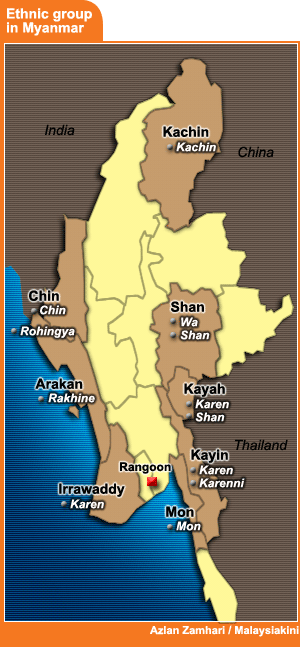 However, in 1982, Myanmar's military rulers enacted a new citizenship law that recognised 135 distinct ethnic groups, except the Rohingya and five others. With this, 800,000 Rohingyas became stateless.
The Myanmar government banned the word 'Rohingya' in 2014 and instead referred to them as "Bengalis".
As of 2013, about 1.3 million live in Rakhine and reside mainly in the north of the state.
Why are the Rohingyas not well liked by the Myanmar Buddhist majority?
The acrimony between Rakhine Buddhists and the Rohingyas started in the 1940s when the British colonial government, which ruled from 1824 to 1948, brought in more Rohingyas to develop the western regions of Burma, as Myanmar was then known.
The British ruled the Buddhist majority, while allowing the Rohingya minority autonomy. Large portions of land were leased to the Rohingyas, who subsequently chased the Buddhist majority off their land in northern Arakan.
During the Japanese Occupation from 1942 to 1945, the British provided arms to the Rohingya to stave off the Japanese. It was reported that the Rohingya instead killed 20,000 local Rakhines in Arakan in 1942.
The locals viewed the Rohingya militants as the accomplice of the country's invader, the British.
After Myanmar's independence in1948, the Rohingya carried on a jihad against the Rakhines in Arakan with an ultimate aim of creating a Muslim country there.
They attacked the Rakhine community, its Buddhist shrines and monasteries, torturing and killing Buddhist monks.
If was only after the 1962 military coup that the army started cracking down on the Rohingya militants who had the support of the Rohingya people, resulting in a minor exodus of the Rohingyas.
What happened to them after this?
Since the military crackdown, the Rohingyas have been fleeing persecution in Myanmar for decades, with the first large exodus occurring in the 1970s when the military forced some 250,000 Rohingyas to leave for Bangladesh.
They were again forced to leave in the early 1990s, early 2000s and in 2012, when communal conflicts broke out.
What's the latest development?
On Oct 9, the Myanmar military locked down part of northern Rakhine, after an attack that killed nine border police guards at three border posts near the country's border with Bangladesh.
The government said the assailants were Islamic militants and began to search for hundreds of Rohingya jihadists.
The lockdown of Rohingya villages blocked the flow of humanitarian assistance, such as food and medicine, to approximately 160,000 Rohingyas.
There were reports of at least 86 killed, mass arrests, rape and burning down of Rohingya villages in the past nine weeks, sending 100,000 fleeing to Bangladesh.
This is reminiscent of 2012, when a riot broke out between Rakhine Muslims and Buddhists that led to 200 dead and 150,000 displaced, mostly Rohingyas.
Have the crackdowns affected neighbouring countries?
Yes, the persecution of the Rohingya has had a spillover effect on the neighbouring countries.
The Rohingya refugees fled to Bangladesh, Thailand, Indonesia, India, Malaysia and Saudi Arabia, particularly during each large scale breakout of violence.
Since the 2012 communal riots, 100,000 Rohingyas have fled from persecution, by boat and by land. It is believed more than 1,000 have died during their journey.
In May 2015, Rohingyas and other economic migrants who had boarded smuggler boats were stranded in the Andaman Sea for weeks after several countries, including Malaysia, refused to take them in.
Both Malaysia and Indonesia later agreed to provide them temporary refuge and assistance.
Last year, 139 Rohingya mass graves and 28 human trafficking camps were discovered in Malaysia, in Wang Kelian, close to the Thai border, with signs that the victims had been tortured.
How many Rohingyas are in Malaysia?
According to the UN refugee agency UNHCR, there are 54,856 registered Rohingya refugees and asylum-seekers in Malaysia as at the end of October.
They have been here for at least two generations.
Are they living in decent conditions in Malaysia?
Not really. The government treats them as illegal migrants instead of refugees and asylum-seekers, as Malaysia is not a signatory to the 1951 UN refugee convention or its 1967 protocol.
The local Rohingyas are vulnerable to human traffickers, labour exploitation and extortion.
Their children are also not allowed to attend government schools and are mostly educated by volunteers.
As of April, the government still detains 320 Rohingya at Belantik detention centre in Kedah, almost a year after rescuing them from the sea.
What is Malaysia doing now to help the Rohingyas?
Following the latest outbreak of violence, Prime Minister Najib attended a protest in which10,000 people took part, and the government has summoned the Myanmar envoy over the crackdown on Rohingyas.
Foreign Minister Anifah Aman has also attempted to meet Aung San Suu Kyi, but the latter has declined to speak with Malaysia on the Rohingya issue.
Malaysia withdrew from two scheduled friendly football matches against Myanmar this month after public pressure.
The government plans to allow 300 Rohingya refugees to seek employment under a pilot project.
What did Aung San Suu Kyi say?
The Myanmar pro-democracy leader has been accused of silence on the Rohingya issue since her National League for Democracy (NLD) won the general election in November 2015.
Last week, she was reported as saying that the Myanmar government has managed to calm the situation and keep it under control.
Suu Kyi also called for the international community to help Myanmar to maintain peace and stability.
She accused the international community of stoking resentment between the Buddhist and Muslim communities in the northwest region.
Suu Kyi was also reported as denying any genocide in Rakhine, claiming the growing allegations of rape, arson and slaughter of Rohingyas as "external fabrications".
How has the Myanmar society reacted?
Najib's plans to attend the solidarity gathering in Kuala Lumpur last week drew criticism from Myanmar, and a group of Buddhist monks were reported holding a street protest against Malaysia.
This instalment of KiniGuide is compiled by Kow Gah Chie.


Report this comment
Are you sure you want to delete this comment?
This action cannot be undone.