



KiniGuide to Orang Asli blockades in Gua Musang
KINIGUIDE The tussle between the Orang Asli community and loggers in Gua Musang has dragged on for years, but it reached boiling point early this month when 54 Orang Asli were arrested for setting up blockades.
Undeterred by the arrests, the Orang Asli community has rebuilt the blockades after authorities dismantled them and are determined to tackle logging activities on what they claim is their ancestral land.
Malaysiakini takes a look at the tussle and why it has become confrontational.
Who are the Orang Asli in Gua Musang?
The Orang Asli community involved in the tussle with loggers in Gua Musang come from the Temiar tribe.
The Temiar tribe, with a population of around 20,000, is one of 18 Orang Asli groups in Peninsular Malaysia.
Some in the Temiar community have adopted an urban way of life, but a substantial number still reside within the forest reserves covering the state borders of Perak, Pahang and Kelantan.
Those living within the forest reserves are highly dependent on their natural environment, from which they forage for fruits and animals for food.
What’s going on in the permanent forest reserves?
Contrary to popular belief, logging in forest reserves is allowed.
The Forestry Department sets an annual limit on how much a state can log.
The logged trees must also be replaced with newly-planted ones.
The size of the permanent forest reserve in Kelantan has remained largely unchanged since 2008, at 623,849 hectares...
KINIGUIDE The tussle between the Orang Asli community and loggers in Gua Musang has dragged on for years, but it reached boiling point early this month when 54 Orang Asli were arrested for setting up blockades.
Undeterred by the arrests, the Orang Asli community has rebuilt the blockades after authorities dismantled them and are determined to tackle logging activities on what they claim is their ancestral land.
Malaysiakini takes a look at the tussle and why it has become confrontational.
Who are the Orang Asli in Gua Musang?
The Orang Asli community involved in the tussle with loggers in Gua Musang come from the Temiar tribe.
The Temiar tribe, with a population of around 20,000, is one of 18 Orang Asli groups in Peninsular Malaysia.
Some in the Temiar community have adopted an urban way of life, but a substantial number still reside within the forest reserves in Perak, Pahang and Kelantan.
Those living within the forest reserves are highly dependent on their natural environment, from which they forage for fruits and animals for food.
What’s going on in the permanent forest reserves?
Contrary to popular belief, logging in forest reserves is allowed.
The Forestry Department sets an annual limit on how much a state can log.
The logged trees must also be replaced with newly-planted ones.
The size of the permanent forest reserve in Kelantan has remained largely unchanged since 2008, at 623,849 hectares.
Did the logging get worse?
According to the Peninsular Malaysia Forestry Department's annual reports, the volume of logs produced from the permanent forest reserves in Kelantan have declined.
The amount produced from within the Kelantan permanent forest reserves was 1.44 million cubic metres and this gradually declined to 887,666 cubic metres in 2015.
The data does not factor in the possibility of illegal logging.
So why is the Temiar community complaining?
A reduced production of logs does not necessarily mean that logging activities have eased.
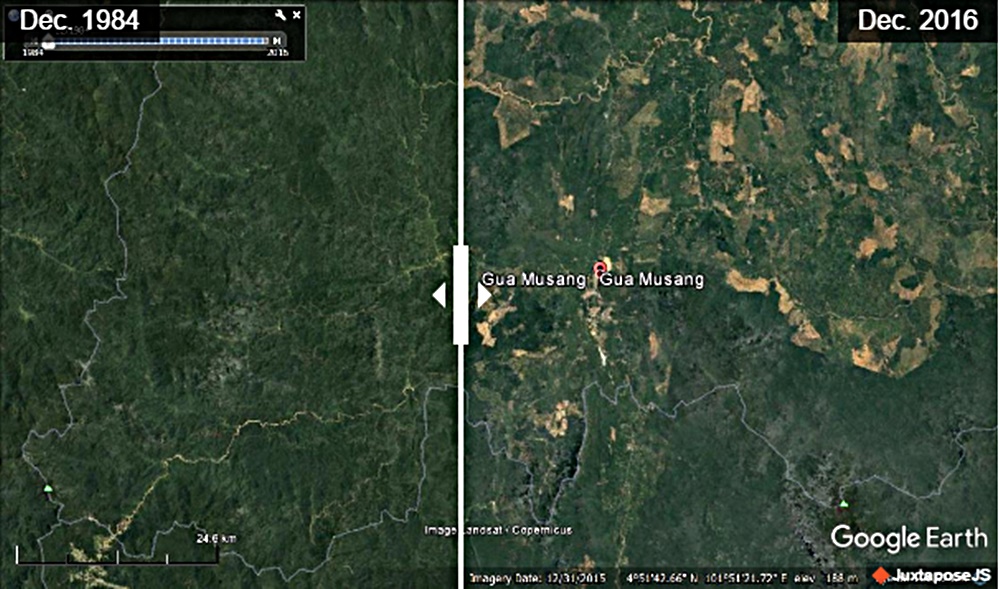
It could be an indication that the availability of quality logs is shrinking and loggers have to resort to areas that they would not previously log, suggesting that the damage is incremental.
The satellite image below highlights the incremental damage by comparing data from 1984 and 2016.
Malaysiakini previously highlighted complaints that logging activitives have polluted the sources of water of the native communities living in the forest reserves and deprived them of fresh water fish.
The dwindling numbers of natural trees means that herbs used for traditional medicine are increasingly hard to come by.
What about the rule that logged trees needed to be replaced?
They are being replaced with commercial crops, in particular, Timber Latex Clone (TLC). This is allowed under the Malaysian forestry regulation.
TLC provides intermediate income from tapping and later, the tree serves as rubber wood.
According to the Kelantan first mid-term review (Semakan Separuh Penggal Pertama) for forest management plan (Rancangan Pengurusan Hutan) from 2006 to 2015, TLC contributes 20 percent to the forest production.
TLC, unlike natural fruit trees, are not a source of food for the Temiar community.
But don’t commercial plantations provide jobs?
Taking away the natural forest, replacing them with commercial crops and demanding that they work nine-to-five jobs would dramatically upset the Temiar community’s hunter-gatherer way of life.
Why the need to log so much in Kelantan?
Logging is a major source of income for the Kelantan government.
Forestry revenue comprised more than a quarter of the state’s income in five out of the eight budgets since 2010.
The Kelantan government expects forestry revenue to be at RM177.2 million in 2017, or 27.81 percent of the state's total revenue.
What is the Temiar community doing about it?
The Temiar community in Gua Musang has put up blockades against logging activities since 2012 and have normally backed down when authorities or loggers dismantled them.
For example, some 300 Orang Asli set up two blockades at Kampung Parit and Kampung Lambok on Jan 4, 2012, but abandoned their efforts after the authorities detained 13 Orang Asli and burnt down the blockades 24 days later.
However, the blockades have become more frequent this year and the Temiar community is refusing to back down.
The first blockade began on Sept 26 but was dismantled by unidentified men just two days later.
The blockade was sparked by new logging areas approved by the state government in places where the Temiar community live.
In October, the Temiar community set up three new blockades, which lasted for more than a month before the state authorities moved to dismantle them on Nov 29 and Dec 1, arresting 54 people in the process.
On Dec 10, the Orang Asli began rebuilding all three blockades and plan to enforce them, effective today.
What is the Kelantan government’s response?
On Dec 3, Kelantan Menteri Besar Ahmad Yakob announced that 973 hectares of land in Pos Gob would be made into an Orang Asli reserve, but it is still in the process of being gazetted.
Ahmad also said another 15,0000 hectares of permanent forest reserve would be allocated for the Orang Asli to forage for food.
However, Jaringan Orang Asli Kelantan secretary Mustapa Along complained that the Kelantan government announced these measures without consulting the local community.
Does all the Orang Asli community in the Gua Musang area support the blockades?
No. Persatuan Orang Asli Semenanjung's Kelantan chairperson Ajom Alang said while he is against environmental degradation, the blockades are shameful to the community as it is not the Orang Asli way to take the confrontational route.
Pos Gob village chief Liman Alang has also lodged a police report against activist lawyer Siti Kasim, for allegedly causing disharmony among the Orang Asli. Siti represents some blockaders.
This instalment of KiniGuide is compiled by Yeong Hui Min.


Report this comment
Are you sure you want to delete this comment?
This action cannot be undone.