



Gov't gets leave to appeal against landmark sedition decision
The Federal Court has granted the government’s application for leave to appeal against the Court of Appeal’s decision which struck down Section 3(3) of the Sedition Act as being unconstitutional.
The Court of Appeal, in a landmark decision in November last year, had ruled that the prosecution must prove intention when charging a person with sedition.
The ruling was made in the case of Mat Shuhaimi Shafiei vs the Public Prosecutor.
The Federal Court has granted the government’s application for leave to appeal against the Court of Appeal’s decision which struck down Section 3(3) of the Sedition Act as being unconstitutional.
The Court of Appeal, in a landmark decision in November last year, had ruled that the prosecution must prove intention when charging a person with sedition.
The ruling was made in the case of Mat Shuhaimi Shafiei vs the Public Prosecutor.
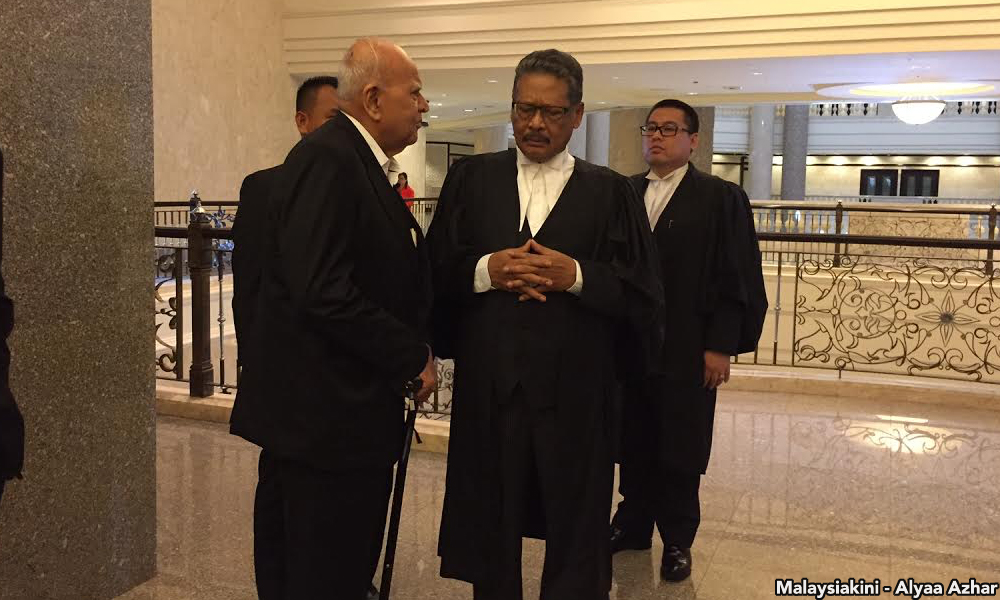
Representing Shuhaimi, retired Federal Court judge Gopal Sri Ram said his legal team was not opposing the public prosecutor’s leave application.
“We reserve the right to argue that the first two questions do not require an answer, and that the third question should be answered in our favour,” Gopal said.
Chief Judge of Malaya Zulkefli Ahmad Makinudin led the three-member panel who heard the application today together with Federal Court judges Abu Samah Nordin and Zaharah Ibrahim.
Meanwhile, lawyer N Surendran, who is also representing Shuhaimi, told reporters that the main issue lies on the third question, which is on the constitutionality of Section 3(3) of the Sedition Act.
“The first two, we think can be disposed of. The main thing is Section 3(3) of the Sedition Act, as to its constitutionality.
“At the main hearing, that will be the issue. We will raise our objection when the main hearing comes,” he said.
The first question concerns whether there is an abuse of the court process in challenging the constitutionality of Section 3 of the Sedition Act through the civil proceeding as a decision had been made by the Court of Appeal in a criminal appeal.
The second question is on whether the constitutionality of Section 3 of the Sedition Act 1948 cannot be challenged in the civil proceeding due to a prior similar challenge in a criminal proceeding.
Surendran explained that they did not object to the leave application as they were of the opinion that the court should be given the opportunity to develop the law and that important constitutional questions must be heard and deliberated by the court.
“Consistent with the position we have taken all this while, we did not oppose the application because there is a novel question which is whether or not Section 3(3) is constitutional or not, on those grounds.”
Surendran then expressed hope that the Attorney-General’s Chambers would not object in other cases involving important constitutional questions that need to be referred to the higher courts for decision.
Apandi leads appeal against landmark sedition decision
Meanwhile, attorney-general Mohamed Apandi Ali led the team from the Attorney-General’s Chambers which sought the Federal Court’s leave to appeal against the Court of Appeal’s decision.
While introducing lawyers from both sides, Apandi referred to lead counsel Gopal as his “sahabat dan abang” (friend and elder brother).
He later confirmed to reporters that he was handling the case as it was about “public interest”.
“It’s something of importance, public interest and involves criminal law and civil law which I want to have it finally decided by the highest court.
“(Yes, it’s) not normal that I come, (but) because this is very important, that’s why I came,” he said.
He also confirmed that he will be leading the team in the main hearing for the appeal.
“Yes, I will follow through, until the end, insyaAllah (God willing).”
The Court of Appeal had ruled that Section 3(3) contravened Article 10 of the Federal Constitution on freedom of expression, and therefore it was invalid and unenforceable.
Justice Varghese George Varughese, who had delivered the judgment, said although Section 3(3) stated the intention of the person charged was deemed irrelevant, in the Court of Appeal's assessment, it was not to create a presumption that the accused could disprove.
The judge also said that Section 3(3) was in conflict with Section 505 of the Penal Code, where intent had clearly to be proven for any offence in the Penal Code.
Mat Shuhaimi was charged in February 2011 in the Sessions Court in Shah Alam with posting an allegedly seditious article in his blog, srimuda.blogspot.com, on the appointment of Mohd Khusrin Munawi as the new Selangor state secretary.
The Sri Muda state assemblyperson is also the political secretary to Selangor Menteri Besar Azmin Ali.
Meanwhile, Gerakan Hapuskan Akta Hasutan (GHAH) said it was apalled at the appeal.
"The Court of Appeal's decision is well-reasoned and sound and makes the outdated and much criticised sedition law fairer by requiring the prosecution to prove 'intention' just like in any other criminal offences.
"Why then is the attorney-general appealing a decision that makes the law better, one that provides a fairer trial to an accused person as it would require the prosecution to prove ‘intention’ like all criminal trials?" said GHAH coordinator Amir Abd Hadi.
He urged the attorney-general to withdraw the appeal.
He also reiterated that all sedition prosecutions should be dropped and the Sedition Act abolished.


Are you sure you want to delete this comment?
This action cannot be undone.