




Bare the facts on CSMU de-recognition
A parliamentary roundtable on the de-recognition of Crimea State Medical University (CSMU) decried the lack of transparency in the handling of the issue.
A parliamentary roundtable on the de-recognition of Crimea State Medical University (CSMU) decried the lack of transparency in the handling of the issue.
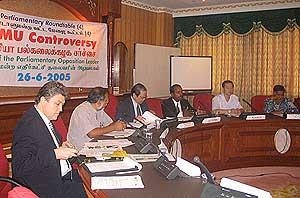 Organised by the parliamentary opposition leader's office, about 40 participants endorsed three resolutions in response to the Malaysian Medical Council's (MMC) controversial decision to revoke the recognition of the university.
MMC had granted recognition to the Ukranian university in 2001.
Political scientist Prof P Ramasamy said the de-recognition should be suspended and a grace period be given to CSMU.
The second resolution is for Health Minister Dr Chua Soi Lek to release the findings of the technical panel's report which had led to the de-recognition.
Participants also wanted a fact-finding mission to be deployed to CSMU to ascertain its status as a medical university.
Ramasamy, who is a political science lecturer at Universiti Kebangsaan Malaysia, said the main problem was MMC's lack of transparency, accountability and responsibility.
"This is the unkindest cut of all because it deprives students from the middle and lower-middle income from pursuing their studies," he said after reading out the resolutions.
"I ask the government and the MMC not to be cavalier about such an important matter," he added.
He said the decision to de-recognise CSMU should be reconsidered as it was "a restraint on the country's human resources development".
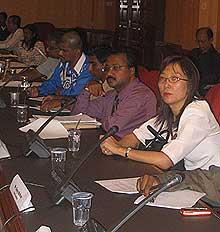
The three-hour roundtable at Parliament yesterday morning was attended by opposition leaders, academics, parents of CSMU students, Malaysian Indian-based groups and social activists.
Why no grace period?
Parliamentary Opposition Leader Lim Kit Siang wanted Chua's ministerial statement in the Dewan Rakyat on a "full and satisfactory account" of the reasons for the de-recognition.
 "Why wasn't CSMU not given a grace period? In the early 1980s, the UK General Medical Council gave Universiti Malaya five years' notice before de-recognition of its medical degrees."
"This issue is not a racial issue but about the training of qualified doctors, justice to Malaysian medical students in CSMU and elsewhere, and the accountability and transparency of the MMC," he said.
Lim said the "bolt out of the blue" dealt a major blow to Malaysia's international reputation for reliability and predictability which are essential in determining the country's global competitiveness.
DAP secretary-general Lim Guan Eng said Malaysia's acute shortage of doctors is clear from the hiring of 700 foreign personnel in government hospitals at an annual cost of about RM40 million.
"Why can't we train doctors locally using this money? You can see that most doctors in Singapore hospitals are Malaysians. Why are they not practicing here?"
The MMC cited concerns over CSMU's admission of arts streams students who failed examinations and the dramatic increase in the student intake which pushed the staff-student ratio to 1:8 - twice as high as MMC's 1:4 criteria.
However, Guan Eng said Higher Education Miniser Dr Mohd Shafie Salleh announced last year the MMC move to raise the ratio to 1:6 for clinical training in order to accommodate the 128 STPM students who were earlier denied medical seats.
The Council of Medical Deans chairperson Prof Dr Zabidi Azhar Hussin had also reportedly noted that some medical faculties had a ratio of 1:8.
"If true, this is no different than the ratio in CSMU and the move could be seen as an attack on a university's reputation and an injustice to the students," he added.
It's 'racial discrimination'
Insisting that the whole issue reeked of racism, Parti Reformasi Insan Malaysia pro-tem president P Uthayakumar said the move "splashed sand" on the ethnic Indian dream of having "at least one child in the family who is a doctor".
"I beg to differ on the point that this is not racial discrimination because the national policy has consistently denied our Indian students seats in local universities.
"Many middle- and working-class families cannot afford private local or foreign universities including in India and the CSMU provides affordable rates," he said, referring to MIC president S Samy Vellu's remarks on the shortage of medical seats in Malaysia.
Uthayakumar said the Melaka Manipal Medical College and the Sungai Petani-based Asian Institute of Medicine, Science and Technology were also de-recognised last year but "political maneuvering" helped to restore their status.
He challenged MMC president Dr Mohd Ismail Merican to implement a common entrance examination for the medical profession and to release the technical panel's report on CSMU.
"We will write to the World Health Organisation and the British General Medical Council for an independent evaluation on CSMU."
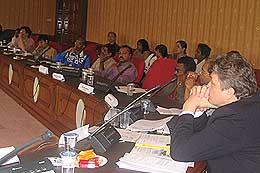 Ukraine ambassador Oleksandr D Shevchenko was also present to field questions and make clarifications.
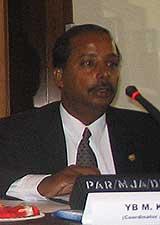
Roundtable co-ordinator Ipoh Barat MP M Kula Segaran said the issue deserved public attention because the government continued to finance costly medical studies overseas despite sufficient medical faculties locally.
He said the Public Service Department (PSD) had clarified on Wednesday that scholarships to Ukraine and Russia will no longer be approved for "security reasons".
"(It) looks like we have to now visit the Russian Embassy for clarification," he said.
He said Samy Vellu, who is also works minister, was invited but had declined to attend, citing personal reasons.
'Don't play with fire'
Kula Segaran also related how Minister in the Prime Minister's Department in charge of parliament Mohd Nazri Abdul Aziz had hugged him outside the MPs lounge on Wednesday, saying that each of them had a job to do.
 Nazri had shouted 'racist' at Kula Segaran 41 times at the tail-end of a heated parliamentary debate on the matter.
One participant remarked that it was disturbing to see Barisan Nasional MPs resort to playing the racial card whenever answers were not forthcoming.
"Every time they cannot answer something, they revert to the 'don't play with fire' line. This is very disturbing because firstly, this is not a racial issue. But even if it was, it's still a Malaysian issue."
He asked for MMC members to be scrutinised as to whether they were qualified enough to make such a decision including their awareness of the country's education system.
Parti Keadilan Rakyat's N Gobalakrishnan slammed the government of trying to marginalise ethnic Indians.
"There are less than five percent Indians in the (administration) system and not a single one is a policy-maker."
Accusing the MMC of being mala fide (in bad faith), he wanted action taken against the officers who had signed the no-objection letters over the years.
No-objection letters are issued by the government to art stream students to enable them to take medical courses overseas, which has however been cited now as a reason for the de-recognition of CSMU.
Among DAP leaders present were Bukit Bintang and Seputeh MPs Fong Kui Lun and Teresa Kok and A Sivanesan, and Malaysian Trades Union Congress president Syed Shahir Syed Mohamud.


Are you sure you want to delete this comment?
This action cannot be undone.