

Manufacturers urge gov't to avoid sudden policy changes
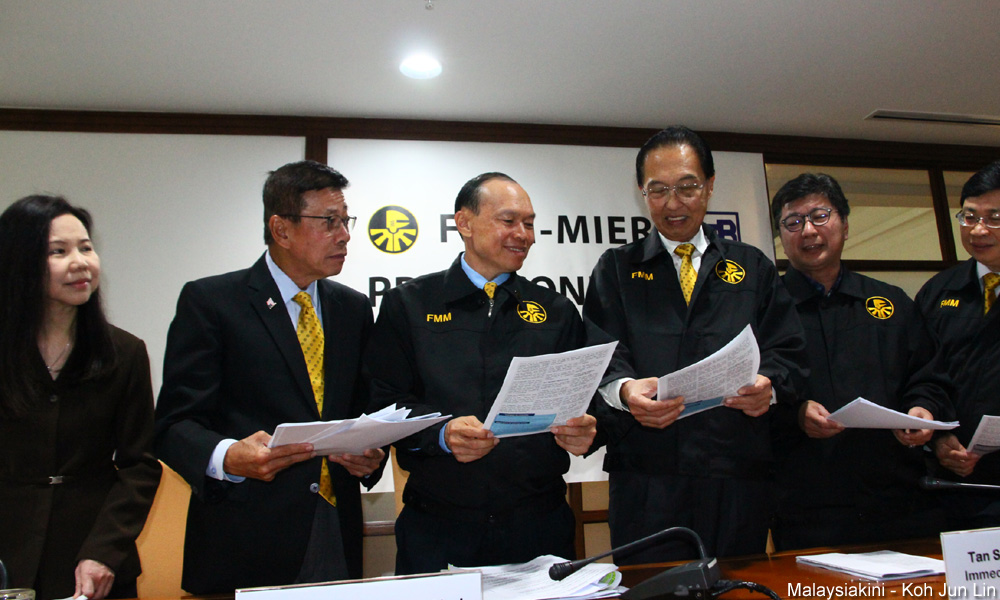
The Federation of Malaysian Manufacturers (FMM) has urged the government to avoid making sudden policy changes that could affect the business community.
The FMM president Lim Wee Chai said this today in relation to Bank Negara's recent spate of changes to its foreign exchange policy since Dec 5.
The Federation of Malaysian Manufacturers (FMM) has urged the government to avoid making sudden policy changes that could affect the business community.
The FMM president Lim Wee Chai said this today in relation to Bank Negara's recent spate of changes to its foreign exchange policy since Dec 5.
"In business environments, we need stability especially for foreign investors. They need a very clear and stable foreign exchange policy so that both foreign and domestic investors have confidence in investing in Malaysia.
"Government change must have proper planning. The business community don't like sudden changes, especially overnight changes - it upsets our planning.
"So the policy must be very clear and stable," he told a press conference today, in conjunction with release of the FMM-Malaysian Institute of Economic Research Business Conditions Survey (BCS) findings for the second half of 2016.
Most prefer old ways
The Bank Negara ruling, among others, allows exporters to keep only 25 percent of the proceeds in foreign currencies, while the remainder must be converted to ringgit, as part of the central bank's efforts to stem currency depreciation.
Lim said although the central bank now allows some flexibility to the restrictions following complaints from various quarters, this entailed converted foreign currencies to ringgit, and then back to a foreign currency.
"Although it is better now, it is very inefficient. This is not good for productivity," he said.
The BCS found that a majority (56.8 percent) of respondents want Bank Negara to revert to the original rule whereby exporters can retain all of their proceeds in foreign currencies, rather than being compelled to convert any portion of it into ringgit.
Another 13.2 percent of the respondents want the central bank to allow them to retain half their proceeds in foreign currencies rather than the current 25 percent limit, while 13 percent said they agree with the current Bank Negara policy.
Fifteen percent of the respondents suggested that Bank Negara allow their proceeds to be "naturally offset" in the month, before converting the net proceeds.
Foreign workers
The semi-annual survey was conducted between Jan 6 and Feb 3, during which responses were collected from 370 respondents over 2,550 FMM members who are also manufacturers.
The survey also found that an overwhelming number of manufacturers (71.9 percent) are opposed to Employer Mandatory Commitment (EMC) scheme, compared to only 17 percent who agreed to it.
Most of the respondents (74.1 percent) felt that it would add to the cost of doing business, while 42.7 percent felt that the issues EMC seeks to address are linked to illegal foreign workers and weak enforcement instead.
Most respondents (48.4 percent) felt that the policy would fail to meet its objectives, compared to 10.5 percent who believed that the policy would succeed.
Nearly one-third of respondents (29.5 percent) suggested that EMC should be implemented in phases according to a schedule that is announced ahead of time.
Under the scheme, the foreign worker levy is to be borne by employers themselves, who currently deduct the fee from the worker's wages.
The EMC was supposed to be implemented beginning Jan 1 this year, but has been postponed to January 2018 due to "unresolved issues".
Cautious optimism
According to the survey findings, 45 percent of respondents felt that the levy should be borne by the foreign workers, compared to 17 percent who said it should be paid by employers. Another 17 percent said the fee should be shared.
Asked on the government incentives for manufacturers under the 2017 budget, 48.1 percent of respondents said their companies would stand to benefit from the lower tax rates for 2017 and 2018 in cases there is a significant increase in their taxable income.
Another 42.4 percent however said they would not benefit from any of the incentives under the 2017 budget, which among others include export promotion programs for small and medium enterprises (SME), and rebates for SME borrowers under the Working Capital Guarantee Scheme.
Overall, the respondents (33 percent) reported that business conditions has improved during the second half of last year compared to the first half, compared to the 28 percent on the previous survey.
The survey found that both local and export sales have improved, although the cost of production had also gone up and 19 percent of respondents reported to have downsized their workforce during the period.
Moving forward, the 48 percent of respondents said they expect business conditions to remain the same for the first six months of 2017, compared to 26 percent who expect conditions to improve, and 26 percent who expect conditions to deteriorate.
Domestic sales in particular are expected to fall, even as exports are expected to remain steady.


Are you sure you want to delete this comment?
This action cannot be undone.