




Its all dandy at Lenggeng
What poor and insufficient food? The Prisons Department refutes the allegation and claims that detainees at an immigration depot in Negeri Sembilan are happy with the three meals they get a day.
What poor and insufficient food? The Prisons Department refutes the allegation and claims that detainees at an immigration depot in Negeri Sembilan are happy with the three meals they get a day.
In an email communique to malaysiakini , the department's spokesperson Supri Hashim said meals at the Lenggeng depot change on a rotational basis.
While daily breakfast consists of coffee, bread and butter spread, lunch and dinner are normally rice and vegetables, coupled with a variety of other dishes such as fish, beef, soy, salted fish or eggs.
Moreover, Supri said the meals are provided according to the budget approved by the government and scrutinised by prison officials to ensure they are of quality.
"Detainees may make complaints to the depot management if the meals prepared are in a bad state or are not up to the standards set by the government.
"So far, we have not found any detainees who have made such complaints," he added.
Dysentery and malnutrition
He was responding to allegations raised by a former detainee, who claimed that the minuscule quantity and poor quality of food served at the depot had led to 40 inmates falling sick, with four suffering from dysentery and severe malnutrition.
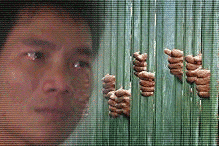 One of the four, Burmese Chin refugee Ki Tho, was said to have become temporarily
paralysed
from the waist down due to the severity of his condition.
One of the four, Burmese Chin refugee Ki Tho, was said to have become temporarily
paralysed
from the waist down due to the severity of his condition.
The four were released on May 18 to the care of United Nations High Commissioner for Refugees (UNHCR) after three months in detention.
They were from among 164 Chins, who are Christians, arrested after a protest in front of their embassy in Kuala Lumpur in January against the Burmese military junta.
After being held at the Pudu police station, they were handed over to the immigration department when the Attorney-General's Chambers decided not to press charges.
According to Ki, the activists found their calls for freedom and liberty in Burma being reduced to pleas for decent food and time to pray without being kicked in the backs by camp officers.
Prison officers would allegedly barge into the halls while the Chin refugees would be kneeling in prayer and force them to conclude prematurely, he added.
No physical abuse
However, Supri denied that such physical abuses or religious violations had occurred but added that restriction on activities can be made 'in accordance with the programs and procedures decided by the depot authorities'.
He said if such abuses have been committed, then complainants should come forward.
"No leniency in this matter is accorded to (prison) staff," he added.
As for detainees' access to medical treatment, Supri said medical officers from a clinic in Lenggeng visit the depot once every one or two weeks.
This is in addition to doctors sent by the United Nations High Commissioner for Refugees, he added.
Detainees are also sent to the Seremban Hospital for immediate treatment whenever the need arises "regardless of the time," he said, adding that paracetamol was only supplied to treat or relieve non-serious ailments.
Ki had alleged that his condition worsened over the course of his detention, including symptoms of gastrointestinal disturbances, swelling in various parts of the body, inflammation and degeneration of nerves and muscular weakness.
Despite this, the former detainee claimed that he was only provided paracetemol by prison officers and taken only once to a doctor.
Furthermore, Ki claimed that weekly visits by volunteer medical teams - arranged by the UNHCR - turned out to be pointless as medicines dispensed would be confiscated by the camp authorities later.
Supri explained that medicines provided by doctors on these occasions are not seized but taken for safekeeping and to be redistributed to detainees according to the times and amounts prescribed by doctors.
"Regulating the supply of medicines is so as to prevent the abuse (or overdose) of such medicines" and to safeguard the well-being of the detainees themselves, he said.


Are you sure you want to delete this comment?
This action cannot be undone.