


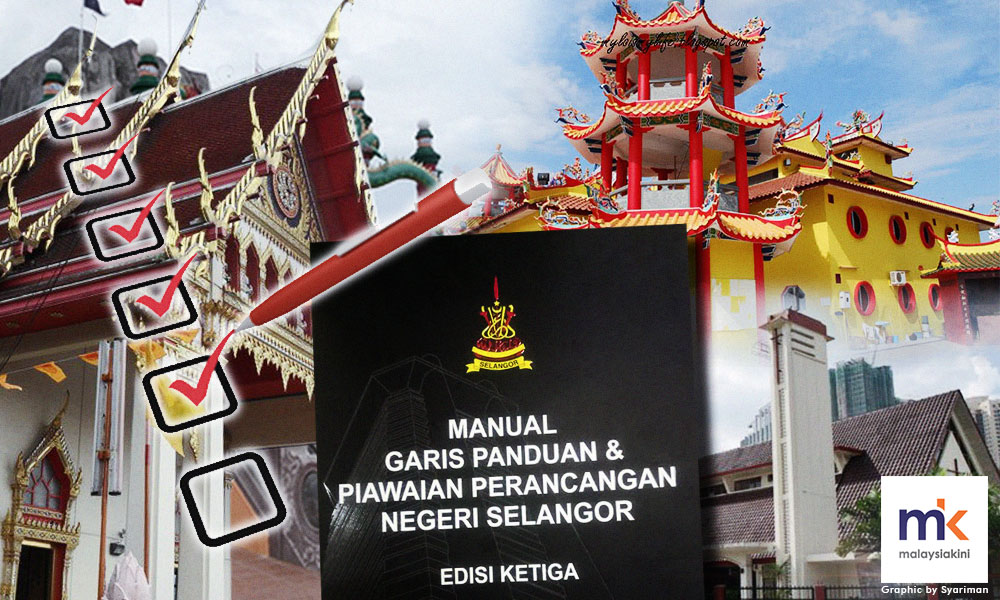

The ins and outs of non-Muslim worship house rules in S'gor and beyond
KINIGUIDE | Selangor state government came under fire for issuing manual guidelines which included a recommendation that non-Muslim places of worship should not be built within 50 metres of a home owned by Muslims.
The state executive council immediately suspended the controversial provision, included in the third edition of the "Selangor Manual Guidelines and Planning Standard", pending a review.
Senior state executive councillor Teng Chang Khim had apologised and offered to resign for the error.
After being slammed by MCA, state assembly speaker Hannah Yeoh said the contentious clauses on the distance and height limitations are not exclusively found in Selangor.
She said the Federal Department of Town and Country Planning Peninsular Malaysia under the Ministry of Urban Wellbeing, Housing and Local Government had issued a draft guideline containing the same clauses for temples, churches and gurdwaras in 2010.
Yeoh added that the draft guidelines have since been adopted by Pahang, Terengganu and Perlis.
In this latest instalment, we will take a look at the relevant guidelines practiced in Selangor and other states, as well in the federal level.
What is written in the third edition of the Selangor's 196-page guidelines on non-Muslim places of worship?
- One worship house to 5,000 population ratio.
- Need a segregation zone of at least 50 metres between the worship house and Muslim community.
- Required to serve notice and get feedback and concern from at least of 40 homes or the households within the radius of 200 metres before gaining approval for the construction of a worship house at an area where majority of the population practice another faith.
- Places of worship for non-Muslims should be built at the centre of the community.
- Should not build non-Muslim places of worship at shoplots and residential areas, unless proven no other suitable land or area available. This should be on case-to-case basis.
- Need to adapt the height of the sculpture and the building of the temple, church and gurdwara to its surrounding buildings.
- In a Muslim majority area, need to adapt the height of the building and sculpture to the surrounding building, dome and a mosque tower.
- If possible, need to take into consideration the height of the worship house and the skyline, colour and scenery so it could harmoniously fit into the development of the surrounding area.
- Not allowed in a commercial area and vacant land. Cannot change a house into a house of worship.
- The designs of worship house should not have elements which may touch on the sensitivity in the surrounding area...
KINIGUIDE | Selangor state government came under fire for issuing manual guidelines which included a recommendation that non-Muslim places of worship should not be built within 50 metres of a home owned by Muslims.
The state executive council immediately suspended the controversial provision, included in the third edition of the "Selangor Manual Guidelines and Planning Standard", pending a review.
Senior state executive councillor Teng Chang Khim had apologised and offered to resign for the error.
After being slammed by MCA, state assembly speaker Hannah Yeoh said the contentious clauses on the distance and height limitations are not exclusively found in Selangor.
She said the Federal Department of Town and Country Planning Peninsular Malaysia under the Ministry of Urban Wellbeing, Housing and Local Government had issued a draft guideline containing the same clauses for temples, churches and gurdwaras in 2010.
 Yeoh (photo) added that the draft guidelines have since been adopted by Pahang, Terengganu and Perlis.
In this latest instalment, we will take a look at the relevant guidelines practiced in Selangor and other states, as well in the federal level.
What is written in the third edition of the Selangor's 196-page guidelines on non-Muslim places of worship?
- One worship house to 5,000 population ratio.
- Need a segregation zone of at least 50 metres between the worship house and Muslim community.
- Required to serve notice and get feedback and concern from at least of 40 homes or the households within the radius of 200 metres before gaining approval for the construction of a worship house at an area where majority of the population practice another faith.
- Places of worship for non-Muslims should be built at the centre of the community.
- Should not build non-Muslim places of worship at shoplots and residential areas, unless proven no other suitable land or area available. This should be on case-to-case basis.
- Need to adapt the height of the sculpture and the building of the temple, church and gurdwara to its surrounding buildings.
- In a Muslim majority area, need to adapt the height of the building and sculpture to the surrounding building, dome and a mosque tower.
- If possible, need to take into consideration the height of the worship house and the skyline, colour and scenery so it could harmoniously fit into the development of the surrounding area.
- Not allowed in a commercial area and vacant land. Cannot change a house into a house of worship.
- The designs of worship house should not have elements which may touch on the sensitivity in the surrounding area.
That was the third edition of the guidelines to take effect in 2017. What about the previous editions?
The first and second edition of manual guidelines were released in 2007 and 2010 respectively.
What did the first and second edition say on the non-Muslim places of worship?
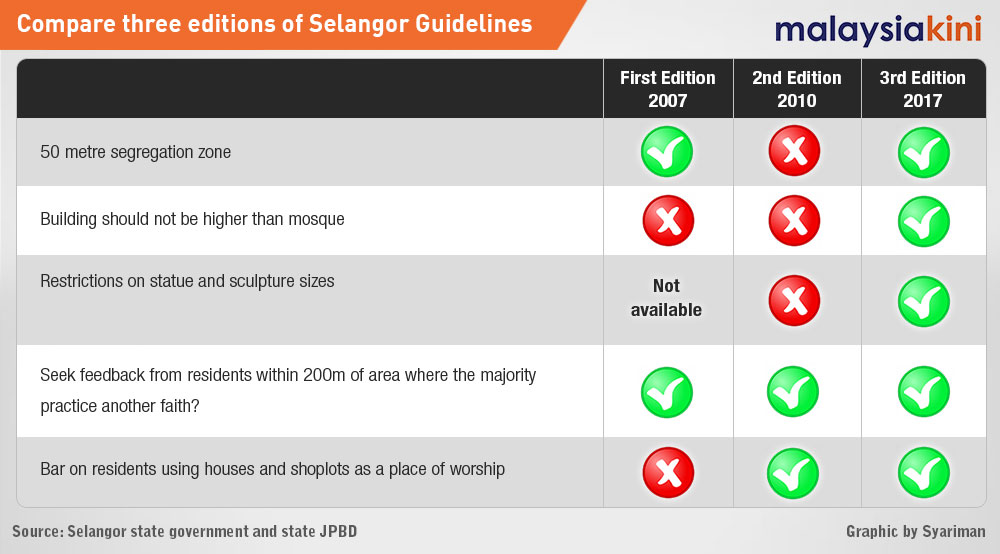
- On 50 metres segregation of non-Muslim worship house and Muslim homes - the condition was stated in the first edition, abolished in the second edition, and reinstated in the latest edition.
- On the height of non-Muslim worship house - the first and second edition made no mention about it but it was included in the latest edition.
- On the banning of setting up a worship house at shoplot and residence - not included in the first edition but was made a condition in the following editions.
- On the maximum five-metre statue - not mentioned in the second edition but appeared in the latest edition.
Is there a similar 50-metre segregation zone stated in the latest state guidelines for the construction of Muslim places of worship?
No.
What it says on the construction of mosque and surau in Selangor?
- Mostly touches on the facilities attached to a mosque and surau.
- A local mosque with a minimum of three-acre size build at an area with more than 20,000 people while a district mosque (three to seven acres) build at an area with more than 500,000 people.
- Preparation of meeting room and preacher's office, library or reading space, religious school and mini garden for mosque.
Is Selangor the only state with 50-metre segregation zone?
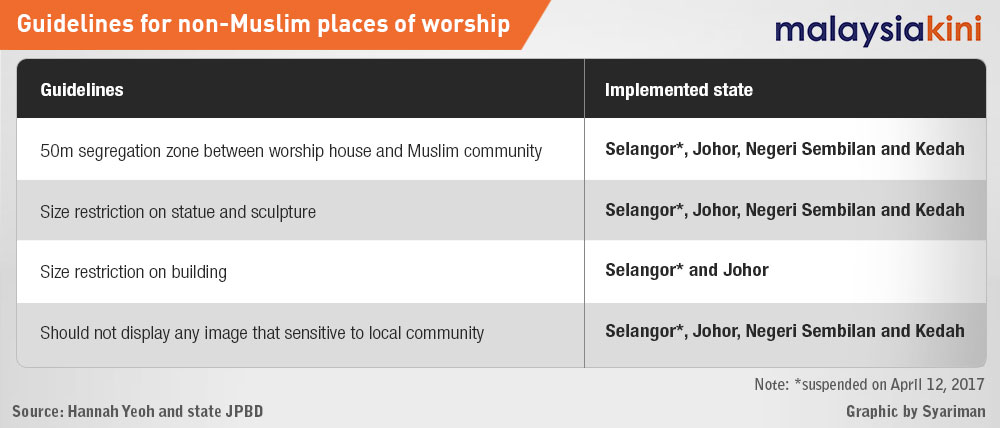
No. The guideline is nothing new. States like Kedah, Johor and Negeri Sembilan also came up with the 50-meter segregation zone.
However, there is no such limitations in Perak, Pulau Pinang, Kelantan, Sabah and Sarawak.
Why did these states adopt the 50-metre segregation guidelines?
They may have followed the blueprint provided at the federal level by Town and Country Planning Department of Peninsular Malaysia (JPBD), under the Town and Country Planning Act 1976.
Under the act, two editions of Universal Planning and Development Guidelines were released in 1997 and 2000 respectively.
How are the state's guidelines drafted?
At federal level, JPBD, the custodian of land-use information, would draft a blueprint of planning guidelines and to be later adopted by the state JPBD.
State JPBD will then modify the blueprints according to the development of their respective states. Once ready, the guidelines will be tabled in the state executive council meeting for approval.
The local governments, however, have the authority to make further adjustments to these guidelines.
What did the previous federal guidelines say about non-Muslim places of worship?
The first version of federal guidelines states:
- The application for construction of the non-Muslim worship house shall be referred to state religious council for feedback and approval.
- A segregation zone is needed to separate the places of worship with other communities, especially the Muslim community.
- Statue and sculpture should not exceed five metres in height.
The second version of federal guidelines states:
- A segregation zone of at least 50-metre is needed to separate the place of worship with other communities, especially the Muslim community.
Did the federal government make any effort to review the 17-year-old central guidelines?
Yes.
JPBD drafted specific guidelines for non-Muslim place of worship, known as Temple, Church and Gurwara Guidelines, which served as a supplementary to Housing Planning Guidelines.
After a check with a JPBD officer, Malaysiakini found that the 30-page new guidelines on non-Muslim places of worship have yet to be implemented.
What did the 2013 draft guidelines (not implemented yet) say about the building of non-Muslim places of worship ?
- The building of non-Muslim places of worship based on integration concept is encouraged to accommodate the local needs of different religions.
- A segregation distance of at least 100 metres is encouraged in the construction of a temple, church and gurdwara at a place where majority of the people practice another faith.
- In a Muslim majority area, the height of the statue and non-Muslim worship house should be lower than the height of building, dome and mosque tower of the surrounding area.
- If possible, the height of the building need to take into consideration the skyline, colour and scenery, so it could fit harmoniously with the surrounding buildings.
- Setting up the threshold of one worship house to 2,300 population in an urban area and one worship house to 1,000 population in a rural area.
Yeoh had said that Pahang, Terengganu and Perlis have adopted the draft guidelines on the 100-metre segregation. What did the states say about it?
Perlis executive council Mat Hassan told Malaysiakini: "Perlis has yet to implement the segregation zone."
An officer of Pahang Town and Country Planning Department, who spoke on condition anonymity, denied that the state had adopted it.
"Bear in mind that, the (central) guideline still remains a draft copy," she had said.
Malaysiakini has attempted to contact Terengganu Menteri Besar Abdul Razif Abd Rahman, state executive councillor Ghazali Taib and state JPBD for respond via telephone and text messages.
This instalment of KiniGuide is compiled by Kow Gah Chie.


Report this comment
Are you sure you want to delete this comment?
This action cannot be undone.