



Do away with vernacular schools? M'sians split down the middle
Reports might suggest that race and religion are the fault lines which divide Malaysians, but a recent survey revealed that views are most divergent when it comes to national education.
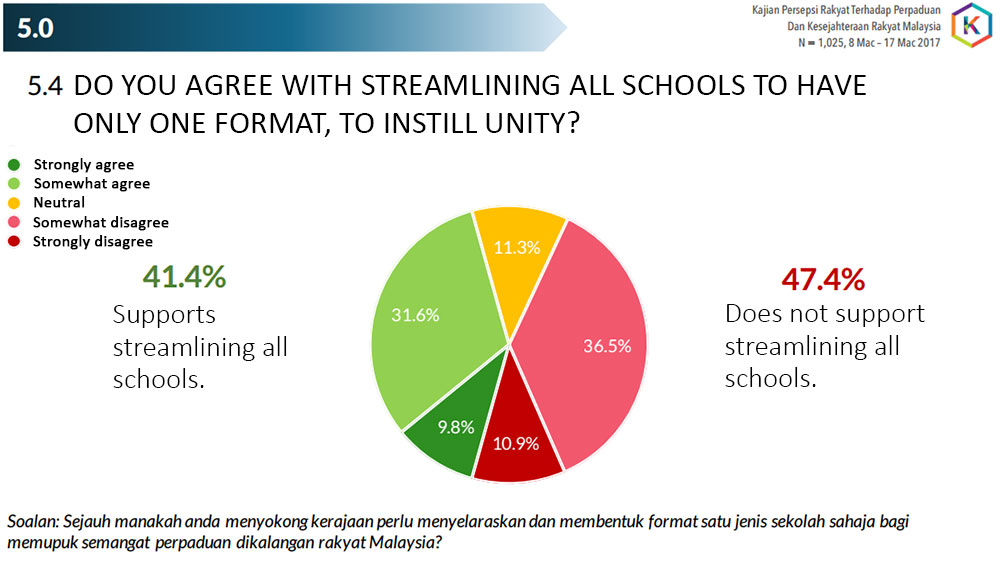
Asked if they would support the streamlining of all schools into a single format, Malaysians were split in polar directions.
A total 41.4 percent of those surveyed by research house Kajidata in March said they agreed with streamlining all schools in the interest of unity, while 47.4 percent disagreed. A total 11.3 percent were fine either way.
Reports might suggest that race and religion are the fault lines which divide Malaysians, but a recent survey revealed that views are most divergent when it comes to national education.
Asked if they would support the streamlining of all schools into a single format, Malaysians were split in polar directions.
A total 41.4 percent of those surveyed by research house Kajidata in March said they agreed with streamlining all schools in the interest of unity, while 47.4 percent disagreed. A total 11.3 percent were fine either way.
The widely divergent views contrasted with responses on questions regarding race and religion
For example, Malaysians surveyed are mostly in the same boat when it comes to Islam being the religion of the federation with 82.5 percent agreeing. The rest were mostly neutral while about 10 percent disagreed.
There is also agreement that there is freedom of religion practiced in Malaysia - eight in 10 surveyed answering in the affirmative.
A total 2.7 percent "strongly disagreed" that freedom of religion existed in the country while 8.7 percent "somewhat disagreed".
Almost two-thirds of Malaysians surveyed also said they do not prioritise having neighbours of the same ethnicity while an overwhelming 95.7 percent said they encouraged their friends and family to befriend those from other ethnicities.
A tiny fraction - just under two percent - said they discouraged loved ones from befriending other races.
Malays and Indians prefer living within own communities
Even so, drilling down into the data revealed that a considerable level of Malays and Indians still prefer to live within their own communities.
One in four of Malays surveyed said they prefer a Malay neighbour, while one in five Indians said the same, according to Kaji Data.
"Our analysis finds that the community spirit among Malaysians need to be improved to overcome racism," it said.
The survey was conducted via telephone interviews on 1,025 respondents from all 222 parliamentary constituencies.
It was conducted to assist the government in understand society's perceptions in the formation of the Transformasi Nasional 2050 framework.
In particular, it sought to measure grassroots support for unity-building efforts and the level of harmony in Malaysia.
KajiData concluded that while there is high level of unity and tolerance in Malaysia, Malays were less supportive of celebrating the festivities of other ethnic groups out of concern that it might impinge on their Islamic beliefs.
According to its website, KajiData is a commercial research house whose advisor Syed Arabi Syed Abdullah Idid, a professor attached to Universiti Islam Antarabangsa's faculty of Islamic Revealed Knowledge and Human Sciences.
Critics of vernacular schools have argued that having parallel systems would lead to children growing up within their ethnic bubbles.
They also argued that graduates of the vernacular school systems do not have the language and social skills to relate to those outside of their race.
However, proponents of such schools note that mother tongue education is guaranteed in the Federal Constitution.
They also point out that in the case of Chinese vernacular schools, more and more non-Chinese students are enrolling due to perceived higher standards of education, making these schools more multicultural than national schools which are increasingly dominated by Malay students.


Are you sure you want to delete this comment?
This action cannot be undone.