




Politics of promotion in UM
 special report
Universiti Malaya the country's oldest tertiary institution has been in the limelight for the wrong reasons in recent months, with academic Dr Edmund Terence Gomez having spilled the beans on
'irregularities'
in two main areas of its operations.
special report
Universiti Malaya the country's oldest tertiary institution has been in the limelight for the wrong reasons in recent months, with academic Dr Edmund Terence Gomez having spilled the beans on
'irregularities'
in two main areas of its operations.
These respectively involve claims that unfair criteria are applied in promoting academic staff and that there is tampering with marks obtained by students sitting for examinations.
As malaysiakini set out to verify the claims and to elicit solutions for reform, two things quickly became clear:
- No lecturer was willing to go on record with the complaints for fear of retribution.
 special report
Universiti Malaya the country's oldest tertiary institution has been in the limelight for the wrong reasons in recent months, with academic Dr Edmund Terence Gomez having spilled the beans on
'irregularities'
in two main areas of its operations.
special report
Universiti Malaya the country's oldest tertiary institution has been in the limelight for the wrong reasons in recent months, with academic Dr Edmund Terence Gomez having spilled the beans on
'irregularities'
in two main areas of its operations.
These respectively involve claims that unfair criteria are applied in promoting academic staff and that there is tampering with marks obtained by students sitting for examinations.
As malaysiakini set out to verify the claims and to elicit solutions for reform, two things quickly became clear:
- No lecturer was willing to go on record with the complaints for fear of retribution.
Those contacted would only speak on condition of anonymity, lending weight to similar claims by malaysiakini readers who had contributed to the letters forum from May to June in the wake of Gomez's allegations.
Among the complaints are that the promotion exercise lacks transparency and that it encourages racial bias as well as pushes academics to 'play politics' to get noticed.
Opaque process
In an interview, a lecturer said dissatisfaction among academics rises after every promotion exercise because of the opaque process.
"Nobody knows what or why (a lecturer) gets promoted. If the system is transparent, we would know who deserves or doesn't deserve (the promotion)," he said.
Without full disclosure, he said, the scene is set for suspicion and speculation among the staff.
Although there are criteria for promotions, another lecturer said "people are not sure whether someone is promoted because of academic excellence or his or her connection with politicians".
"A call from a minister could totally change a decision of the university to promote and demote someone," he said.
The procedure begins with lecturers submitting an application to the department head, who then pursues it with the dean if the applicant has the necessary qualifications.
At faculty level, a peer review committee is formed to assess the applicant on teaching ability, publication of papers, attendance at conferences and competence in administrative duties. Those who make the mark are selected for an interview.
The curriculum vitae of those shortlisted is given to external assessors - who are not with the university for them to prepare a recommendation report that will be forwarded to the promotion board.
Subsequently, the board comprising the vice-chancellor, deputy vice-chancellor and two professors - one each from the arts and social science and science faculties - will determine who gets to be promoted.
Political connections
One lecturer alleged that those who have 'political connections' with the vice-chancellor or deans would stand a better chance of being promoted.
While he claimed there was no racial bias in the exercise, another lecturer disagreed.
"Most non-bumiputeras do not get to be heads of departments, deans or even vice-chancellors," he claimed in e-mail correspondence, adding that cronyism raises another point of contention.
"If you are not in the favour of the committee members, they may find all sorts of excuses not to promote you. However, if you are in their good books, even if you don't meet the requirements, you can still get promoted."
A malaysiakini reader has written that close relationships between department heads and their immediate superiors sometimes facilitates prospects for promotion.
This sends negative signals to subordinates and encourages junior scholars to climb the bureaucratic ladder. Departments may therefore be run by those without the required academic expertise, since they would not have produced quality research and writing.
Another reader noted that the rules for promotion may appear stringent on paper in terms of academic performance, but that application is weak. New lecturers may be appointed because of " their links with the university officers".
"There is at least one case of blatant abuse of power where an individual (in UM) who does not have a PhD degree and has a rotten academic and research record, (but) was appointed as a lecturer," the reader wrote.
John Hopkins University's School of Advance International Studies assistant professor Bridget Welsh, who has extensive connection with the Malaysian academia, said academic standards have dropped as political loyalty is rewarded over publications and job performance.
"Promotions appear to be based on personal relationships and political affiliations rather than on professionalism. Leadership positions within universities have become venues to fawn over politicians rather than to educate," she said.
 Conversely, academics critical of authority are deemed to be 'anti-establishment' and have been taken to task for this, according to UM Academic Staff Association head Rosli Mahat.
"People who have voiced criticism about the management have complained that, during their interview for promotion, they were upbraided for being vocal about problems in UM," he said in an interview.
Evidence found
Rosli, a senior lecturer himself, confirmed the allegations of irregularities in the promotion exercise, citing complaints by three lecturers to their faculty head after the 2002 promotion exercise.
He said a committee of inquiry comprising four members of the 450-strong association had investigated the allegation the following year.
The team found evidence of irregularities, but the management halted the probe even before it could be completed, he said.
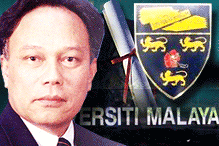 However, the committee still managed to submit a
confidential report
last year, highlighting the evidence, to Vice-Chancellor Prof Dr Hashim Yaacob (
photo, left
) and Higher Education Minister Higher Education Minister Dr Mohd Shafie Salleh.
However, the committee still managed to submit a
confidential report
last year, highlighting the evidence, to Vice-Chancellor Prof Dr Hashim Yaacob (
photo, left
) and Higher Education Minister Higher Education Minister Dr Mohd Shafie Salleh.
(Hashim, when interviewed earlier, had claimed that he was not aware of irregularities in the promotion exercise. Shafie, meanwhile, had told parliamentary opposition leader Lim Kit Siang that there is no truth to the allegations of favouritism in promotions in a written reply to the Dewan Rakyat on June 22.)
The report called for a Public Commission of Inquiry to be set up to complete the investigation, stating that it would enable transparency and accountability to restore confidence in the university's management.
Although the matter has since been raised repeatedly with Hashim during departmental joint council meetings, the management has yet to take any action, said Rosli.
The head of the investigation committee, who did not want to be named, told malaysiakini when contacted that he had resigned from his post when the process was terminated.
He claimed he had destroyed the relevant files at the time, in explaining why he could not produce a copy of the report.
Improving transparency
Asked to comment on ways to improve transparency in the promotion exercise, a lecturer suggested making public the curriculum vitae (CV) of those who are promoted.
"If you look at the CV of some professors and associate professors, you will find that many actually don't deserve the promotion," he claimed.
Another lecturer said the usual practice in foreign universities is to post the CV of academics on the website "as there is nothing to hide."
It was also suggested that the appointment of vice-chancellor should be free of external interference, such as that from government as this could lead to political influence on the university.
One lecturer said the concept of public universities is still not well understood by the government, resulting in the stifling of intellectual growth and maturity in Malaysia.
"If the government is truly serious (about tertiary education), then it has to step back from universities. This institution belongs to the public and we serve the public. We don't belong to the Barisan Nasional," he said.
A further recommendation is to scrap the government's 'efficiency assessment' test for promotion in the civil service, and which covers academics as well.
"The test doesn't really reflect anyone's ability as an academic," said a lecturer, who points out that the evaluation is generalised and includes such skills as 'public speaking'.
"Some of us can speak (well) in public. Some of us can't. But that does not mean that we are not good as academics. Even a really boring lecturer may not be a bad lecturer, and it sure does not make the person a bad academic.
"We should not be treated like a bunch of civil servants. This is a university, not a government agency."
Independent body
On the issue of alleged tampering with students' marks, Rosli said this is done mainly "by raising the marks without the agreement of the examiner of the course".
This is done despite a university senate ruling that marks should not be raised by more than three percent.
"There was one serious case where it was raised by 13 percent across the board against the wishes of two of its three examiners," he alleged.
Rosli described the tampering as being 'student-friendly'.
Although there are guidelines on handling marking when the grades are questionable either because of a 'too high' failure rate for a course or when 'too many' students obtain good grades this is not heeded, he added.
As a solution, a lecturer suggested that an independent body be formed to deal with cases of tampering with marks.
Part 2: A pervasive culture of fear
Part 3: Stranglehold over undergrads


