




Stranglehold over undergrads
 special report
The heads of two student bodies in Universiti Malaya (UM) typify the intake since the early 1970s students who are fearful of initiating change and mindful of keeping their heads low. Both leaders refused to be identified by name in this report.
special report
The heads of two student bodies in Universiti Malaya (UM) typify the intake since the early 1970s students who are fearful of initiating change and mindful of keeping their heads low. Both leaders refused to be identified by name in this report.
This is the combined impact of the University and University Colleges Act 1971 (UUCA) and the Akujanji pledge of loyalty , which have persuaded students that it is not worth their while to get into "trouble" for expressing themselves freely and openly.
Like fellow Malaysians who are corralled by a raft of other repressive laws, university students too heed the dictates of the UUCA which prevent their participation without consent in organised activities or membership in social and political groups.
 special report
The heads of two student bodies in Universiti Malaya (UM) typify the intake since the early 1970s students who are fearful of initiating change and mindful of keeping their heads low. Both leaders refused to be identified by name in this report.
special report
The heads of two student bodies in Universiti Malaya (UM) typify the intake since the early 1970s students who are fearful of initiating change and mindful of keeping their heads low. Both leaders refused to be identified by name in this report.
This is the combined impact of the University and University Colleges Act 1971 (UUCA) and the Akujanji pledge of loyalty , which have persuaded students that it is not worth their while to get into "trouble" for expressing themselves freely and openly.
Like fellow Malaysians who are corralled by a raft of other repressive laws, university students too heed the dictates of the UUCA which prevent their participation without consent in organised activities or membership in social and political groups.
The student leader said this is exacerbated by the fact that undergraduates today are less interested in current issues than in entertainment and leisure activities.
"When we were told to sign the Akujanji (in May 2002), some initially had doubts about the purpose. But they were afraid to say anything openly and signed the document regardless," he said.
"Students 10 years ago were bolder and would have held demonstrations but not today."
A UM post-graduate student, who declined to be identified, expressed concern that most of her course-mates had signed the oath unquestioningly.
"They said their main focus is on their studies and they did not see the point of saying 'No' to signing the Akujanji ," the student said, agreeing that there is little interest in critical issues among the student body.
Targeting a degree
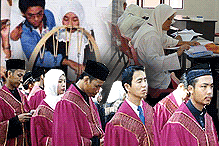 The other student leader noted: "
Akujanji
has certainly had a negative psychological impact on the students. They are prevented from doing things that are deemed contradictory to oath of loyalty," he said.
The other student leader noted: "
Akujanji
has certainly had a negative psychological impact on the students. They are prevented from doing things that are deemed contradictory to oath of loyalty," he said.
"There is a need to instil awareness among campus residents of basic rights guaranteed by the human rights charter and the Federal Constitution."
In this respect, he said the university is "the best place" to give meaning to democracy and human rights.
"As future leaders, undergraduates should actively participate in national and international issues by bringing up ideas and views. They should also be involved in providing solutions for society's problems," he said.
Instead, they are complacent and focus their attention on the sole target of obtaining a degree.
Asked to comment on students' freedom to conduct dialogues, the leader said the campus authorities allow discussion of any topic except politics.
They are also not allowed to invite opposition politicians or representatives of non-governmental groups that have political leanings to events on campus.
"This has held back the students' ability to think critically," he said.
At the same time, the university management monitors programmes organised by student bodies, which has discouraged dialogues.
Such intervention extends to the annual campus elections, which are often considered a litmus test of support among the youth for the government candidates usually fall into either the pro- or anti-establishment faction.
Last September, the anti-establishment UM Undergraduates Coalition boycotted the UM elections due to "frustration over interference by the management", according to one leader.
"They felt there was no point in contestingthey probably realised they could not make much difference to the students," he said.
As a result, the 'pro-government' UM Undergraduates Council swept the posts uncontested to take 'power' for the first time in eight years.
Hurdles to leap
One reason why student leaders are hampered in organising activities is because the management throws up obstacles, according to one leader.
He said approval is withheld for certain activities or organisers are told to change the content of the programmes scheduled, on grounds that the objectives are "unsuitable" for students.
 While the campus authorities often cite budget constraints as their reason, they have never told students exactly how much is available for student development programmes.
"If the management doesn't like a student, it would take a long time for him or her to get approval (of programmes)," claimed the leader.
Meanwhile, a lecturer revealed the effect of the UUCA and the Statutory Bodies Discipline and Surcharge Act 2000 - the Act from which Akujanji is derived from - on university staff and academic staff.
"The impact of UUCA is not as bad for academic staff as it is for students," he said, noting that the law only bars academics from making off-campus comments about the university management.
However, he said the Statutory Bodies Discipline and Surcharge Act 2000 - which is applicable to statutory bodies, including universities should be abolished in order to encourage intellectual discourse.
The Act prohibits academic staff from making any comment outside or within the university premises positive or otherwise about government policies, among others, without the ministerial's consent.
"This has added another law that hangs over our heads, strengthening the culture of fear," he said, pointing out that it cultivates lecturers who are not willing to risk losing their career.
If found guilty, the lecturer could be fined, face a disciplinary hearing or have his or her services terminated.
Both pieces of legislation have to be thrown out, he added.
Part 1: Politics of promotion in UM
Part 2: A pervasive culture of fear


Are you sure you want to delete this comment?
This action cannot be undone.