


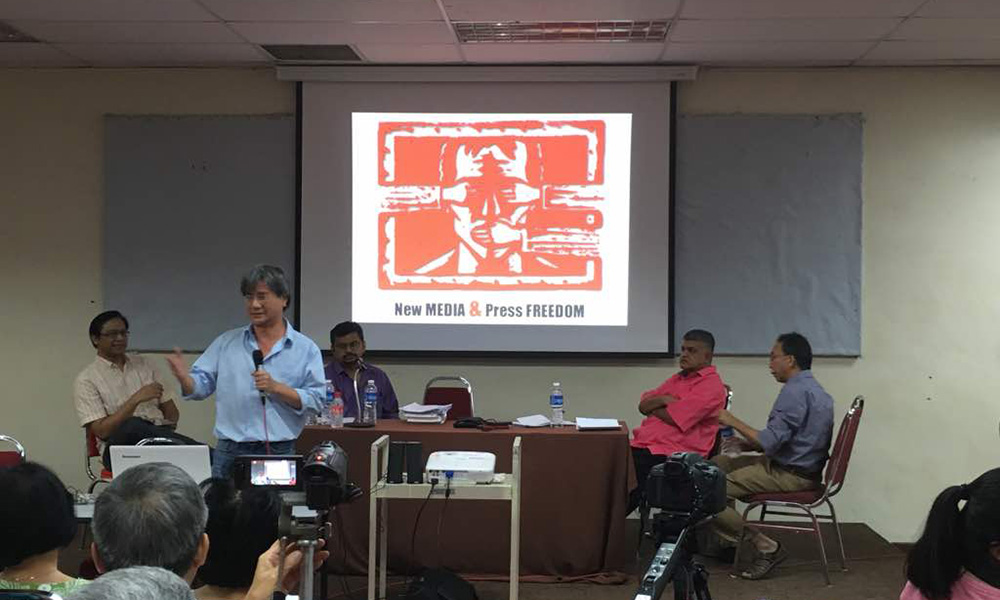

Sedition Act 'invalid' as it's not an Act of Parliament
Although applied extensively in Malaysia, the 1948 Sedition Act is “invalid” as it is not an Act of Parliament, advocate and solicitor Simon Murali argued in Penang last night.
Since it is not an Act of law passed by Parliament, the Sedition law cannot restrict a citizen’s right to freedom of speech and expression, the lawyer said.
Addressing a crowd of 70, Simon said: “The stark reality and stark truth is, the Sedition Act is nothing more than the product of British creativity.
“It is a relic of our colonial past. It was used during the turbulent times of the colonial era, just after World War II,” he added at a forum on ‘Defending Freedom of Speech’ organised by Aliran at the Caring Society.”...
Although applied extensively in Malaysia, the 1948 Sedition Act is “invalid” as it is not an Act of Parliament, advocate and solicitor Simon Murali argued in Penang last night.
Since it is not an Act of law passed by Parliament, the Sedition law cannot restrict a citizen’s right to freedom of speech and expression, the lawyer said.
Addressing a crowd of 70, Simon said: "The stark reality and stark truth is, the Sedition Act is nothing more than the product of British creativity.
“It is a relic of our colonial past. It was used during the turbulent times of the colonial era, just after World War II,” he added at a forum on ‘Defending Freedom of Speech’ organised by Aliran at the Caring Society.
“At the time, voices demanding for independence were becoming louder and something had to be done to shut them down. So, the Sedition Act came into force.”
However, our Parliament only came to being in 1957, after the country’s independence, Simon said.
So, it cannot fall under Article 10(2)
Therefore, the Sedition Act was not enacted by the power of Parliament, and since it was not passed by Parliament, it cannot come under the blanket of Article 10(2) of the Federal Constitution, he added.
Under this clause, the Federal Constitution states that for a law to restrict our freedoms, it must be enacted by the Malaysian Parliament.
“So, by right, the sedition law cannot be employed to restrict freedoms. Whenever there is a conflict between the Sedition Act and your freedom of speech, the latter should prevail,” Simon said.
However, the Federal Court has held that the Sedition Act is applicable, and rejected this argument, based on Article 162 of the Federal Constitution.
Article 162 states that existing laws can be accepted and applied with little modification so that they can be used within the framework of the constitution.
“But with greatest respect and reverence to the Federal Court, it is my humble opinion that Article 10(2) is very clear, that if we want to have restrictions on these fundamental rights, Parliament must enact the law,” Simon pointed out.
“If the law is to have restrictions on freedom, it must go through three stages of process - the Dewan Rakyat (Lower House), Dewan Negara (Senate), get Royal Ascent and be gazetted.
“So, with all greatest respect, the Sediton Act is invalid and cannot curb these fundamental freedoms,” he said.
Other than Simon, other speakers at the forum last night were Malaysiakini editor-in-chief Steven Gan, political cartoonist Zunar (Zulkiflee Anwar Ulhaque) and Aliran secretary Mustafa K Anuar.


Are you sure you want to delete this comment?
This action cannot be undone.