



Calculating GE14 - building up to be a cliffhanger?
COMMENT | It is far too early to know when the next general election in Malaysia will be held. It would be the 14th in Malaysia's history, though.
But who will perish in the impending 14th general election? The proverbial knife, to be sure, will cut both ways. It may seem hypothetical, but the risks are highest to Prime Minister Najib Abdul Razak, as the bejewelled crown is, after all, his to lose.
Thus, if there is an anti-Najib wave, which is increasingly likely due to the increase in the cost of living, the coming general election will see the end of his political career as the sixth prime minister of Malaysia.
In turn, if Najib can hold back Pakatan Harapan, it would be the opposition that will probably see the end of itself - especially if it refuses to work together in avoiding multi-cornered fights. Thus, this election is building up to be a cliffhanger. However, a caveat is due too.
Even if Najib loses, there is the National Security Council Act 2016 that can be kicked into operation to suspend the electoral process in its entirety. If this be the case, it would signal the end of Malaysian electoral democracy too; as the incumbent has refused to give in to the verdict of the voters.
Come what may, Umno has been at the top of the political food chain since 1946. In the last general election in 2013, despite losing the popular votes, it still garnered 88 parliamentary seats (now, with two seats gone to the opposition), making it the first among equals in the proverbial game of thrones.
But, due to a spate of alleged corruption scandals, especially 1MDB, Umno is fast losing steam too. Thus, it is deriving its strength primarily from working with the political parties in Sabah and Sarawak.
These two states contributed 22 and 25 parliamentary seats to the stable of the government led by Umno. With a total of 47 additional seats, Umno was able to rule Malaysia based on the crucible of uniting Umno with the seats derived from the two Borneo states.
However, the much celebrated Pan-Borneo Highway that has been launched and relaunched numerous times, which seeks to connect Sabah and Sarawak, has not seen serious progress as yet or at best, at a very infant stage...
COMMENT | It is far too early to know when the next general election in Malaysia will be held. It would be the 14th in Malaysia's history, though.
But who will perish in the impending 14th general election? The proverbial knife, to be sure, will cut both ways. It may seem hypothetical, but the risks are highest to Prime Minister Najib Razak, as the bejewelled crown is, after all, his to lose.
Thus, if there is an anti-Najib wave, which is increasingly likely due to the increase in the cost of living, the coming general election will see the end of his political career as the sixth prime minister of Malaysia.
In turn, if Najib can hold back Pakatan Harapan, it would be the opposition that will probably see the end of itself - especially if it refuses to work together in avoiding multi-cornered fights. Thus, this election is building up to be a cliffhanger. However, a caveat is due too.
Even if Najib loses, there is the National Security Council Act 2016 that can be kicked into operation to suspend the electoral process in its entirety. If this be the case, it would signal the end of Malaysian electoral democracy too; as the incumbent has refused to give in to the verdict of the voters.
Come what may, Umno has been at the top of the political food chain since 1946. In the last general election in 2013, despite losing the popular votes, it still garnered 88 parliamentary seats (now, with two seats gone to the opposition), making it the first among equals in the proverbial game of thrones.
But, due to a spate of alleged corruption scandals, especially 1MDB, Umno is fast losing steam too. Thus, it is deriving its strength primarily from working with the political parties in Sabah and Sarawak.
These two states contributed 22 and 25 parliamentary seats to the stable of the government led by Umno. With a total of 47 additional seats, Umno was able to rule Malaysia based on the crucible of uniting Umno with the seats derived from the two Borneo states.
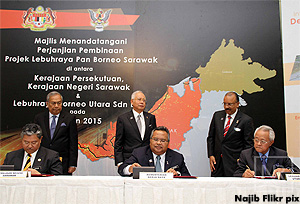 However, the much celebrated Pan Borneo Highway that has been launched and relaunched numerous times, which seeks to connect Sabah and Sarawak, has not seen serious progress as yet or at best, at a very infant stage.
Perhaps never, if Malaysian finances remain in a quagmire.
At 1,000km in length in Sarawak, with another 400km in Sabah, the cost of cutting through the rainforests and land will be high. Not unless some major corporations come into play, with the land and forest concessions bartered to them in exchange, the Pan-Borneo Highway will take time to materialise.
Even if there are companies that will build the Pan Borneo Highway, high exposure to corruption cannot be ruled out, as the government is inclined to do. Remember, corruption used to be a fact of life in Malaysia. Now it is a way of life.
As things are, it has been two years since Najib made his promise to the locals in Borneo. Very little progress has been made; a pattern that echoes the lack of any progress in Bandar Malaysia.
At this rate, the original supporters' patience is bound to wear thin, making them more likely to switch sides in the next general election. No thanks to the constant pressures from Dr Mahathir Mohamad and Harapan, which forms the opposition, Sabah and Sarawak are no longer a sure bet for Najib.
One must also not underestimate the strong personal relationship between the newly-minted Harapan’s director of elections and Parti Peribumi Bersatu Malaysia (Bersatu)’s president, Muhyiddin Yassin, with the Sarawak Chief Minister Abang Johari Abang Openg.
A pivotal demonstration of true virility
In all likelihood, Najib will try to let biology take its course. Despite his age, Mahathir's vigorous health can still put many people half his age to shame. His schedule is often packed to the brim.
When he delivers an anti-Najib speech, often in humid and hot settings, he can hold the audience in awe for close to an hour or more. Mahathir, for the lack of a better word, is nothing less than a pivotal demonstration of true virility.
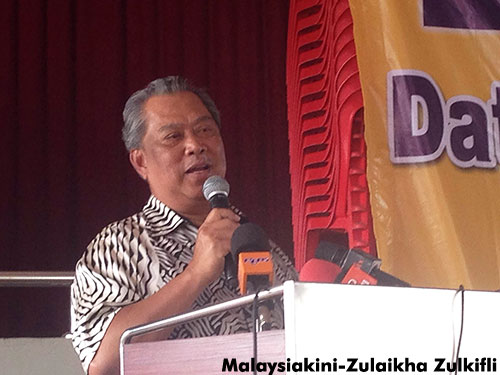 Muhyiddin (photo) also has, from a serene bureaucrat technocrat personality, begun to pump iron in his speeches, no more pulling any punches away. Increasingly, we see a reinvented Muhyiddin.
But Najib and his inner circles do not believe that Mahathir can take on the punishing schedules indefinitely. At some point between now and the middle of next year, something is bound to give.
Thus, while the opposition huffs and puffs, often abetted by Mahathir, Najib has refused to relent. He has dished out electoral goodies to all and sundry without announcing if the election is near. He wants to tire Harapan down, and Mahathir too.
Without a doubt, Najib wants the next general election to be Mahathir's last. Moreover, granted that Anwar Ibrahim cannot contest in any election unless he is first pardoned by the Agong, Najib too feels that Anwar has been checkmated, especially when the latter has to serve a ban of five years more before he can run for any office. On Aug 10, Anwar Ibrahim would be marking his 70th birthday.
Hadi is frail in health
But Najib's own tactical guile has his own flaws too. This is where the risks come into play.
Abdul Hadi Awang, the president of PAS who is staunchly defending Najib, is frail in health, as he has had a heart bypass. Doctors have advised Hadi to take a two-month rest, without which his health may fail further.
Next in line to the succession of PAS, a religious conservative party, is Tuan Ibrahim Tuan Man, who is not necessarily in Najib's corner.
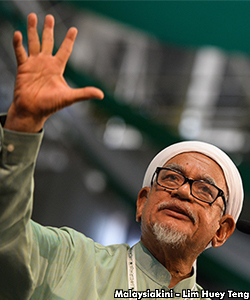 On more than one occasion, when Hadi (photo) purged those in PAS who were anti-Umno and anti-Najib, Tuan Ibrahim brought them back into the fold as his own advisers. One of them is Mustapha Ali, who is a strategic thinker in PAS. He is one of the old war horses in PAS who was once part of the BN and PAS cabinet in 1976-1978.
Mustapha Ali does not approve of PAS' close affiliation with Umno undertaken by Hadi at the urging of the five 'tembikai' (watermelons) - green (PAS) on the outside, red (Umno) on the inside - consisting of Ahmad Samsuri, Nik Abduh, Mohd Zuhdi, Nasruddin Tantawi and Khairuddin Takiri.
Invariably, by bidding for time, Najib is taking a big risk on his alliance with PAS, as it is secured through the exclusive support of Hadi and his five 'tembikai' alone.
Hadi, too, could wilt under the heat of the general election as the tempo picks up. Especially from PAS grassroots and majority of their leaders who have fought Umno for generations.
With merely 12 parliamentary seats to date, PAS is a pale reflection of its old self. It is neither a kingmaker nor a spoiler. Voters who ignore Umno will ignore PAS.
Indeed, PAS has promised to contest in 150 parliamentary seats, a strategy that is at once desperate as it is foolhardy. It is more likely the latter, as PAS has never won more than 27 parliamentary seats as it did in 1999. Thus it stretches belief that PAS can increase its seats by manifold.
With a weak hand, Najib has no choice but to wait. With a dividend of RM13 billion from Petronas over the next few months, Najib's war chest is the only life saver. But no one knows if loyalty can be bought with cash.
Mahathir has encouraged the voters to take all that they can get from the government. It is the people's money anyway, he affirmed.
If the voters do follow his biddings, Najib and Umno are skating on thin ice with every delay in calling for the snap election.
RAIS HUSSIN is a supreme council member of Parti Peribumi Bersatu Malaysia (Bersatu). He also heads the party's policy and strategy bureau.
The views expressed here are those of the author/contributor and do not necessarily represent the views of Malaysiakini.


Are you sure you want to delete this comment?
This action cannot be undone.