



Skolafund connects varsity students in need with those who can help
FEATURE | In 2013, Hafiz (not his real name), was a student at Universiti Islam Antarabangsa Malaysia (UIA) who found himself struggling to pay his university fees.
The lad had no choice but to work two jobs to pay off his parents’ medical bills. This affected his studies and Hafiz was forced to extend his studies by an additional semester.
As it was an extra semester, the National Higher Education Fund Corporation (PTPTN) did not cover the fees and Hafiz was forced to look for a third job.
Posting about his plight on UIA’s Facebook group for suggestions or offers for a third job, Hafiz was instead bombarded with queries for his bank account number.
Hundreds of UIA students offered to transfer money to Hafiz who could not believe his stroke of good luck.
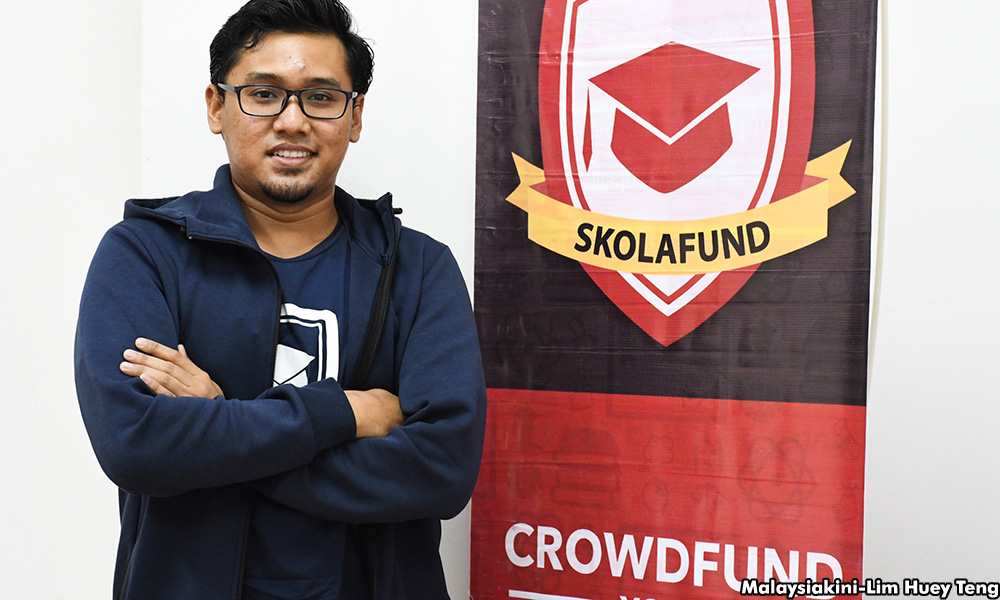
Hafiz’s story was being recounted by Skolafund co-founder Tengku Ahmad Syamil Tengku Ibrahim, who noticed the Facebook posting in his first year of studies at the university.
Skolafund is a crowdfunding platform that matches varsity students in need with those who are willing to provide them financial assistance.
It was that Facebook post and a few other similar incidents that made Syamil realise how open people were towards supporting deserving students facing financial difficulties.
“I thought there's that gap in between. I thought there should be a crowdfunding platform that matches these two parties together.”
The issue of transparency was another reason why Syamil thought having a crowdfunding platform for university students would be best.
FEATURE | In 2013, Hafiz (not his real name), was a student at Universiti Islam Antarabangsa Malaysia (UIA) who found himself struggling to pay his university fees.
The lad had no choice but to work two jobs to pay off his parents’ medical bills. This affected his studies and Hafiz was forced to extend his studies by an additional semester.
As it was an extra semester, the National Higher Education Fund Corporation (PTPTN) did not cover the fees and Hafiz was forced to look for a third job.
Posting about his plight on UIA’s Facebook group for suggestions or offers for a third job, Hafiz was instead bombarded with queries for his bank account number.
Hundreds of UIA students offered to transfer money to Hafiz who could not believe his stroke of good luck.
Hafiz’s story was being recounted by Skolafund co-founder Tengku Ahmad Syamil Tengku Ibrahim, who noticed the Facebook posting in his first year of studies at the university.
Skolafund is a crowdfunding platform that matches varsity students in need with those who are willing to provide them financial assistance.
It was that Facebook post and a few other similar incidents that made Syamil realise how open people were towards supporting deserving students facing financial difficulties.
“I thought there's that gap in between. I thought there should be a crowdfunding platform that matches these two parties together.”
The issue of transparency was another reason why Syamil thought having a crowdfunding platform for university students would be best.
“When they were doing it via Facebook, no one actually tracked how much the students have actually received.
“There were cases where people would copy and paste messages, change the bank account number, spread it via WhatsApp and then the money doesn’t actually go to the student, it goes to a totally different account,” said Syamil.
He went on to participate in various social impact and innovation-related competitions to validate the idea before he roped in more team members to join him.
The co-founder of Skolafund has his own interesting story to tell.
The unassuming student was named on Forbes’ first “30 under 30 Asia” list and recognised by Digital News Asia’s “Digerati 50 - The Ones Who Will Shape Malaysia’s Digital Economy”.
Speak to the 26-year-old and you will find that his maturity is unlike that of a normal varsity student whose main priority is to avoid flunking papers.
Although most of his time is spent managing Skolafund, the third-year business administration major has never neglected his studies, and has consistently appeared on the Dean’s List every semester.
The Singaporean decided to study in Malaysia after being exposed to UIA by his teachers at Madrasah Al-Irsyad in Singapore, where he was a student from primary one to secondary five.
Despite having been offered a place at Singapore’s Nanyang Business School, Syamil decided to enrol at UIA after he was advised by several businessmen to “get out of Singapore” if he wanted to learn more about business by meeting other entrepreneurs and to learn from them about dealing with bigger markets.
The opening of the Malaysian Global Innovation and Creativity Centre (Magic) in 2013 was another factor that influenced Syamil’s decision to study in Malaysia.
“I could sense that the start-up scene in Malaysia was growing. I wanted to be part of this growth and I wanted to learn together with others who want to learn about start-ups. Malaysia was quite attractive from that angle.”
His interest in anything related to social impact started in secondary school when he realised that he had to apply for sponsorship every time he wanted to start a project.
“That was something I felt wasn't sustainable. Every single voluntary programme I started was no longer there after almost a year.
“I thought there should be a sustainable model for whatever I want to do so that even if I'm not there, the system could still continue.”
After coming across social entrepreneurship, Syamil learned that some business elements are essential in any venture.
“I realised that a lot of social entrepreneurship programmes don't really focus on the business side so I got myself interested in general business and technology business.
“The main interest is social impact but I realised to make efforts sustainable, it has to have some kind of financial business model, that's where I got myself interested in business.”
Syamil is thankful for the support of his family when it comes to Skolafund. Although they live in Singapore, the eldest of four siblings tries to keep them updated on Skolafund’s latest happenings.
“My parents are not from any social enterprise or business background. My dad's in the army, my mom is a teacher.
“When times were hard, they would remind me to remember why I started this venture. At times, when I decided to take leave from school, they got a bit worried but alhamdulillah, things have been going quite well.”
Even in his free time, Syamil either tries to spend time with his family or tries to pick up new skills related to information technology such as digital marketing, web and application design as well as graphic and video editing either through YouTube or Udemy.
Explaining his one-year break from his studies, Syamil credited it to having helped to accelerate the growth of Skolafund.
“The number of campaigns we launched and the amount of money crowdfunded through the platform doubled during the time,” he said.
Syamil tells the story of Skolafund further in his own words:
WE STARTED SKOLAFUND IN APRIL 2015. We got in Startupbootcamp FinTech Singapore, an accelerator programme for financial technology start-ups. Each year they would select 10 start-ups from around the world to be a part of that and we were fortunate to be selected for that programme. It was a three-month programme. In July 2015, we got into Magic’s accelerator programme which was another four months of acceleration. Within this period, we got a lot of feedback and funding support as well.
WE ENDED UP CHOOSING THE NAME SKOLAFUND BECAUSE SKOLA IS SWEDISH FOR SCHOOL AND EDUCATION IS FREE IN SWEDEN making it accessible to those who qualify for it. We thought that this is a good ideal to look up. My co-founder Syakir Hashim and I came up with the name together. Before Skolafund, it was called Crowdscholarship. We were looking for a name that was shorter and more catchy than Crowdscholarship. Supporting reasons include the fact that Skola sounds like both scholar and “sekolah” (school).
SKOLAFUND PRESENTLY HAS FIVE MEMBERS. Syakir and I handle the business and administrative side of the platform. I handle business development, both client-facing and business-facing so I deal with sponsors, students and ensuring the success of campaigns. Ahmad Zaid is content head - he comes out with content on our blog related to university life while Faruq Rasid and Wildan Zulfikar are the technology guys, they develop the website and the technology.
WE HAVE BEEN GIVEN AN INCUBATOR ROOM BY UIA.The incubator is a dedicated space at the Information and Communication Technology (ICT) faculty to incubate technology start-ups founded by UIA students. It is not only for Skolafund, there are currently three other teams in the incubator. However, it has yet to be officially launched to the student body. It is made available to Skolafund for free as we are the incubator’s entrepreneur-in-resident. We are expected to help and guide new start-up ideas by other students. The current agreement on having the incubator room is for a year.
WE VERIFY EACH APPLICATION THAT COMES IN. OUR VERIFICATION IS THE VALUE THAT WE GIVE TO OUR SPONSORS. We get students’ university application letters and matriculation cards. They need to declare their household income and parents' income slips. If a student's household income falls below the national average which is about RM6,100, we allow them to crowdfund, and will quicken their application process. But if it's above RM6,100, we require them to provide further explanations on why they are crowdfunding and why the current household income or current financial backing that they have is insufficient.
For example, some of the students explained that their father faced bankruptcy, so we got them to submit the relevant documents. In addition to that, the funds they crowdfund for university fees will be channelled directly to the university, so they won't get to touch it. Money for meals and transport will be transferred to them. The verification process normally takes two to seven days.
WE ARE DIFFERENT FROM OTHER CROWDFUNDING PLATFORMS DUE TO OUR FOCUS ON HIGHER EDUCATION AND THE VERIFICATION PROCESS. To start a crowdfunding campaign on other platforms, normally there is no user verification. We give our sponsors the assurance that all students that come to Skolafund are verified.
WE HAVE LAUNCHED 123 CAMPAIGNS SINCE APRIL 2015.Any Malaysian students studying here or abroad or any international students who are studying in Malaysia are allowed to start a campaign. They need to sign up for an account on Skolafund, they need to fill up the form, upload all relevant documents, submit them and we will check their documents and stories to make sure everything is okay. Once we have verified everything, we will launch their campaign and they will have a page on Skolafund for them to raise funds. They'll get 30 days after the launching date to crowdfund.
WE HAVE AN ALL-OR-NOTHING POLICY so if they raise 100 percent of the funds, their scholarships will be deemed successful and we'll channel the funds accordingly. If not, their funds will be refunded to their sponsors. The reason we have this policy is because when we launched in 2015, we received a lot of applications from non-serious students. These applications take time and we needed to vet them. Some of them just wanted to get their campaign launched to get whatever amount they can get and then just disappear.
We work with the students for their crowdfunding page. We work with them to promote their pages. The students are actually required to share their pages on their social media accounts. Those who do so will be successful in their campaigns. Only those who refuse to share will take a long time to reach their targets. Most applications come from students from public universities.
SEVENTY-SEVEN STUDENTS HAVE SUCCESSFULLY RAISED MONEY THROUGH CROWDFUNDING WHILE 22 STUDENTS HAVE RECEIVED SCHOLARSHIPS VIA SKOLASHIP. The highest amount crowdfunded was RM15,400. Another feature we have is the creation of scholarships. We allow anyone – individuals, businesses, small and medium enterprises to create their own scholarship, name it whatever they want and set whatever criteria they want to set. They can select the students and then they award the funds.
THE MAIN REASONS THAT STUDENTS OPT FOR CROWDFUNDING ARE THEIR LOW-INCOME FAMILY BACKGROUNDS AND CHANGES IN MAJLIS AMANAH RAKYAT’S (MARA) LOAN POLICY. Students from public universities who apply for Skolafund largely come from low-income families, and are experiencing financial difficulties because PTPTN somehow doesn't cover the full amount of their student loans anymore. For private university students, the more common reason is the change in Mara’s policy because previously Mara used to cover certain institutions and courses but after the loan scheme policy changed, a lot of students were affected. When the loan policy changed, we saw increasing number of applications from private university students.
WE HAVE A TRANSPARENCY SHEET THAT SHOWS ALL TRANSACTIONS. It’s a Google sheet that we make public. People can see all the transactions that are happening. We attach all the receipts in the transparency sheet, and anyone can access to it. That's one of the ways through which we are further enhancing transparency. We also get our accounts audited yearly to ensure everything is in its proper order. When we started there were a couple of social media users who were criticising us, questioning us whether we were really transferring the money. But we already had the transparency sheet, so we just shared the link.
THERE WERE PEOPLE WHO WERE UNHAPPY WITH US BECAUSE WE CHARGE EIGHT PERCENT PER TRANSACTION FOR SUCCESSFUL CAMPAIGNS. They said we were trying to monetise from poor students. When we launched we had no fee at all because we thought there would be other ways to monetise the platform. But we were proven wrong because we had so many problems trying to get sponsors for the platform because we had no traction. To sustain the platform, we had to introduce the eight percent fee. We had to, not because we want to. 5 percent goes to general and administrative expenses, manpower, technology development and maintenance as well as the growth of Skolafund. 3 percent goes to the payment gateway.
Sponsors actually know this upfront. They are charged an additional eight percent; we don't take from the students’ crowdfunded funds. Students get the full amount. Whatever that is displayed on the website, that's the amount that the students are getting. Now that we have a bit more traction, we are looking at ways to get corporations to sponsor the eight percent fee. In return, their brands will be featured after each transaction.
WE ARE LOOKING TO GET UNIVERSITY PARTNERS TO WORK WITH US. One university that is working with us is Cyberjaya University College of Medical Sciences (CUCMS). Every student from that institution who uses Skolafund will be vetted by its administration. The perk of being under a partnering university is that the amount of funds raised, however much it is, will be received by a student even if he or she doesn't meet the target. This is because the university is backing the student in saying that he or she is a serious student who really needs funds. Whatever amount of funds the student raises will be channelled accordingly.
IT HAS BEEN QUITE TOUGH GETTING UNIVERSITY PARTNERS. We would have good meetings with the staff but the moment it gets to the board, that's where it gets tricky. We are in talks with a couple of them and we are waiting for their side to either reject or approve the proposal.
From their end, I can say they are a bit afraid of new things, afraid that the money will go somewhere else and then it would affect the university's image so they are trying to be extra careful when it comes to working with a third party. So it's largely about convincing them that the platform is working well and people are trusting the platform as well as ensuring the small details are being taken care of. That will help us in working with these universities.
PRIVATE UNIVERSITIES ARE MORE OPEN TO WORKING WITH US IN CONTRAST TO PUBLIC UNIVERSITIES which are taking a relatively longer time to give a response - they don’t say no or yes. We really hope to work with public universities because the majority of students that come to Skolafund are from public universities.
UIA always invites me to share my knowledge of crowdfunding. I will write proposals to them but the moment it gets stuck is when they say they want to push this to the board. That's when they say they couldn’t table it this month and that they will do it next month.
DUE TO BUDGET CUTS, A LOT OF UNIVERSITIES ARE LOOKING INTO ALTERNATIVE SOURCES OF FUNDING. Among the things they are exploring is crowdfunding through university alumni. That is something we can do. We have the technology, we have the crowd and we can help them to reach out to alumni. That's something they are interested in doing.
THE MAIN CHALLENGE IS TO EDUCATE STUDENTS ABOUT HOW CROWDFUNDING WORKS. Crowdfunding for scholarships is only the first thing we plan to do. We plan to introduce research and project crowdfunding as well. With the budget cuts, researchers are being affected. So if they have research projects that make an impact on the community, we want them to still be able to crowdfund for whatever expenses they require to conduct their research successfully. We plan to launch research and project crowdfunding by October.
I realised many people are still unfamiliar with ways to promote their campaigns and the creative measures they can take to make their campaigns successful. Crowdfunding education is the main challenge right now, apart from getting universities to work with us.
THE SWEETEST MEMORY IN RELATION TO SKOLAFUND WAS OUR FIRST EVER CAMPAIGN. When we first launched in April 2015, no one knew us. We knew that we needed the people's trust so we were really doubtful at that point of time whether this platform would work or not, whether people would entrust us with their funds.
We were fortunate to receive support from several social media influencers and Malaysian celebrities. Before we launched, we contacted them and asked whether they would support us in doing this. They were very supportive, they spread the word out to followers on what we were doing. The first campaign of RM5,000 of a student from Universiti Teknologi Petronas (UTP), was crowdfunded within three days. Celebrities that helped were Imran Ajmain, Fazley Yaakob and Anwar Hadi. When we launched, they helped retweet our posts and mentioned us in their tweets. This increased the credibility of the platform. That was the breakthrough. Previously, we met a lot of people who said that this platform will never work. They said that no one will entrust us with their funds, that no one will fund another student that they don't know.
WE AIM TO BE THE PLATFORM THAT STUDENTS GO TO WHEN THEY THINK ABOUT MONEY AND UNIVERSITY. All the other sources of funding, loans, scholarships, bursaries - when they think of it, they'll know how to find it on Skolafund. We want to help them acquire funds and subsequently manage the funds. We do have plans to expand to other countries like Indonesia and the Philippines in the future. However, our main focus right now is Malaysia, given our limited resources.


Report this comment
Are you sure you want to delete this comment?
This action cannot be undone.