



1MDB's debt payment plan and how it doesn't add up
KINIGUIDE | After almost two years of stripping 1MDB to repay its debts, its settlement plan, what the government calls "rationalisation", is reaching a close, with four more key assets or issues to be resolved.
The first two concerns 1MDB's land bank, namely the 310 acres of land in Pulau Indah, Selangor and 235 acres of land in Ayer Itam, Penang.
The other two concerns the redemption of 1MDB's US$2.5 billion in "fund units" and resolution of the US$3.5 billion it allegedly paid to Aabar Investments PJS (Aabar) but the latter claimed it never arrived.
A parliamentary written reply by the Finance Ministry outlined how the government planned to deal with these four items.
Malaysiakini, according to the written reply, lists here how the government plans to monetise the four items and to which debt the raised money will go towards paying.
In addition, Malaysiakini provides here the context of why the debts were raised and how they were used as well as the challenges the Finance Ministry will face, based on filings by the US Department of Justice.
ITEM 1 AND 2: 1MDB land banks
What does the government plan to do?
According to the Finance Ministry's parliamentary written reply to Beruas MP Ngeh Koh Ham dated Aug 1, the government intends to transfer the Pulau Indah and Ayer Itam lands to the Ministry of Finance Incorporated (MOF Inc).
After the transfer, the lands will either be sold and/or developed. The funds raised from this will go towards paying 1MDB's RM5 billion sukuk which will mature in 2039 and 1MDB Global Investment Limited's (1MDB Global) US$3 billion bond which will mature in 2023.
What was the RM5 billion sukuk for?
This was the first debt Putrajaya raised for the then Terengganu Investment Authority (TIA) in 2009, allegedly against the wishes of the Terengganu government and palace....
KINIGUIDE | After almost two years of stripping 1MDB to repay its debts, its settlement plan, what the government calls "rationalisation", is reaching a close, with four more key assets or issues to be resolved.
The first two concerns 1MDB's land bank, namely the 310 acres of land in Pulau Indah, Selangor and 235 acres of land in Ayer Itam, Penang.
The other two concerns the redemption of 1MDB's US$2.5 billion in "fund units" and resolution of the US$3.5 billion it allegedly paid to Aabar Investments PJS (Aabar) but the latter claimed it never arrived.
A parliamentary written reply by the Finance Ministry outlined how the government planned to deal with these four items.
Malaysiakini, according to the written reply, lists here how the government plans to monetise the four items and to which debt the raised money will go towards paying.
In addition, Malaysiakini provides here the context of why the debts were raised and how they were used as well as the challenges the Finance Ministry will face, based on filings by the US Department of Justice.
ITEM 1 AND 2: 1MDB land banks
What does the government plan to do?
According to the Finance Ministry's parliamentary written reply to Beruas MP Ngeh Koh Ham dated Aug 1, the government intends to transfer the Pulau Indah and Ayer Itam lands to the Ministry of Finance Incorporated (MOF Inc).
After the transfer, the lands will either be sold and/or developed. The funds raised from this will go towards paying 1MDB's RM5 billion sukuk which will mature in 2039 and 1MDB Global Investment Limited's (1MDB Global) US$3 billion bond which will mature in 2023.
What was the RM5 billion sukuk for?
This was the first debt Putrajaya raised for the then Terengganu Investment Authority (TIA) in 2009, allegedly against the wishes of the Terengganu government and palace.
It triggered a dispute between the federal government and Terengganu government which ended with Putrajaya taking full control of TIA and renaming it as 1MDB.
The sukuk provided early capital for 1MDB which began its first venture with a joint-venture with PetroSaudi International (PSI).
Where did the money really go?
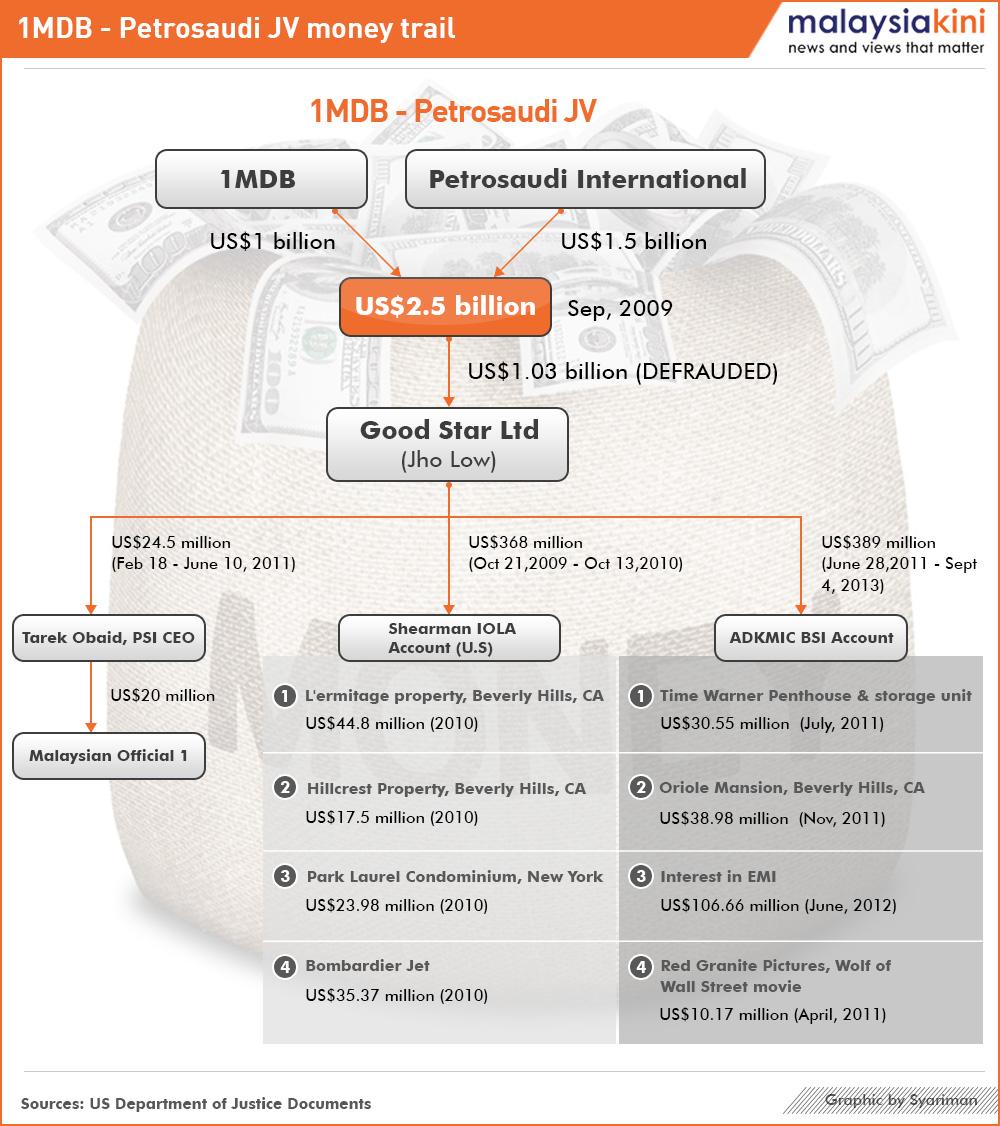
Between 2009 and 2011, 1MDB spent a total of US$1.83 billion for its joint-venture and dealings with PSI.
Of this, at least US$1.03 billion was allegedly diverted to Good Star Ltd, a company controlled by Penang businessperson Low Taek Jho, according to the DOJ.
At least US$24.5 million of this money was then transferred to a Saudi prince who passed on US$20 million to Malaysian Official 1.
What was the 1MDB Global US$3 billion bond?
This was 1MDB's third bond facilitated by Goldman Sachs. It is separate from the other two bonds totalling US$3.5 billion, also facilitated by Goldman Sachs, which is now a subject of dispute with the International Petroleum Investment Company (IPIC) and its subsidiary Aabar.
The US$3 billion bond was raised in March 2013 and was intended for 1MDB's joint-venture with Aabar through Abu Dhabi Malaysia Investment Company (ADMIC).
The funds were intended for, amongst others, the Tun Razak Exchange project.
Where did the money really go?
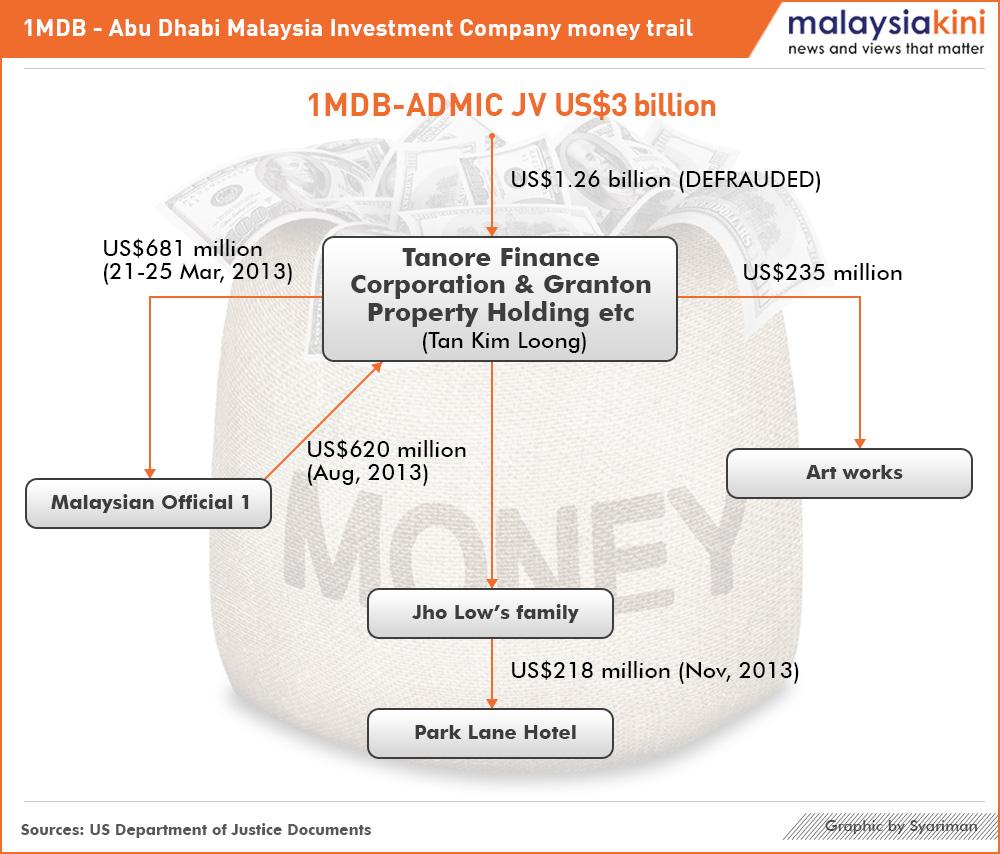
According to the DOJ, at least US$1.26 billion of this money was diverted to Tanore Finance Corporation, a company owned by one Tan Kim Loong.
Singapore court proceedings suggest that Tan is an alias for Low, who used the name to conceal his identity.
Tanore later sent US681 million to Malaysian Official 1. The sum is colloquially referred to as RM2.6 billion based on the exchange rate when the transfer was exposed by the Wall Street Journal 2015.
ITEM 3: Redemption of 1MDB's US$2.5 billion "fund units"
1MDB's investments in "fund units" were done through two subsidiaries, namely Brazen Sky Ltd and 1MDB Global.
In total, Brazen Sky invested US$2.318 billion in Bridge Global Absolute Return Fund SPC and 1MDB Global invested US$1.59 billion in three funds, namely Devonshire, Enterprise and Cistenique.
Collectively, the investments by Brazen Sky and 1MDB Global in fund units were US$3.908 billion.
1MDB claimed it had redeemed US$1.412 billion from the Brazen Sky investment by the end of 2014. This leaves the remaining investment by Brazen Sky and 1MDB Global at US$2.5 billion.
According to the parliamentary written reply, 1MDB intends to use this remaining money to pay off two bonds by 1MDB Energy Limited and 1MDB Energy (Langat) Limited totalling US$3.5 billion.
What were the US$3.5 billion 1MDB Energy and 1MDB Energy (Langat) bonds about?
These were the first two bonds facilitated by Goldman Sachs and were referenced earlier in this article.
The 1MDB Energy bond, raised in May 2012, was intended to acquire energy assets from Tanjong Energy Holdings Sdn Bhd.
The 1MDB Energy (Langat) bond, raised in October 2012, was intended to acquire energy assets from Genting Bhd.
What really happened to the money?
1MDB Energy paid US$650 million from its US$1.75 billion bond to Tanjong Power as intended.
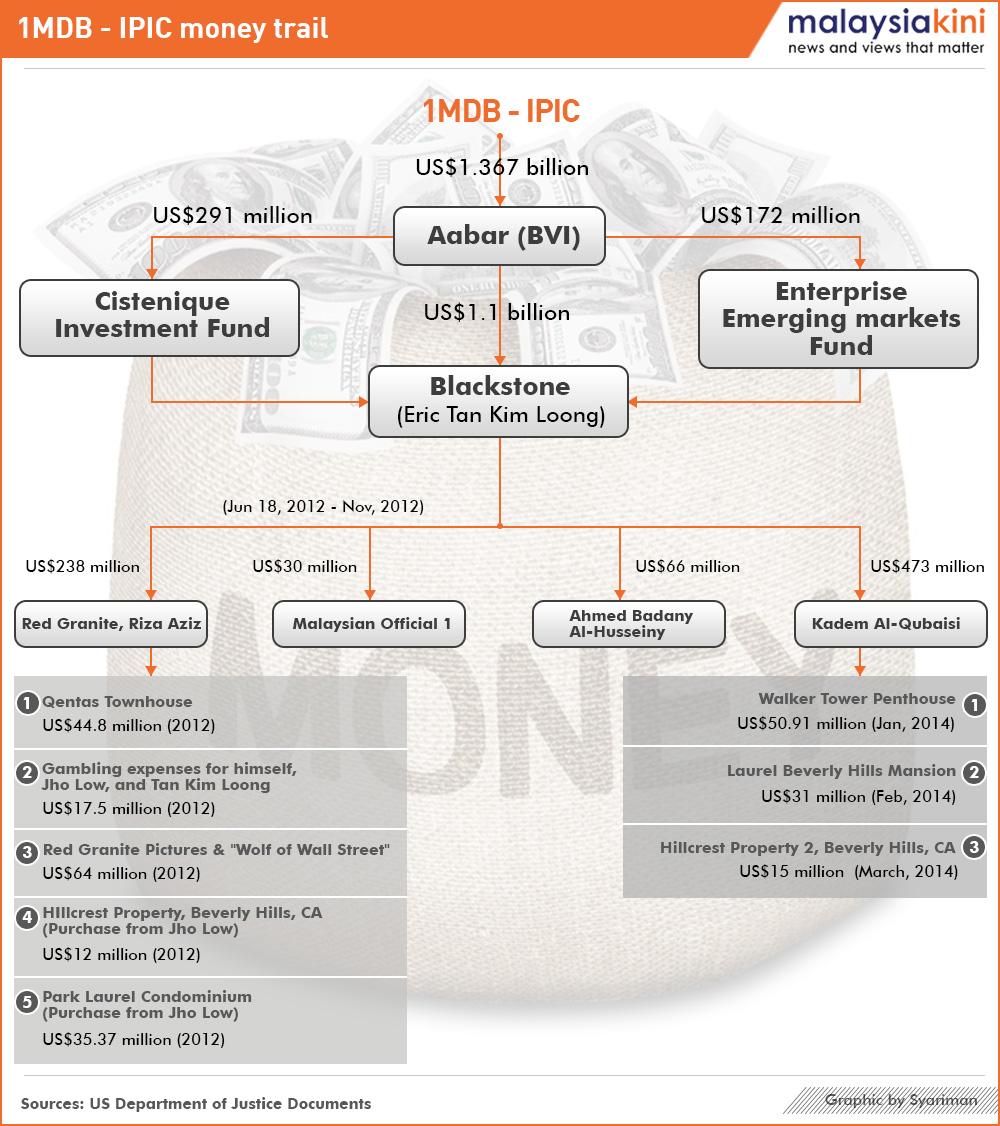
However, at least US$577 million was allegedly diverted to Aabar Investments PJS BVI (Aabar BVI), a company set up to appear like Aabar but was not a legitimate subsidiary of IPIC and were controlled by rogue Aabar officials in coordination with Low.
1MDB Energy (Langat) paid US$692 million of its US$1.75 billion bond to Genting Power Holdings Limited as intended.
However, at least US$790 million was also allegedly diverted to Aabar BVI. In total, US$1.367 billion was allegedly diverted from the two bonds.
The diverted money to Aabar BVI was later distributed amongst officials of Aabar, 1MDB, Low and his associates, as well as, Malaysian Official 1, who received US$ 30 million.
Regardless of how the bond funds were really used, we still have to repay the debt, do we have the money to do it?
With regard to 1MDB's land banks, Yes. Money can be raised from the sale or development of the Ayer Itam and Pulau Indah lands.
However, it is unclear if the valuation of the lands will be sufficient to cover the servicing of the RM5 billion sukuk and 1MDB Global's US$3 billion bond as intended.
With regard to 1MDB's fund units, no. According to the DOJ, most of the money is missing.
The Brazen Sky investment of US2.318 billion into fund units was derived from selling its stake in the PetroSaudi venture, with profit.
But note, it was previously mentioned that a substantial sum of this money was allegedly misappropriated.
1MDB did not receive cash for "selling" its stake but instead receive promissory notes, which it "invested" in the fund units.
How 1MDB was still able to receive US$2.318 billion from its PetroSaudi venture despite the misappropriation raises questions about the true value of the "fund units".
But didn't 1MDB redeem US$1.417 billion from Brazen Sky's fund units?
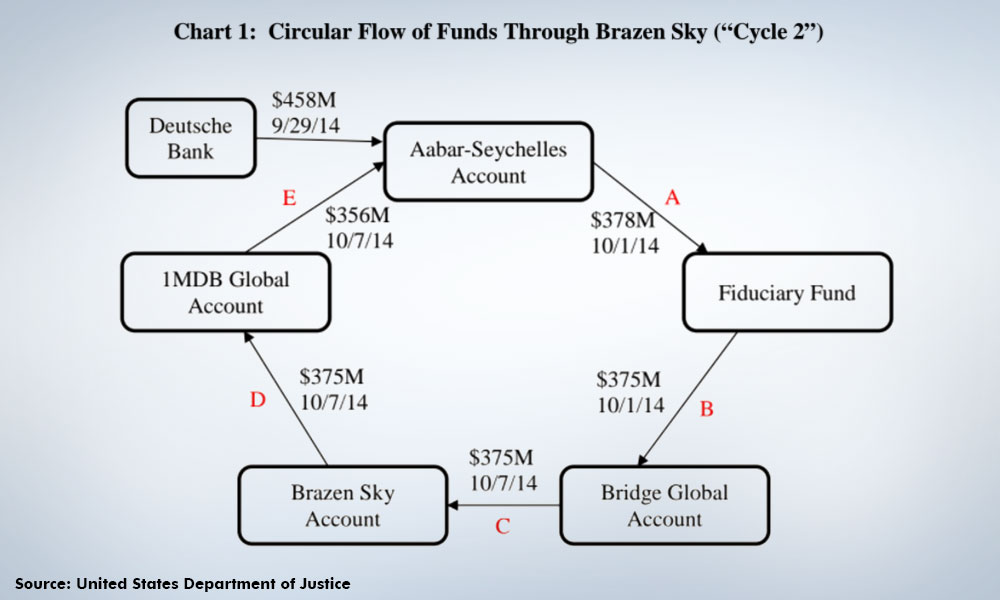
The DOJ in a filing detailed how 1MDB allegedly used a part of a US$975 million loan it took out from Deutsche Bank in 2014 to repeatedly cycle the money through Brazen Sky's accounts, giving the appearance of a redemption.
After at least six cycles over a period of three months, using borrowed money, it appeared as if 1MDB had redeemed US$1.412 billion from the Brazen Sky fund units.
Is 1MDB Global's fund units missing too?
Apparently so. Recall this article earlier mentioned that according to the DOJ, at least US$1.26 billion of 1MDB Global's US$3 billion bond was misappropriated.
The money went to Tanore Finance which was the source of the now infamous "RM2.6 billion".
But the transfer from 1MDB Global to Tanore was not direct and was layered, as is normal with money laundering activities according to the DOJ.
As soon as the bond was disbursed in March 2013, 1MDB Global "invested US$646.46 million in Devonshire, US$414.76 million in Enterprise and US$531.09 million in Cistenique. The total was US$1.59 billion.
Within two days these investment funds sent the money to Tanore and Granton Property Holdings, also controlled by Tan Kim Loong.
The total sum the fund units sent to the non-1MDB entities was US$1.26 billion - which is the allegedly misappropriated sum.
It remains to be seen how 1MDB Global can redeem the allegedly missing fund units, even though the Brazen Sky fund units was "redeemed" through a ponzi scheme-like mechanism.
The same investment funds were used for pass-through transactions after Malaysian Oficial 1 "returned" the multi-billion ringgit deposits in his personal bank accounts which he claimed were a donation from a member of the Saudi royal family.
ITEM 4: Resolution of dispute with Aabar
1MDB claimed it had paid US$3.5 billion to Aabar, which the latter denied ever receiving.
According to the parliamentary written reply, if 1MDB can recover this money, it also intends to use this to pay the US$3.5 billion bonds by 1MDB Energy and 1MDB Energy (Langat).
The US3.5 billion disputed sum, like the fund units, are unlikely to be recovered, going by facts in the DOJ's filing.
This is because the US$3.5 billion was paid to Aabar BVI instead of Aabar.
As mentioned earlier in this article, according to the DOJ, Aabar BVI was an intermediary used to divert 1MDB funds, which is then distributed to key players of the 1MDB scandal.
Proponents of arbitration had argued that if the 1MDB had indeed paid US$3.5 billion to the real Aabar, there was no need for a settlement with the IPIC.
Malaysia had agreed to pay IPIC US$1.2 billion and assume responsibility for the payment of 1MDB Energy and 1MDB Energy Langat's US$3.5 billion bond which was guaranteed by IPIC.
However, both sides agreed to enter "goodwill" discussions about 1MDB's alleged payments to the real Aabar.
1MDB missed the first tranche of the settlement payment to IPIC on July 31 and was given an extension until the end of this month to pay up.
This KiniGuide was compiled by Nigel Aw.


Report this comment
Are you sure you want to delete this comment?
This action cannot be undone.