


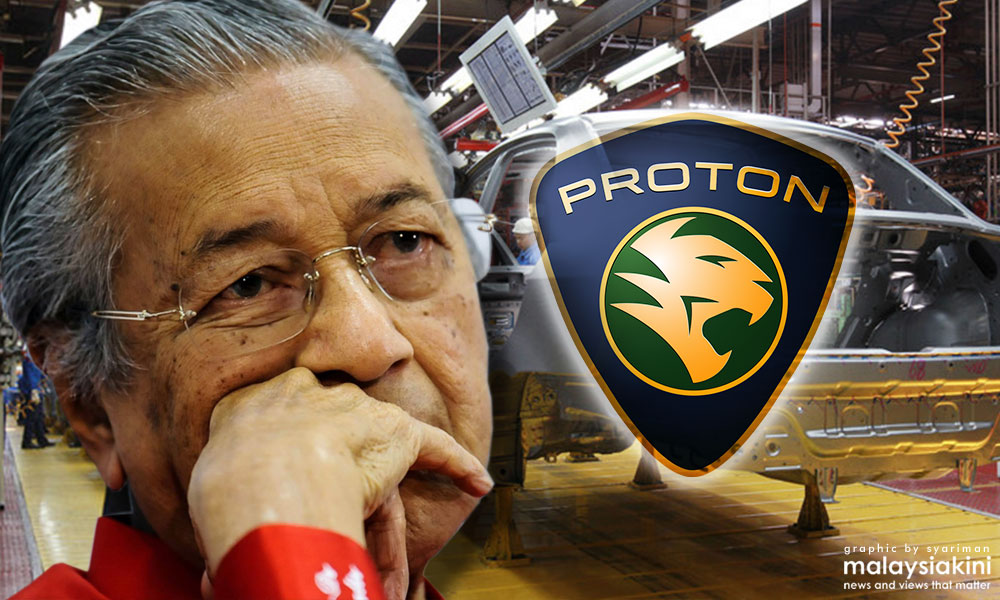

Proton's father mulls new national car after losing brainchild
If Pakatan Harapan were to capture Putrajaya in the next general election, there might be plans to start a new automotive company similar to national carmaker Proton Holdings, said former prime minister Dr Mahathir Mohamad.
“I would say, if I cannot get Proton (back), I have some idea about starting another automotive (company), remembering of course, that the idea of building a national car is not just for the sake of having a national car, but as a catalyst for growing our engineering know-how and capability,” he said during a forum about China’s investments in Malaysia at the Kuala Lumpur and Selangor Chinese Assembly Hall last night...
If Pakatan Harapan were to capture Putrajaya in the next general election, there might be plans to start a new automotive company similar to national carmaker Proton Holdings, said former prime minister Dr Mahathir Mohamad.
“I would say, if I cannot get Proton (back), I have some idea about starting another automotive (company), remembering of course, that the idea of building a national car is not just for the sake of having a national car, but as a catalyst for growing our engineering know-how and capability,” he said during a forum about China’s investments in Malaysia at the Kuala Lumpur and Selangor Chinese Assembly Hall last night.
He was responding to a question from an audience member about whether he would wrest back the 49.9 percent stake in Proton sold to China’s Zhejiang Geely Holding Group if Pakatan Harapan were to win in the next general election.
Proton was the brainchild of Mahathir during his 22-year premiership, and the nonagenarian had previously decried the sale to Geely as an attempt to spite him.
The government, meanwhile, had said the move was necessary as a means to revive Proton’s ailing fortunes.
Mahathir also defended Proton during the forum, saying that he was “sad” about what had happened to the company.
“Proton was dreamed relatively well for a developing country. No other developing country in the world has been able to produce a motorcar of a standard that is the same as those of developed countries.
“The Proton car in the market today has all the features of cars coming in from other countries.
“The only thing it doesn’t have is, it doesn’t conform to Euro 5 or Euro 6 (standards), which we could have if we are prepared to pay the price,” he said.
'Premature deindustrialisation worrying'
Meanwhile, prominent economist KS Jomo, who was also a panellist at the forum last night lamented the phenomenon of “premature deindustrialisation” in the country.
“Until 1997, we achieved a high level of economic development of 8 percent a year, but after the financial crisis of 1998, our economic growth slowed to 5 percent a year.
“What worries me more, we find a process where there is premature deindustrialisation.
“Our industrial sector hasn’t matured, and it is already shrinking. Why are we experiencing deindustrialisation?” he asked.
The government should be prioritising this issue as it is actually a big challenge, he said.
Instead, he said, deindustrialisation is being considered a success, with some saying it is a sign of a developed nation.
“Premature deindustrialisation, which is actually a failure, is being touted as a success,” he said.
He also questioned how the country’s economy can develop in the future by merely relying on the services sector.
As such, it is important for Malaysia to look for investments that would stimulate the economy, especially in sectors which will require more skilled workers.
This will require a good education system, he said, which Malaysia lacks.
“Malaysia spends a lot on education, but our achievements on education markers are embarrassing,” he said.
He also conceded that FDI is “good and necessary”, including FDI from China.
However, he said, half of the mega-projects funded by China in Malaysia are unnecessary, such as the RM55-billion East Coast Railway Link (ECRL).
He argued that the current train lines in the country were sufficient to transfer cargo, even though one of the benefits of ECRL is that it will supposedly facilitate faster cargo transportation.
“Cargo does not need to be transported through a high-speed railway. So who is it for?
“Are people going to travel from work from Kuantan or Kelantan to Kuala Lumpur every day?” he asked.


Are you sure you want to delete this comment?
This action cannot be undone.