


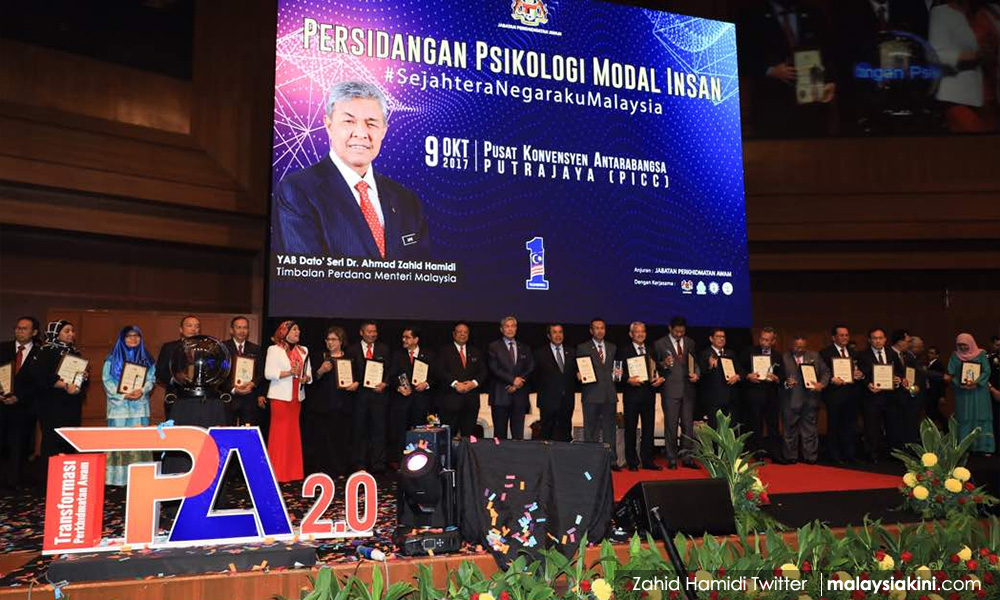

Zahid wants index to measure rakyat's psychological wellness
Deputy Prime Minister Ahmad Zahid Hamidi has proposed to establish a Psychological Well-being Index to assess the psychological wellness of Malaysians.
This comes after a 2015 survey that revealed 4.2 million Malaysians aged above 16, or 29.2 percent of the total population, were found to have mental health problems, Zahid said.
"The mental health problems were caused by depression, substance abuse and neurological illnesses," he said at the Human Capital Psychology Conference held in Putrajaya today...
Deputy Prime Minister Ahmad Zahid Hamidi has proposed to establish a Psychological Well-being Index to assess the psychological wellness of Malaysians.
This comes after a 2015 survey that revealed 4.2 million Malaysians aged above 16, or 29.2 percent of the total population, were found to have mental health problems, Zahid said.
"The mental health problems were caused by depression, substance abuse and neurological illnesses," he stated at the Human Capital Psychology Conference held in Putrajaya today.
According to the 2015 National Health Morbidity Survey (NHMS), Zahid said that stress at the workplace, relationship issues, lack of parenting skills, divorce and domestic violence were also among the reasons that led to the rise in mental illnesses.
"I am of the view that a specific index needs to be established to measure the psychological well-being of Malaysians.
"We need to build up the terms of reference and parameters which are suitable to measure psychological wellness.
"I challenge the intellectuals from the civil service and the experts to form this index," he said.
Instead of organising the psychology awareness campaigns once a year, Zahid called for the country to organise it on a more regular basis.
On the impact of psychological issues relating to the private sector, he called on employers to raise the wages of their staff.
"We want the private sector (employee) wages to be on par with the civil service. It is a big shame if they get a lower pay," he said.
Touching on the problems relating to the public sector, Zahid, who is also the home minister, explained that he had instructed for indebtedness issues in every government agency to be resolved.
Zahid, who also chaired the cabinet committee panel on the tahfiz school fire, pledged to ensure that the RM30 million allocation would be used to upgrade all tahfiz schools.
"I know the amount of money is not adequate, but we will start with this allocation to benefit the tahfiz schools," he said.
"Last year, the same amount was given to upgrade the schools, but 80 percent (of the funds) were used to pay the wages of the teachers," he said.
The Sept 14 fire that broke out at the Darul Quran Ittifaqiyah residential religious school in Kuala Lumpur claimed the lives of 21 children and two teachers.


Are you sure you want to delete this comment?
This action cannot be undone.