


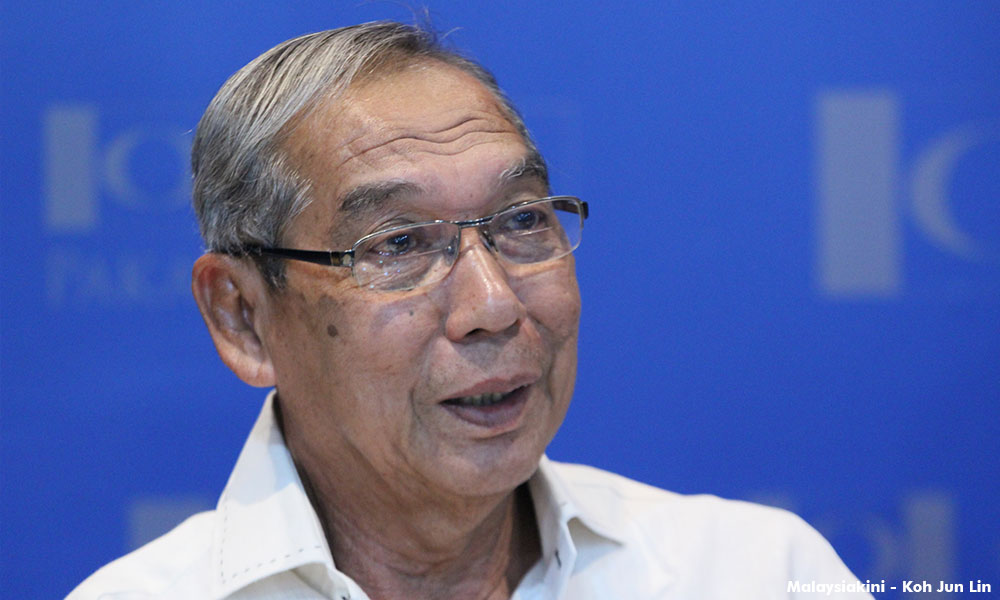

Rashid denies EC destroyed voter info during his tenure
Former Election Commission (EC) chairperson Abdul Rashid Abdul Rahman has denied that there was any destruction of the addresses and locality names of voters during his tenure.
Rashid said this in an affidavit dated Oct 6, which was produced at the High Court in Kuala Lumpur today, in the hearing of the Selangor government's challenge of the recent delimitation exercise in the state.
An affidavit in support from the present EC chairperson Mohd Hashim Abdullah, as well as a submission made by a senior federal counsel for the EC, had said that such information had been "dilupuskan" (destroyed)...
Former Election Commission (EC) chairperson Abdul Rashid Abdul Rahman has denied that there was any destruction of the addresses and locality names of voters during his tenure.
Rashid said this in an affidavit dated Oct 6, which was produced at the High Court in Kuala Lumpur today, in the hearing of the Selangor government's challenge of the recent delimitation exercise in the state.
An affidavit in support from the present EC chairperson Mohd Hashim Abdullah, as well as a submission made by a senior federal counsel for the EC, had said that such information had been "dilupuskan" (destroyed).
Rashid said that in his tenure, he had overseen three delimitation exercises and five general elections.
He said that although he was in charge of the migration of voter information to a computerised system in 2002, there was no decision or policy which resulted in the destruction of their addresses.
This stood in contrast to what the EC and its senior federal counsel stated at both at the High Court and at the Court of Appeal, when they claimed that the records had been destroyed.
It was previously reported that the Selangor government partially won their discovery application regarding 136,272 voters in the state, when the High Court ordered the EC to furnish the addresses and localities of the voters in question.
This decision was overturned by the Court of Appeal when it allowed the EC's appeal over the discovery application after they claimed the locality records for 1994 and 2003 were destroyed. This was affirmed by the Federal Court.
Rashid, who is now vice-president of opposition party Bersatu, affirmed in his affidavit that for each delimitation exercise – including in 1994 and 2003 – the EC had to use the relevant electoral roll.
"I am therefore shocked that the respondents (the EC and present EC chairperson Mohd Hashim) have claimed that the addresses of voters have been destroyed, and that they are not relevant in the delimitation process," he said.
“First and foremost, I dispute that the addresses of voters, including that of the 136,272 voters, have been destroyed. As an institution in charge of the integrity of the electoral process in Malaysia, I believe that the EC has an administrative duty to keep the addresses of voters at all times."
Commissioners must approve destruction
Rashid added that the destruction of any information relating to voters record and system, especially addresses, must be done with the consent and approval of the EC commissioners.
“Such a decision must be done via a meeting and there must be documentation proving the same, such as minutes of the meetings. As secretary and chairperson, I never approved, neither was I aware of any request for the destruction of addresses of voters,” he added.
Rashid emphasised that the addresses of voters are vital because the EC periodically send letters to voters to inform them and seek clarification of the constituencies and voting information, whenever necessary. A letter cannot reach the voter if the EC only possesses the voter's locality.
“It is thus illogical for the EC to destroy the only means of direct communication with individual voters."
“It is thus illogical for the EC to destroy the only means of direct communication with individual voters."
Rashid further disputed the reliance of the present EC on Regulation 10 of the 2002 regulations to justify the present EC move not to keep records of the old electoral rolls after updating it every three months as affirmed in the affidavit by the present chairperson.
“This is illogical. It is merely a process to updating. It does not involve the destruction of the previous electoral rolls. I never approved, neither was I aware of any destruction of these rolls. I verily believe that the EC is in possession or has a record of all the previous electoral roll, even after updating,” he said in the affidavit filed last week.
He added that electoral rolls are a very important document which must be kept by the EC for future references.
No reply by present EC chief to Rashid
As Rashid affirmed the affidavit last week, there was no reply made by Hashim to what was stated.
The lawyer representing the Selangor government Ambiga Sreenevasan said Hashim only replied to the affidavit affirmed by Thomas Fann, a former Bersih 2.0 committee member.
Ambiga appeared with lawyers Derek Fernandez, Latheefa Koya, Lim Wei Jiet and Shahid Adli Kamarudin.
Ambiga further said Malaysian voters are not given ample information over the delimitation exercise compared to those of other countries.
Lim told the court that in other countries like the United Kingdom, they give voters two maps including a digital map to contrast the present election map and the new election map.
“Here the polling district maps have to be obtained from the Department of Survey and Mapping,” he said.
Lim emphasised the need to follow the Federal Constitution with regards to the constituencies should be divided along the lines of the local authorities so as not to have constituencies being run by two local authorities.
“This is a requirement under the Federal Constitution,” he said.
Senior federal counsel Amarjeet Singh, Alice Loke, Suzana Atan and Azizan Md Arshad appeared for the EC who will reply at the next session
The hearing before Justice Azizul Azmi Adnan continues on Oct 20.


Are you sure you want to delete this comment?
This action cannot be undone.