




Ramasamy: Budget 2006 is NEP all over again
 Budget 2006 is 'anti-workers, anti-consumers and anti-common people' according to DAP leader P Ramasamy. He described it as being pro-crony capitalists and of benefit only to 'a particular ethnic group'.
 Budget 2006 is 'anti-workers, anti-consumers and anti-common people' according to DAP leader P Ramasamy. He described it as being pro-crony capitalists and of benefit only to 'a particular ethnic group'.
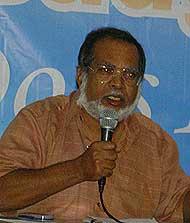 "The average Malaysian will not benefit from this pro-business budget," he told a forum organised by the DAP at the Selangor Chinese Assembly Hall in Kuala Lumpur last night.
Other panelists were DAP secretary-general Lim Guan Eng, chartered accountant and auditor KK Chow, and Research for Social Advancement director Richard Yeoh. The forum, which attracted about 50 people, was moderated by DAP parliamentarian Dr Tan Seng Giaw.
Ramasamy pointed out that the handing out of bonuses and benefits is concentrated on those in the public sector, where more than 95 percent of employees are from a particular ethnic group.
"We have 10 million workers in this country...how come they are not looking at the nine million workers in the private sector?" he asked as he pointed out that the demand by private sector unions for a minimum wage has been ignored.
"This is simply because the government still believes that its cheap labour policy can attract investment... but we can't compete with Indonesia, Vietnam, Cambodia and China."
He said the spirit of the New Economy Policy (NEP) has been incorporated into the budget, given that RM2 billion has been allocated for bumiputeras to purchase commercial properties in major towns.
"That is NEP... so why did they (Umno Youth at the last party assembly) ask to reintroduce the NEP? Maybe they are asking for a bigger allocation."
Ramasamy criticised the government for its ethnic outlook in policy making, saying the budget will only benefit a tiny group of Umno-putras instead of all the Malays.
Government weakness
Yeoh, meanwhile, said that his expectation that Prime Minister Abdullah Ahmad Badawi would present a bold economic programme had been dashed.
 "I am deeply disappointed... the great weakness of this government is that there is no economic programme. What is our economic direction? Where is our country moving? We're running around in circles, not going anywhere," he commented.
He claimed that the conservative attitude of some politicians had undermined the country's economic growth.
"We should be, and could be, a great nation. But because we are not willing to let go of old policies - such as race-based policies... policies that only benefit certain groups - how will we become a great nation?
"Leaders of the ruling party would say that if the price of Malaysia to be a great nation is that they lose dominance, they would rather that Malaysia is not a great nation."
He warned that Malaysia has passed its economic peak and that many experts in both the private and public sectors have predicted that it will revert to a commodity-based economy.
Yeoh said some policies outlined in Buget 2006 "'do not make sense", for instance the (maximum of) RM50,000 financial assistance to be allocated to 200 unemployed graduates so that they can go into business.
"How do you give RM50,000 to unemployed graduates? Based on what criteria? Do you give to those with the worst grades?" he asked.
He also questioned the need to establish a foundation with capital of RM2 billion to help bumiputeras purchase commercial property.
"What property are they going to buy? Unsold property? And how does sinking (all that) cash into property contribute to economic growth? I don't understand. It is dead money once you sink it into property."
He described the government's efforts to combat corruption as "all talk and no action" and claimed this is well known by foreign observers.
"The prime minister appears to be serious, but either he doesn't have the political will, or his hands are tied," he noted.
'Review past budgets'
 Lim commented that the budget has failed to address the two major challenges the country is facing - the increase in both the oil price and inflation rate.
He said DAP's alternative budget includes such proposals as opening up half of government contracts to non-bumiputeras, increasing the research and development allocation to 2.5 percent of GDP and distributing Petronas' profits to all Malaysians.
On his part, Chow suggested that the government should review the previous budget and policies before offering new proposals, in order to avoid repeating mistakes.
Chow, who viewed the new budget as "conservative, not decisive and afraid to change", added that the government has never done a review of its previous budgets.


Are you sure you want to delete this comment?
This action cannot be undone.