



How politicians use Facebook to influence your vote
KINIGUIDE | British data analytics firm Cambridge Analytica has been in the limelight for the past week over revelations that it harvested the data of 50 million Facebook users through questionable means.
The data was allegedly used to help develop a software programme to influence and predict voter behaviour in the 2016 US presidential election.
On its website, the firm has listed as working for political campaigns in 11 countries, including a “targeted messaging campaign” for Kedah BN in Malaysia.
Whistleblower Christopher Wylie said he created tools of “psychological warfare” for Cambridge Analytica, which may have played a key role in bringing US President Donald Trump to power. But what does that actually mean?
In this KiniGuide, we help you understand how your personal data can shape the political advertising you see on social media, particularly on Facebook.
We will look at how Cambridge Analytica harnesses psychology, big data and social media to target specific voters, and how you can become savvier at evaluating such political messages.
What is big data?
There are various ways to define big data, but in this case, it refers to the extremely large data sets we generate as a result of our online and offline activities.
Your likes and shares on Facebook, Google searches, credit card swipes, healthcare records – all of this and more can be recorded and then analysed to glean insights into any aspect of your life.
What is psychometrics?
Psychometrics refers to a field of study within psychology that measures psychological traits, such as personality.
Of particular relevance is the “big five” test, which was created in the 1980s to measure how people scored on five personality traits. These traits are openness, conscientiousness, extroversion, agreeableness and neuroticism - or 'Ocean', for short.
Importantly, your Facebook activity – what kind of pages and posts you like, the content you share – can be a good predictor of your results on the Ocean spectrum.
Psychometric data (or psychographics) is particularly valuable for marketers, more so than demographic data.
Demographics focus on extrinsic or physical factors such as age, race and gender, whereas psychographics examines intrinsic factors such as motivations, biases and beliefs.
By understanding your personality and what makes you tick, marketers can influence you more effectively.
How can my personal data influence the political ads I see on Facebook?
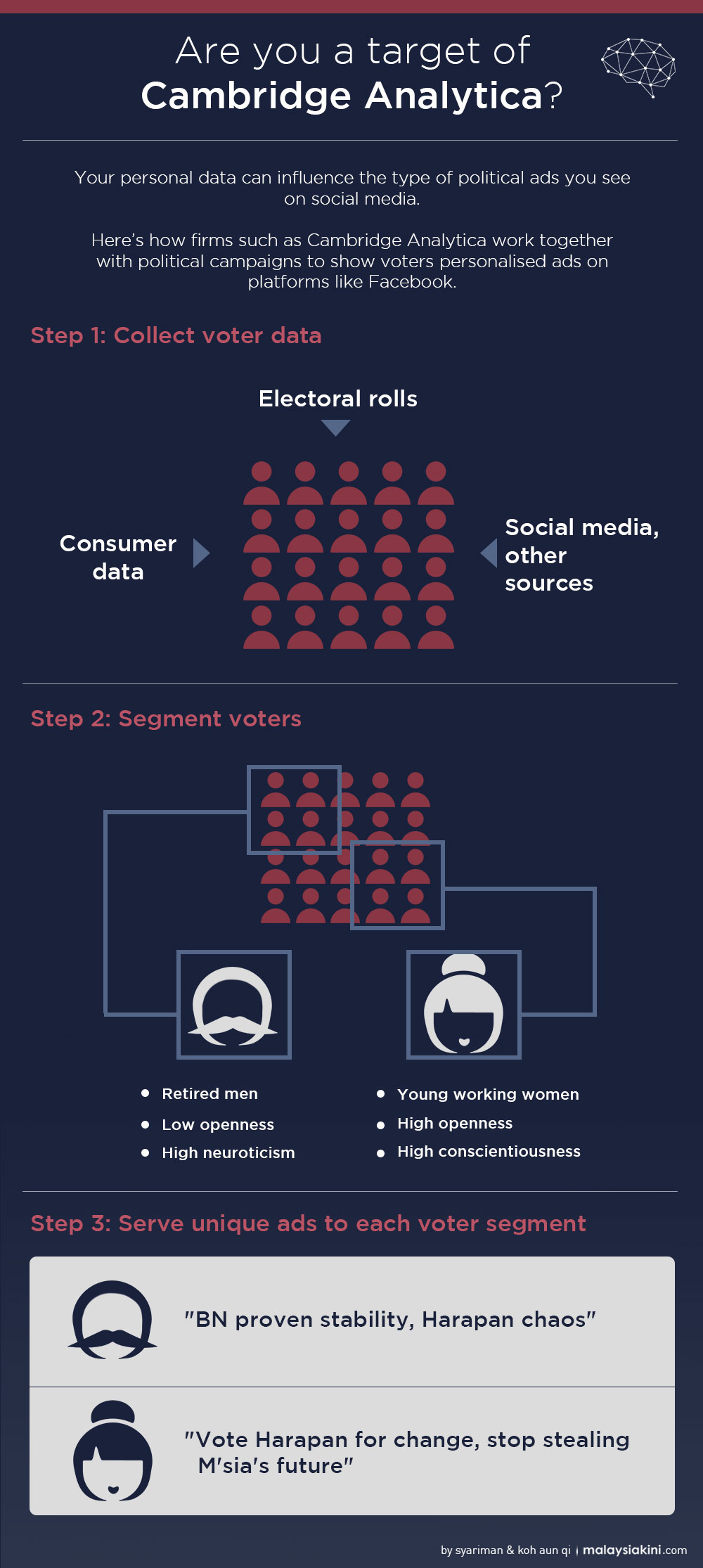
There are three phases: Collecting voter data, segmenting the voters, and serving unique advertisements to each voter segment.
We’ll use Cambridge Analytica as an example of how the process works...
KINIGUIDE | British data analytics firm Cambridge Analytica has been in the limelight for the past week over revelations that it harvested the data of 50 million Facebook users through questionable means.
The data was allegedly used to help develop a software programme to influence and predict voter behaviour in the 2016 US presidential election.
On its website, the firm has listed as working for political campaigns in 11 countries, including a “targeted messaging campaign” for Kedah BN in Malaysia.
Whistleblower Christopher Wylie said he created tools of “psychological warfare” for Cambridge Analytica, which may have played a key role in bringing US President Donald Trump to power. But what does that actually mean?
In this KiniGuide, we help you understand how your personal data can shape the political advertising you see on social media, particularly on Facebook.
We will look at how Cambridge Analytica harnesses psychology, big data and social media to target specific voters, and how you can become savvier at evaluating such political messages.
What is big data?
There are various ways to define big data, but in this case, it refers to the extremely large data sets we generate as a result of our online and offline activities.
Your likes and shares on Facebook, Google searches, credit card swipes, healthcare records – all of this and more can be recorded and then analysed to glean insights into any aspect of your life.
What is psychometrics?
Psychometrics refers to a field of study within psychology that measures psychological traits, such as personality.
Of particular relevance is the “big five” test, which was created in the 1980s to measure how people scored on five personality traits. These traits are openness, conscientiousness, extroversion, agreeableness and neuroticism - or 'Ocean', for short.
Importantly, your Facebook activity – what kind of pages and posts you like, the content you share – can be a good predictor of your results on the Ocean spectrum.
Psychometric data (or psychographics) is particularly valuable for marketers, more so than demographic data.
Demographics focus on extrinsic or physical factors such as age, race and gender, whereas psychographics examines intrinsic factors such as motivations, biases and beliefs.
By understanding your personality and what makes you tick, marketers can influence you more effectively.
How can my personal data influence the political ads I see on Facebook?
There are three phases: Collecting voter data, segmenting the voters, and serving unique advertisements to each voter segment.
We’ll use Cambridge Analytica as an example of how the process works.
Phase one: Collecting voter data
Cambridge Analytica is currently accused of misusing Facebook data harvested through an online app that offered the “big five” personality test.
However, in 2016, US media outlet Vice reported then-CEO Alexander Nix as saying that Cambridge Analytica had bought personal data legally from a range of different sources.
Such data can be bought from “data brokers,” which are companies that collect and sell any information about you that is publicly available.
Phase two: Segmenting the voters
Cambridge Analytica can then take their collected data, combine it with data from electoral rolls, and calculate a “big five” personality profile for each voter.
The company thus has a potent combination of a voter’s basic details and psychological make-up. It can now take an entire population, divide it into categories and choose any mix of those categories to promote an ad on social media to. In marketing terms, this is called “segmentation.”
Phase three: Serving unique ads to each voter segment
Political campaigns can then pay for sponsored ads on Facebook’s News Feed, which are targeted at voters with specific personality traits. No one else can see these posts, because they are crafted for specific user profiles. These are known as “dark posts.”
Nix was also reported by Vice as saying that if a campaign wished to persuade voters on the issue of gun rights, different photos would be used for Facebook ads, based on voters’ personalities.
For example, a neurotic, highly-conscientious person would be shown an image of a burglar entering a house, and the suggestion of a gun for insurance. A person who was more “closed and agreeable” – suggesting someone who values family and tradition – would instead be shown a man and a child shooting ducks at sunset.
Trump’s digital director Brad Parscale and Cambridge Analytica’s chief product officer Matt Oczowski have since denied that Trump’s 2016 presidential campaign used psychographic targeting.
How might personalised political ads work in Malaysia?
Assuming that the relevant data on Malaysian voters had been processed, different voter segments could receive different political ads on social media.
If BN wanted to target retired men, for example, it could issue specific ads to Facebook users with those profiles. The message could be, “BN proven stability, Harapan chaos.”
If we take personality traits into account, such messages would be targeted at men who are neurotic and have a low degree of openness – meaning someone who is easily anxious and prefers to stick to a routine.
Alternatively, if Pakatan Harapan wanted to target young working women who showed a high degree of openness and conscientiousness in their personality profiles, it might target them with this Facebook ad: “Vote Harapan for change, stop stealing Malaysia’s future.”
What issues arise from political advertising on Facebook?
Firstly, data privacy and security. In the case of Cambridge Analytica, Facebook CEO Mark Zuckerberg has since apologised and promised to tighten controls on developers’ access to user information.
Legally-acquired data from data brokers also raises questions about the ethics of an industry that collects consumer data, compiles profiles based on that data, and sells them to third parties.
Another key issue is transparency. The “micro-targeting” enabled by Facebook means that politicians are allowed to target different audiences with different messages, with little oversight or accountability.
This also raises the issue of whether political ads should be held to different regulatory standards on social media, compared to corporate ads.
As a former Facebook product manager told The Guardian, it seems "morally different" to sell a politician than a shoe on the social media platform.
How do I know if a political ad on Facebook is targeting me?
Just like anything you read on the internet, you can employ a set of skills to evaluate a political ad on Facebook. We covered these information literacy skills in our previous KiniGuide on fake news.
Most importantly, given that such ads can be geared to take advantage of the way you think and feel, check your biases.
You can also wait for a new Facebook feature which should be launched later this year. The company has promised that every political ad will be linked back to the page that paid for it.
In Canada, Facebook users can already view all ads being run by a political candidate in a specific tab on their page.
But this feature is unlikely to be introduced in time for the 14th general election.
Can my personal data be used without my consent in Malaysia?
Legally, as a consumer, the answer is no. The Personal Data Protection Act 2010 (PDPA) stipulates that consent for personal data processing has to be explicit, rather than assumed. This means that a consumer has to “opt in” for data to be used for purposes other than the commercial transaction he or she is entering.
This is similar to European Union countries that enforce the “opt in” system, compared to the US, which adopts an “opt out” approach.
However, the effectiveness of PDPA has been called into question with the recent series of data breaches involving 48 million telecommunications customers and more than 220,000 organ donors, amongst others.
Have any laws been introduced to regulate political ads on social media?
In the US, John McCain and two other senators have proposed the Honest Ads Act.
The legislation would allow internet ads to be regulated in the US, and require online platforms to maintain a public file of the political ads they publish, as well as who funds those ads.
However, no such law has been mooted in Malaysia.
This KiniGuide instalment was compiled by KOH AUN QI.


Report this comment
Are you sure you want to delete this comment?
This action cannot be undone.