


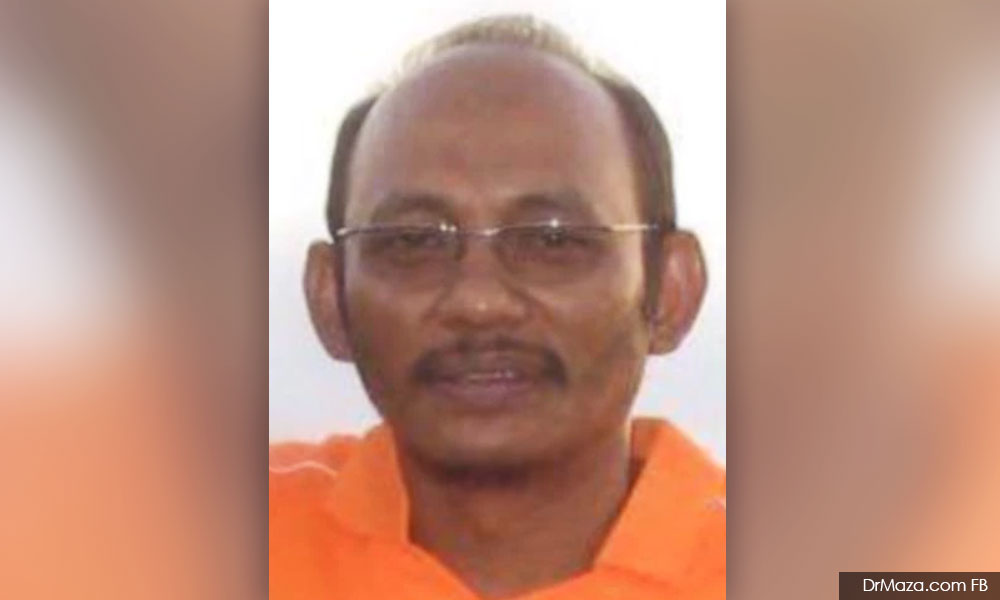

Police: Smashed windows of Amri’s car proof of ‘malicious action’
SUHAKAM INQUIRY | The primary investigating officer for the disappearance of Perlis Hope activist Amri Che Mat concluded that there was “malicious action” in how the latter’s car was found with broken windows shortly after his disappearance.
Nevertheless, Amri’s disappearance remains a missing persons case, a Suhakam inquiry heard today...
SUHAKAM INQUIRY | The primary investigating officer for the disappearance of Perlis Hope activist Amri Che Mat concluded that there was “malicious action” in how the latter’s car was found with broken windows shortly after his disappearance.
Nevertheless, Amri’s disappearance remains a missing persons case, a Suhakam inquiry heard today.
Amri had been driving a black Toyota Fortuner before he disappeared in the early hours of Nov 25, 2016.
Taking the stand today, inspector Khor Yi Shuen of the Kangar district police station said the vehicle, which was transported to the Padang Besar district police station the morning after the incident, had all of its four side windows smashed.
Forensic police officers had also found an empty plastic water bottle and samples of “sand mixed with glass” obtained from the car.
“I can say that this was perbuatan khianat (malicious action) as it involved (intentional) damage to property,” he said in response to questions from K Muthiah, the counsel for Amri’s family.
When pressed further, Khor said that despite the evidence, the case remained classified as missing persons, but added that the possibility of Amri being abducted had not been ruled out.
“The information I have received so far is only in regards to this being a missing persons case…(but) we are investigating this case from multiple angles,” the inspector said.
While not mentioned in proceedings today, Khor’s information about the number of broken windows contradicts the police report of previous Suhakam witness Yousri Khalid, who said he had seen only two broken windows.
Yousri, a security guard who had been on duty at the site where Amri’s car was found, later told the inquiry that there were three broken windows, and admitted there were discrepancies in his report.
Meanwhile, further cross-examination revealed that Khor had not investigated concerns from Amri’s wife Norhayati Ariffin about possible threats to the activist’s safety due to allegations that he was a Syiah Muslim.

The inspector reiterated that his team had interviewed a Perlis Islamic Religious Department (JHEAIPS) official to better understand Syiah religious practices some 11 months after the incident in Oct 2017, but did not press further.
“This shows the level of investigations done despite there being possible threats. No investigations were done in regards to these threats,” Muthiah told the Suhakam panel.
Syiah Islam is considered deviant in Malaysia, where most Muslims adhere to Sunni Islam.
‘Bankruptcy not an issue’
During the morning session of the inquiry, Muthiah contended that Amri did not face financial difficulty despite his official bankrupt status, as revealed previously by police observer and Sentul police chief R Munusamy.
The counsel showed the panel letters to prove how the Insolvency Department had paid all Amri’s creditors on Nov 25, 2016. However, the activist’s bankrupt status remained because he had disappeared before he was able to apply to remove it.
Muthiah further argued that the police had failed to note the above information because they did not run thorough investigations.
“His creditors received full payment from him... a day after he disappeared.
“No proper investigations were done to follow up on (his bankrupt status) and that led to Amri’s financial status being an issue in this case,” he said.
Today’s inquiry was presided by commissioners Mah Weng Kwai, Aishah Bidin and Nik Salida Suhaila Nik Saleh.
The inquiry will resume on April 12, with Perlis mufti Mohd Asri Zainul Abidin scheduled to take the stand.
Suhakam is currently investigating whether the disappearances of Amri and two others were “enforced or involuntary,” as defined by the International Convention for the Protection of All Persons from Enforced Disappearance (ICPPED).
This is defined as the arrest, detention, abduction or any other form of deprivation of liberty by agents of the state or by persons, or groups of persons acting with the authorisation, support or acquiescence of the state.
The instrument was adopted by the United Nations General Assembly in 2006. Malaysia is not a signatory to the ICPPED.
The two other disappearances being investigated are that of pastor Joshua Hilmy and his wife Ruth Sitepu.
The commission had previously investigated pastor Raymond Koh’s disappearance, but was forced to suspend proceedings after former Uber driver Lam Chang Nam was charged in court for abducting Koh.
The law bars Suhakam from probing matters which have been brought before the court.


Are you sure you want to delete this comment?
This action cannot be undone.